

Outsourcing means hiring an external provider to perform work. Offshoring means moving business work to another country. The two describe separate choices: who performs the work and where it happens. A business can combine them through offshore outsourcing.
For a growing company, the distinction affects more than staffing costs. Hiring a provider to manage customer inquiries leaves you with different responsibilities from running your own support office overseas. Start by comparing the work, the management required, and the full cost of delivery.
What Is the Difference Between Outsourcing and Offshoring?
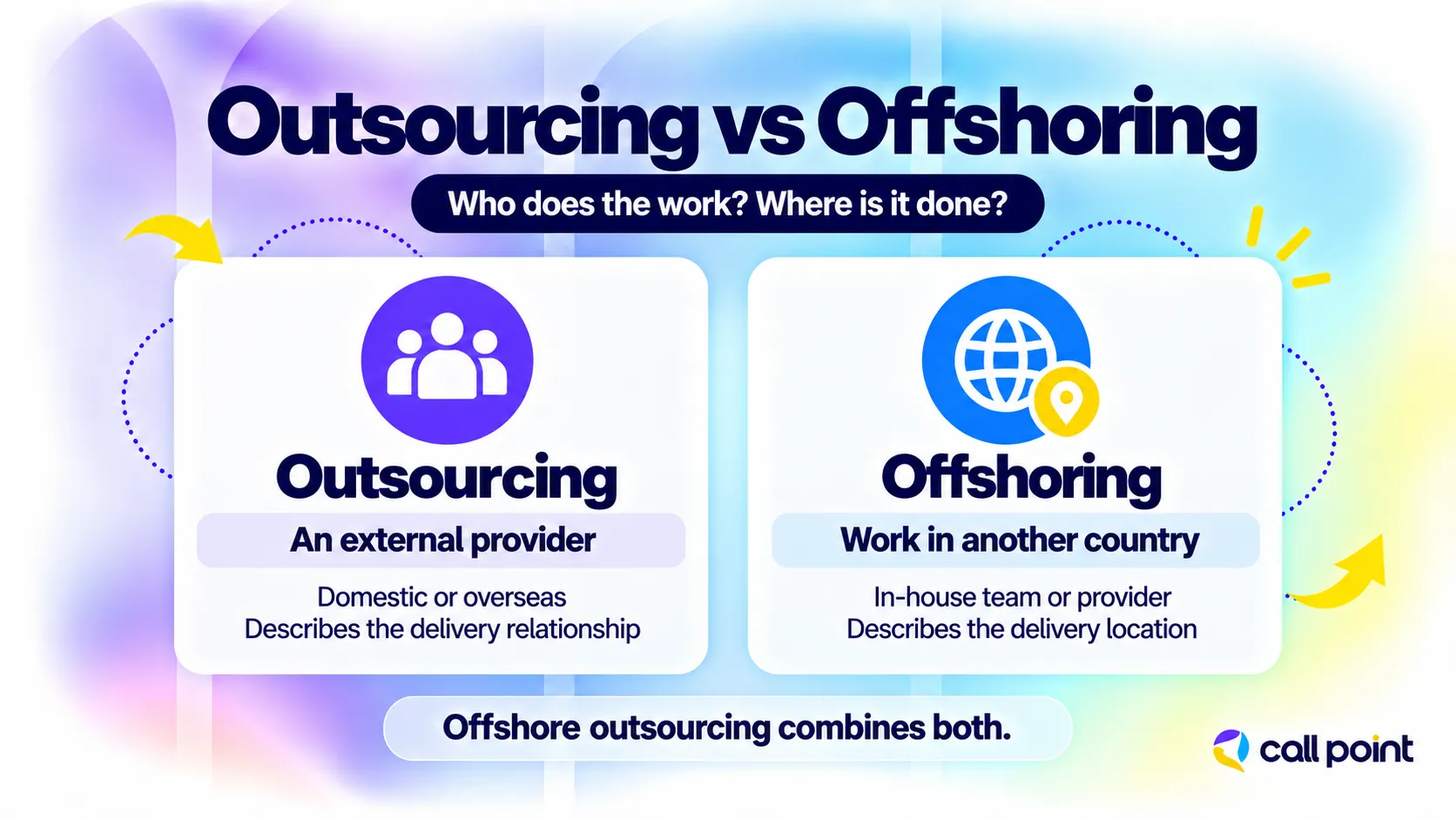
Outsourcing changes the delivery relationship. Offshoring changes the delivery location. An OECD working paper distinguishes the two using location and whether the work stays within the company or goes to an external supplier.
| Factor | Outsourcing | Offshoring |
| Main question | Who will perform the work? | Where will the work happen? |
| Delivery arrangement | An external company or professional | Your own overseas operation or a foreign provider |
| Location | Domestic or international | Outside your home country |
| Management | Provider-managed or shared, depending on the service | Internal management for a company-owned team; agreed management for an external provider |
| Examples | Contracting payroll, design, customer support, or bookkeeping | Operating an overseas development center or using an offshore support provider |
Outsourcing can involve a specific project or a continuous function. For instance, MetaLab worked on Slack’s early app design, branding, and website, utilizing an outside specialist for this defined project.
In contrast, Microsoft provides a different example. Its India Development Center, established in Hyderabad in 1998, is part of its global development organization and represents a company-operated team based overseas.
The distinction is important: offshoring does not always mean company-owned operations. When a company hires an overseas provider, the arrangement is both offshore and outsourced.
What Is Offshore Outsourcing?
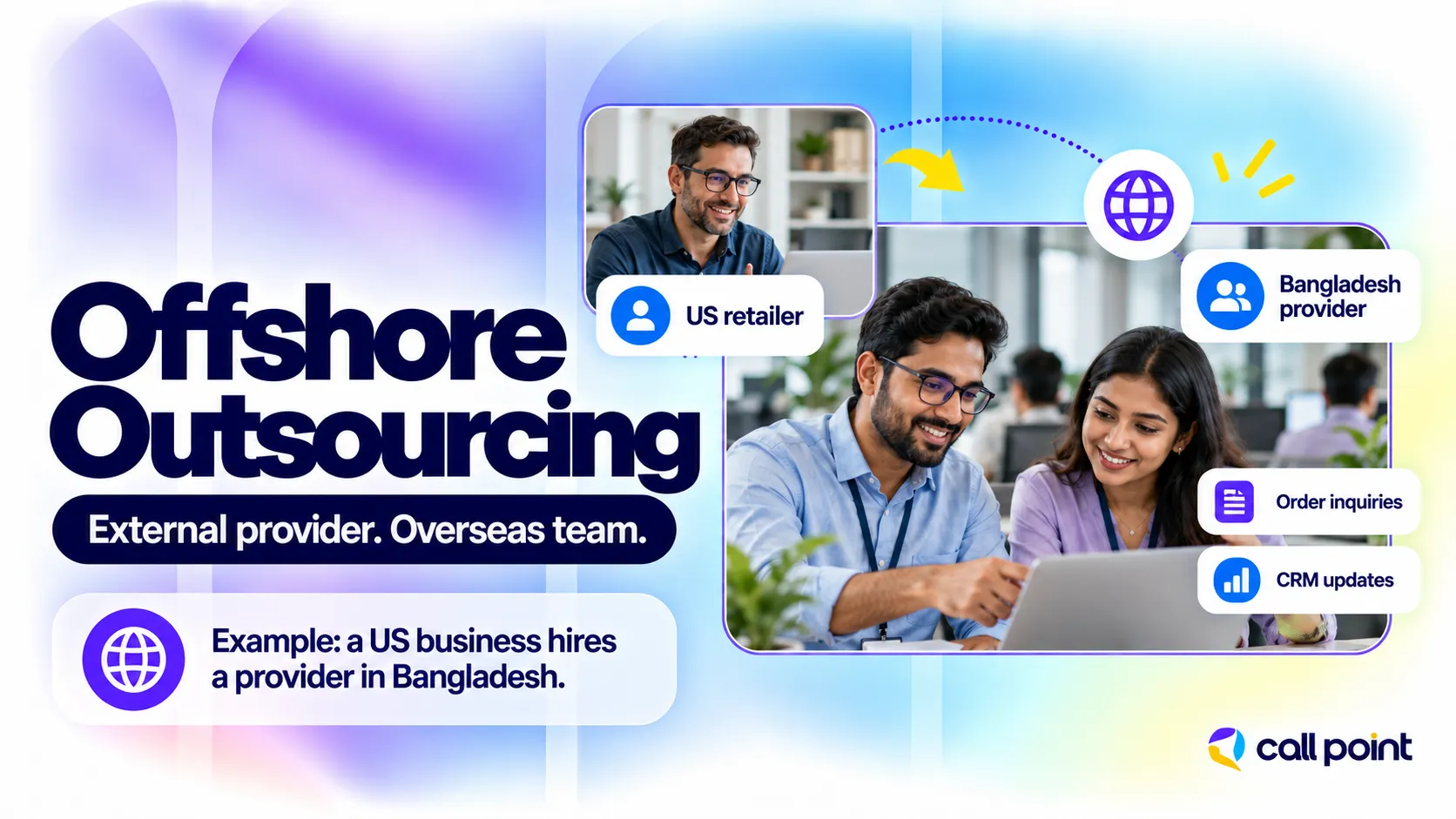
Offshore outsourcing means contracting a provider in another country to perform agreed tasks or business processes. It combines external delivery with access to an overseas workforce. Services can include customer support, accounting support, IT services, and administrative work.
Consider a US retailer that needs help answering order questions. If it contracts a Bangladesh-based BPO provider, the work is outsourced because another company delivers the service. It is offshore because the team works outside the United States.
One attraction is lower delivery costs. A provider operating in a lower-cost market can offer staffing and infrastructure at a different cost base from an equivalent local operation. Sharing recruitment, facilities, and management resources across its business may also reduce what a client needs to build internally.
TTEC reports a 60% reduction in employee costs after moving premium loyalty-member support to an offshore model. That figure describes one engagement and employee costs, rather than a general reduction in total business expenses.
Actual savings depend on the role, workload, required coverage, provider fees, and internal oversight. Offshore outsourcing is more useful when the lower delivery cost comes with the training and supervision needed to complete the work accurately.
For an introduction to the broader service category, see what business process outsourcing includes.
Who Manages an Outsourced or Offshore Team?
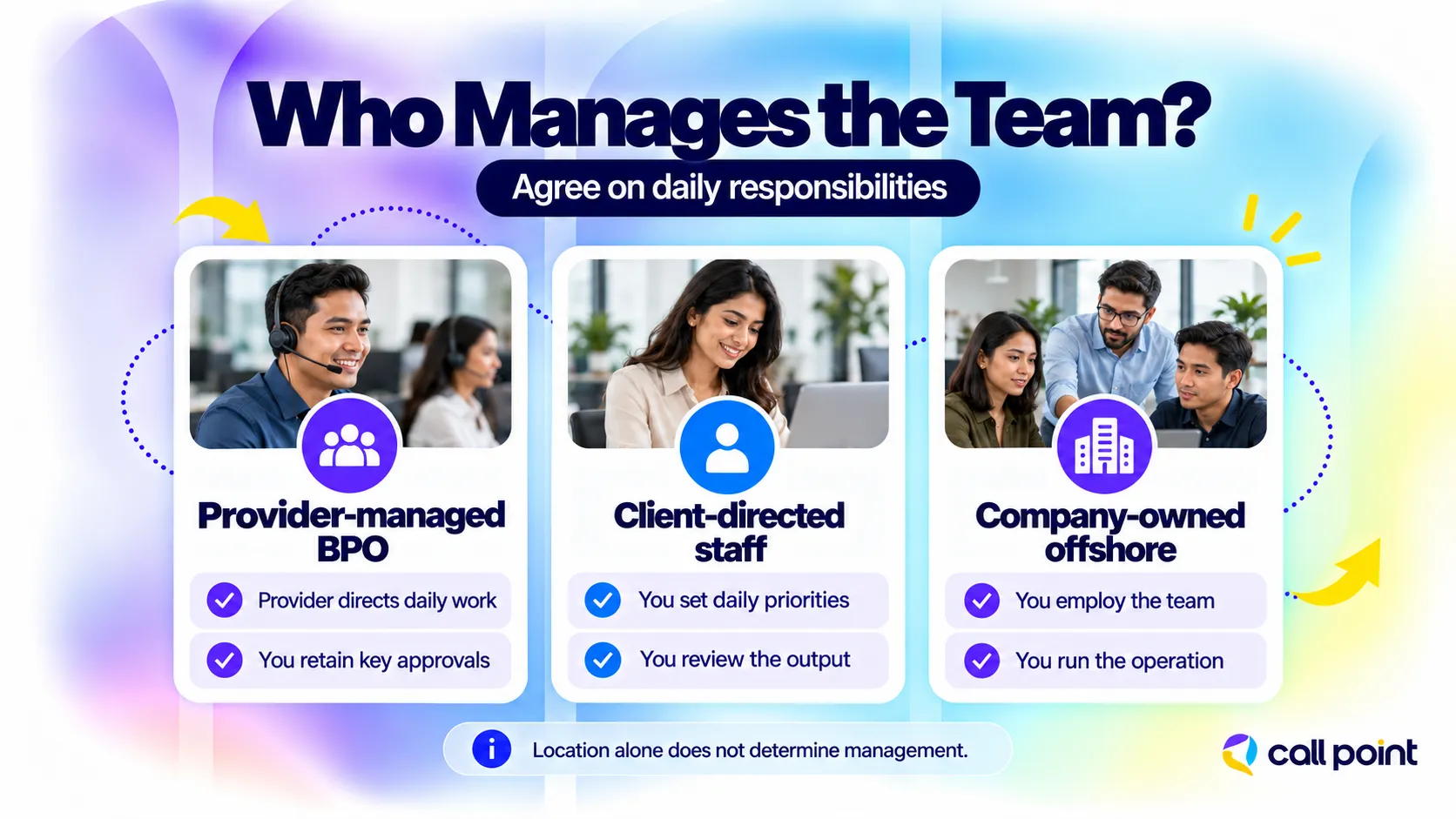
Management depends on the arrangement you buy. A provider may run a complete process, supply staff for your managers to direct, or share responsibilities with your internal team. Ask who assigns work, supervises staff, checks quality, and resolves exceptions.
Provider-Managed Support
In a managed BPO arrangement, the provider handles agreed activities such as recruitment, scheduling, supervision, quality reviews, and reporting. Your business supplies product knowledge, approves policies, and retains decisions that require internal authority.
For example, a retail support agent might answer delivery questions and explain the returns policy. A refund outside that policy would go to your designated manager. The provider handles routine delivery while your business controls the exception.
Client-Directed External Staff
Some services provide people while leaving daily priorities and review with you. This suits a business that has a capable manager but needs more people to complete the work.
It offers less relief when the manager’s time is already the main constraint. In that situation, compare a staffing arrangement with a service that includes supervision.
A dedicated team can still be employed by the provider. Dedication to one client does not make those workers the client’s employees. With a company-owned offshore operation, your organization remains responsible for managing its own overseas team.
How Do Outsourcing and Offshoring Costs Compare?
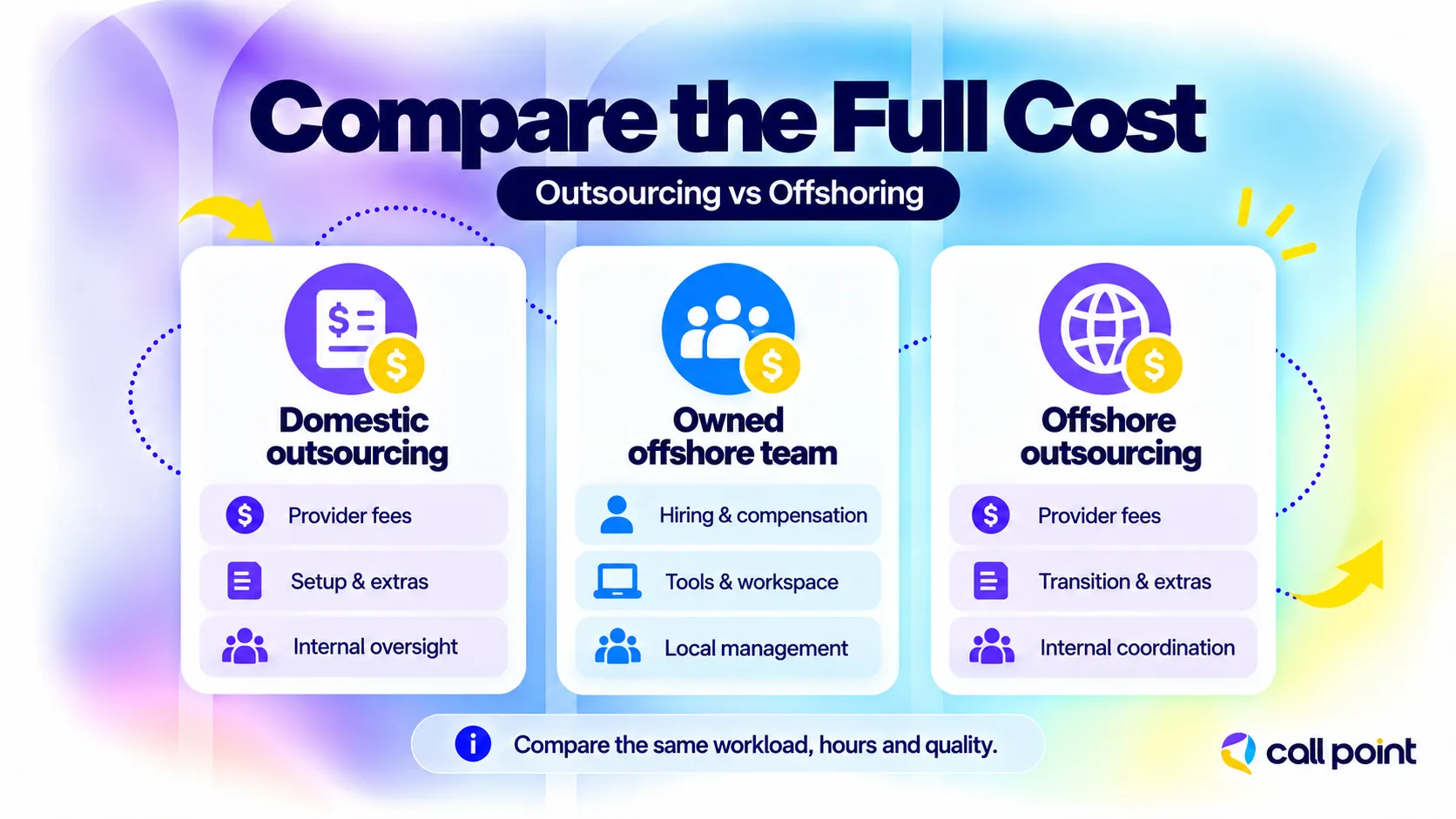
Compare each option against the same workload, service hours, and quality requirements. Domestic outsourcing, a company-owned offshore operation, and offshore outsourcing have different expense profiles.
| Arrangement | Main costs to assess | Work that remains with your business |
| Domestic outsourcing | Provider fees, onboarding, tools excluded from the quote, and additional coverage | Business-specific training, approvals, and provider oversight |
| Company-owned offshore operation | Recruitment, wages, benefits, technology, workspace, local administration, and management | Building and operating the overseas function |
| Offshore outsourcing | Provider fees, transition, excluded technology, additional coverage, and coordination | Process knowledge, approval decisions, and service review |
A provider fee may already include recruitment, equipment, and supervision. Check the proposal before adding those expenses separately. For your own overseas operation, check which expenses you must arrange directly.
US employment figures provide some context. The Bureau of Labor Statistics reported average compensation of $36.73 per hour worked for private-industry office and administrative support occupations in June 2026. That included $25.22 in wages and $11.51 in benefits. These are occupational averages, not a quote for a particular role or a complete operating budget.
Before comparing a provider’s price with an internal team, confirm:
- Scope: The same tasks, volumes, channels, and service hours.
- Transition: Training, documentation, and setup charges.
- Internal effort: Time spent answering questions, reviewing work, and approving exceptions.
- Commercial terms: Minimum commitments, changes in volume, and additional charges.
- Exit: Data return, process documentation, and handover assistance.
Compare the Cost of Completed Work
A lower hourly rate can lose its advantage if your employees spend more time correcting mistakes. Measure output as well as price.
Cost per accepted task = total delivery cost ÷ tasks completed to the agreed standard
For CRM administration, compare records with similar complexity over the same period. Use the same requirements for accuracy and completion. Include any internal checking or correction time in the total cost.
Our in-house vs outsourcing comparison covers employment costs and internal staffing decisions in more detail.
Which Model Fits Your Business?
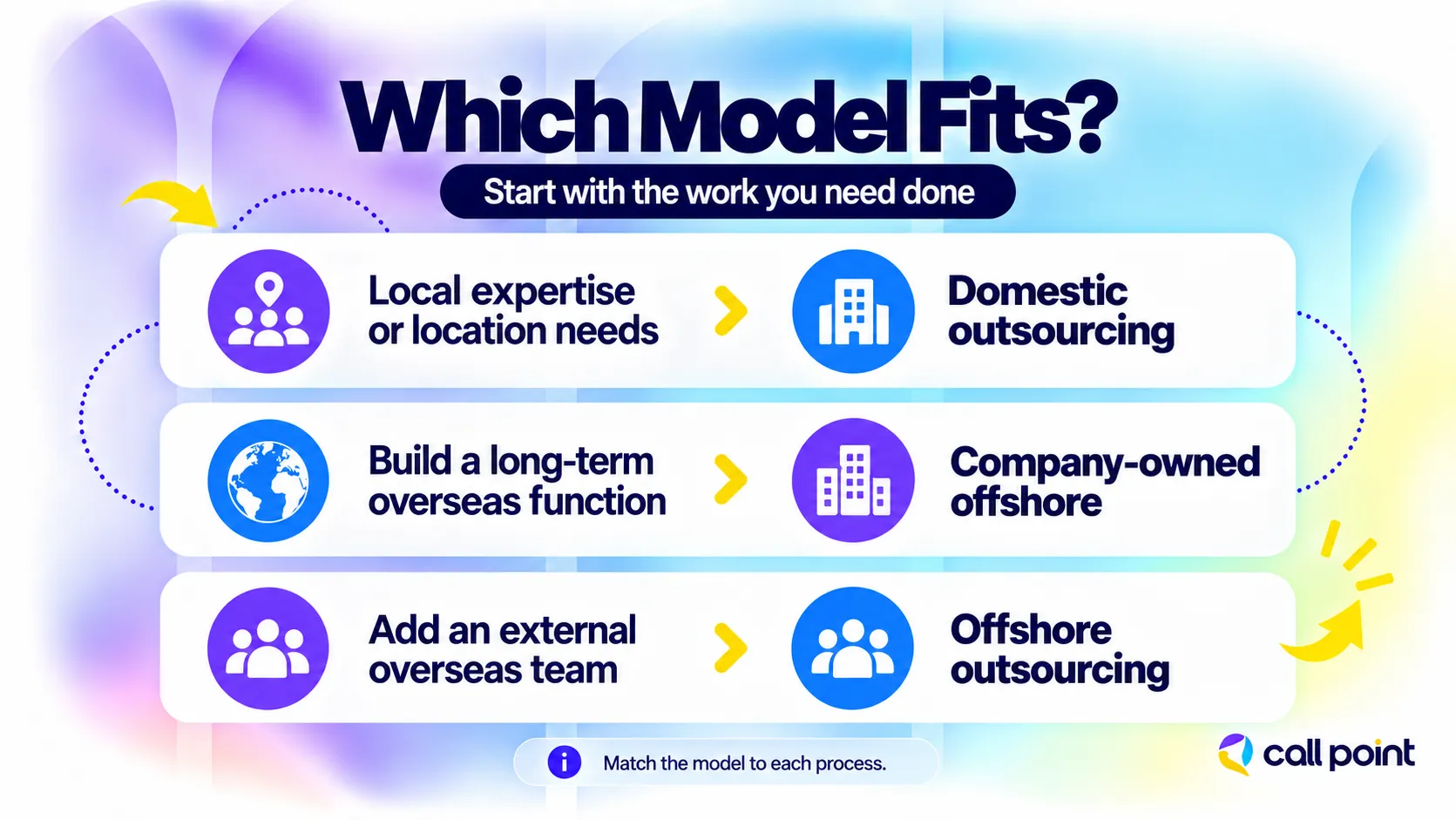
The right arrangement depends on whether you need external expertise, additional people, or a company-operated overseas function. Apply that decision to each process rather than choosing one model for every department.
When Domestic Outsourcing Fits
Consider a domestic provider when the work has a specific location requirement or needs local expertise. Check that the provider can meet the required hours, systems, and service standards.
For a retailer, this might involve outsourcing a function that requires particular knowledge of its domestic market. Local delivery should address a defined need; proximity alone does not establish service quality.
When a Company-Owned Offshore Operation Fits
Consider your own offshore operation when you have sustained work and the resources to recruit, manage, and support an overseas team. It may suit a business that wants to develop a long-term internal capability abroad.
Using the retail example, this could mean building a permanent overseas support department. The business would need managers, systems, staffing coverage, and local administrative support for that operation.
When Offshore Outsourcing Fits
Consider offshore outsourcing when the work follows a clear process and a provider can deliver the staffing, skills, or supervision you need. Suitable tasks might include order inquiries, CRM maintenance, document processing, and routine reporting.
The retailer could delegate standard order questions while keeping supplier disputes and unusual refunds with its internal team. It gains support for recurring work without setting up its own foreign delivery office.
For administrative examples and management options, see our back-office BPO guide.
Delay the handover if the process is undocumented, no internal person can answer questions, or the workload does not justify the proposed commitment. Clarifying the process first gives both teams a workable starting point.
Before requesting proposals:
- Identify the tasks and measure their current volume.
- Document normal steps, exceptions, and approval limits.
- Specify working hours, required systems, and access permissions.
- Assign an internal owner for questions and decisions.
- Agree on how initial delivery will be reviewed before expanding the scope.
What Risks Should You Address Before Moving Work?
The main concerns are service consistency, communication, data access, and continuity. Evaluate how each arrangement handles those issues rather than assuming a location or provider label resolves them.
Training and quality: Give the team examples of accurate work and common errors. For support inquiries, review the accuracy of the answer and the escalation decision. For administrative work, check completed records and unfinished items alongside turnaround time.
Working hours and handoffs: Confirm scheduled coverage, holidays, urgent contacts, and how pending work passes between teams. An overseas location can support extended hours, but 24/7 service still requires an appropriate staffing plan.
Data and system access: Limit permissions to assigned responsibilities. The Federal Trade Commission advises businesses to evaluate providers’ security practices, document expectations, and verify implementation. Ask where data is processed, who can access it, and how incidents are reported.
Continuity and handover: Ask what happens when someone is absent or leaves. Confirm responsibility for replacement training and current process documentation. The agreement should also address access removal, ownership of work product, and the return or deletion of client information when the service ends.
Frequently Asked Questions
Is Remote Work the Same as Offshoring?
Remote work describes working away from a central office. Offshoring concerns work performed in another country. A remote worker can be in the same country as the business. Meanwhile, an offshore team may work together in a company or provider office rather than from home.
Is Outsourcing Only Suitable for Short-Term Work?
Outsourcing can cover short projects or ongoing processes. A design assignment may end after delivery, while customer support or bookkeeping can continue under a recurring service agreement. The duration should follow the workload and commercial arrangement rather than the outsourcing label.
How Does Nearshoring Differ From Offshoring?
Nearshoring means locating work in a nearby country, often to make collaboration easier. A US business working with a team in Mexico is an example. Business guides commonly distinguish nearby nearshore locations from more distant offshore locations. Both can involve internal teams or external providers.
Can an Outsourced Team Use Our Existing CRM?
An outsourced team can use your CRM when authorized access, platform permissions, and training support the work. Define which records the team can view or change, which actions need approval, and how completed work will be checked before granting access.
How Call Point Supports Offshore Outsourcing
Call Point Business Solutions provides business process outsourcing services through its operational team in Dhaka, Bangladesh. We support businesses that need additional capacity for customer communication, sales support, and administrative work.
Depending on the agreed scope, that support can include:
- Customer support: Phone, email, live chat, and ticket-based inquiries.
- Back-office work: Data entry, CRM updates, document processing, order administration, and reporting.
- Sales support: Prospect research, lead generation, appointment setting, and follow-up.
Our quality process includes supervisor checks, task and call reviews, KPI tracking, client feedback, and performance reporting. Access to approved client platforms can be limited by role and assigned responsibilities.
The proposal defines the team arrangement, service hours, training needs, responsibilities, and fees. Your business supplies the product knowledge and approval rules the team needs to follow.
If routine work is taking too much time from your internal team, start with the process that needs support. Share the tasks, approximate workload, required hours, and systems with us. Request a customized outsourcing proposal to discuss an offshore support arrangement built around those requirements.