

Choosing between an in-house team and outsourcing is not simply a staffing decision. It affects cost, management time, control, flexibility and how quickly your business can add capacity.
Keeping work in-house gives you direct oversight of the people, processes and decisions involved. It also means your business is responsible for recruitment, training, supervision, equipment and employee costs. Outsourcing shifts some of that responsibility to an external provider while allowing your internal team to stay focused on the work that needs their knowledge and judgment.
So, which option makes more sense?
Keep work in-house when it is closely tied to strategy, sensitive decisions or knowledge that is difficult to transfer. Outsourcing is often a better fit when the work is repeatable, measurable, time-consuming or difficult to staff efficiently.
What Is The Difference Between In-House vs Outsourcing
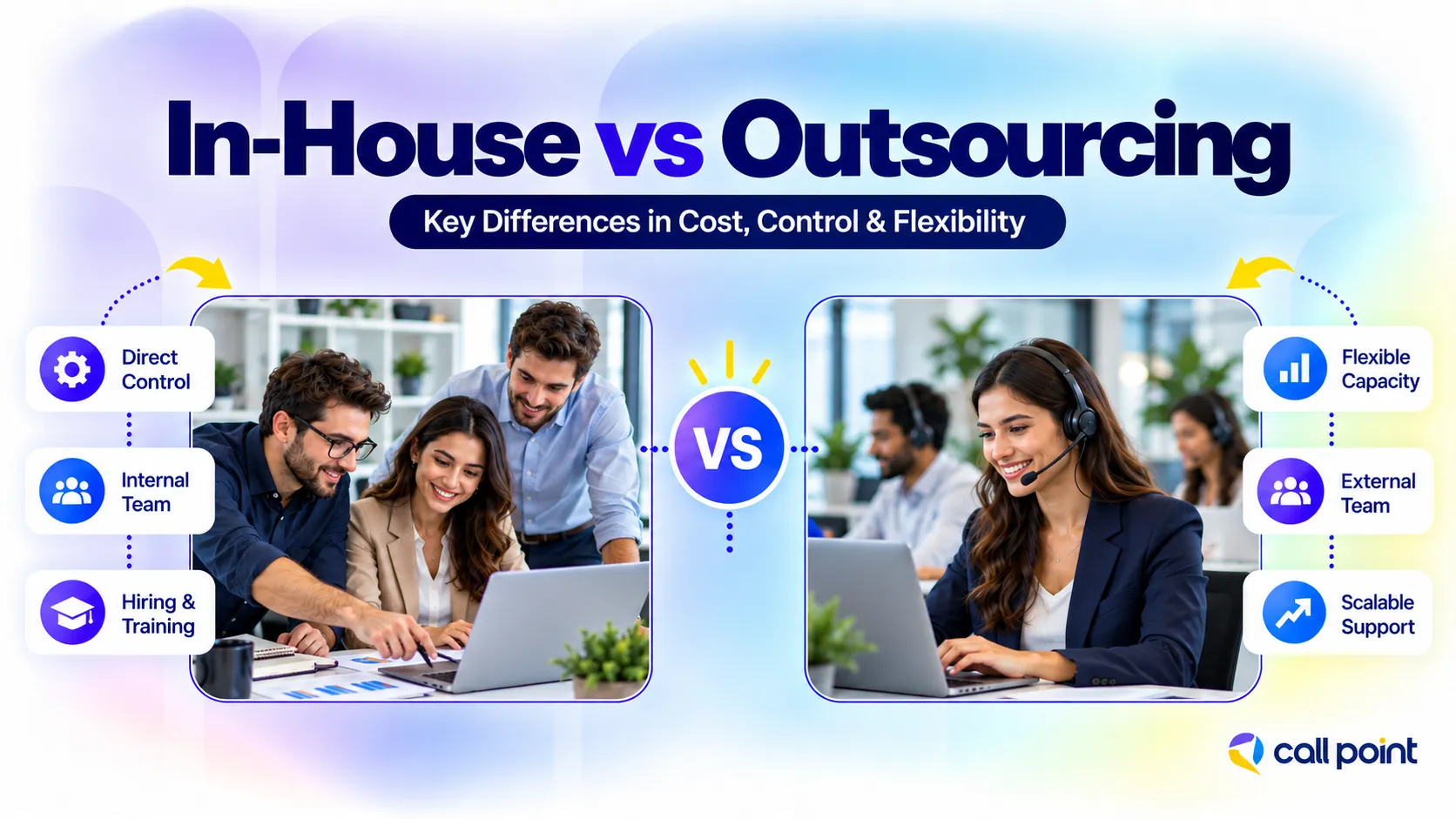
In-house hiring means your company employs and manages the people doing the work. Outsourcing means contracting an external provider to perform agreed tasks or manage a business process. The provider’s responsibilities depend on the service agreement; outsourcing does not automatically transfer every operational responsibility.
Consider a customer support desk. An internal team needs recruitment, training, scheduling and supervision. An outsourced provider supply agents and supervisors, while your business supplies product information, approves policies and handles exceptions. Both arrangements need someone accountable for service quality.
| Factor | In-House | Outsourcing |
| Recruitment | Your business recruits employees | Provider usually recruits its team |
| Daily supervision | Your managers oversee staff | Provider or shared management, depending on scope |
| Business-specific training | Delivered internally | Requires input from your business |
| Cost structure | Salary, benefits and operating costs | Service fee plus client-side and additional costs |
| Coverage | Built through internal staffing | Defined by the contracted schedule |
| Process changes | Managed directly within the team | Coordinated with the provider; may affect scope or fees |
| Main limitation | Requires management capacity and backup staffing | Requires handovers, oversight and a suitable provider |
Our guide to business process outsourcing explains the model in more detail. You can also review the types of BPO services to see which functions businesses can assign to external teams.
What Does an In-House Employee Cost?

An employee’s total cost includes compensation, recruitment, training, equipment and management time. A salary figure alone will not show what it takes to keep the work covered and completed to the required standard.
For context, the U.S. Bureau of Labor Statistics’ June 2026 data reported average employer compensation of $36.73 per hour worked for private-industry office and administrative support occupations. Wages accounted for $25.22 and benefits for $11.51. This is an occupational average, not an estimate for a particular vacancy.
Salary and Employee Benefits
Use the proposed salary and your actual benefit costs to estimate employment expense. Include employer contributions, insurance, retirement benefits and any applicable bonuses. Paid leave also affects available working time, although you should avoid counting the same expense twice if it is already included in your calculation. Compare the role’s expected output and service hours with the outsourcing proposal before drawing conclusions about cost.
Recruitment and Hiring Costs
Recruitment includes advertising, screening, interviews and the time managers spend assessing applicants. In its October 2025 benchmarking release, SHRM reported an average nonexecutive cost-per-hire of $5,475 among participating U.S. organizations. That average does not predict the cost of your next hire. A referral may be inexpensive, while a difficult vacancy can involve agency fees and weeks of internal effort.
Training, Equipment and Software
A new employee needs access to the right tools and enough guidance to use them correctly. Budget for equipment, software accounts and the colleague who will explain your customers, processes and approval rules. Some expenses are already covered by existing systems; others increase with each person added. Outsourcing also requires business-specific training, so include your team’s handover time when comparing the options.
Management and Quality-Control Costs
Management remains part of the cost even when it does not appear on a separate invoice. A support manager reviews complaints, checks responses, coaches staff and handles escalations. Sales support needs oversight of qualification criteria, contact records and appointment quality. A provider take on routine supervision, but an internal contact still needs to review performance and answer questions about the business.
Leave, Turnover and Replacement Costs
Backup arrangements matter when work cannot wait for an employee to return. A colleague cover occasional administrative tasks, but a daily support desk needs a staffing plan for leave and unexpected absences. Turnover brings another recruitment and training cycle. Ask an outsourcing provider how replacement staff are prepared for your account rather than assuming that an available agent can immediately take over.
How Much Does Outsourcing Cost?
Outsourcing costs depend on the task, required skills, team size, service hours and level of supervision. Providers charge by the hour, dedicated agent, monthly team, project or transaction. The proposal should explain what the fee includes and when additional charges apply.
Clutch’s back-office outsourcing pricing guide lists marketplace rates below US $25 per hour for data entry and virtual assistance, and US $25–$49 for finance and accounting outsourcing. These are broad platform benchmarks, not Call Point prices or a guarantee of what your service will cost.
Before comparing a provider’s fee with employment costs, account for the same workload, quality requirements and coverage. Include onboarding, software access, internal review time and any charges for extra hours or changes to scope.
| Cost to Check | In-House Estimate | Outsourcing Estimate |
| Staffing | Compensation for the required team | Fee for the agreed staffing and workload |
| Setup | Recruitment, equipment and training | Transition fees and client training time |
| Technology | Equipment and software costs | Included tools plus client-funded accounts |
| Oversight | Internal supervision and quality checks | Client reviews plus any separately charged management |
| Coverage | Backup staff or overtime | Contracted backup and extended-hours charges |
| Changes | Additional hiring or retraining | Scope changes, volume charges or contract amendments |
An inexpensive hourly rate offers poor value if your staff spends a substantial amount of time correcting work. Equally, an internal hire underused if there is only a small amount of work each week. Compare the complete arrangement over the same period.
When Is Outsourcing a Better Choice Than Hiring In-House?
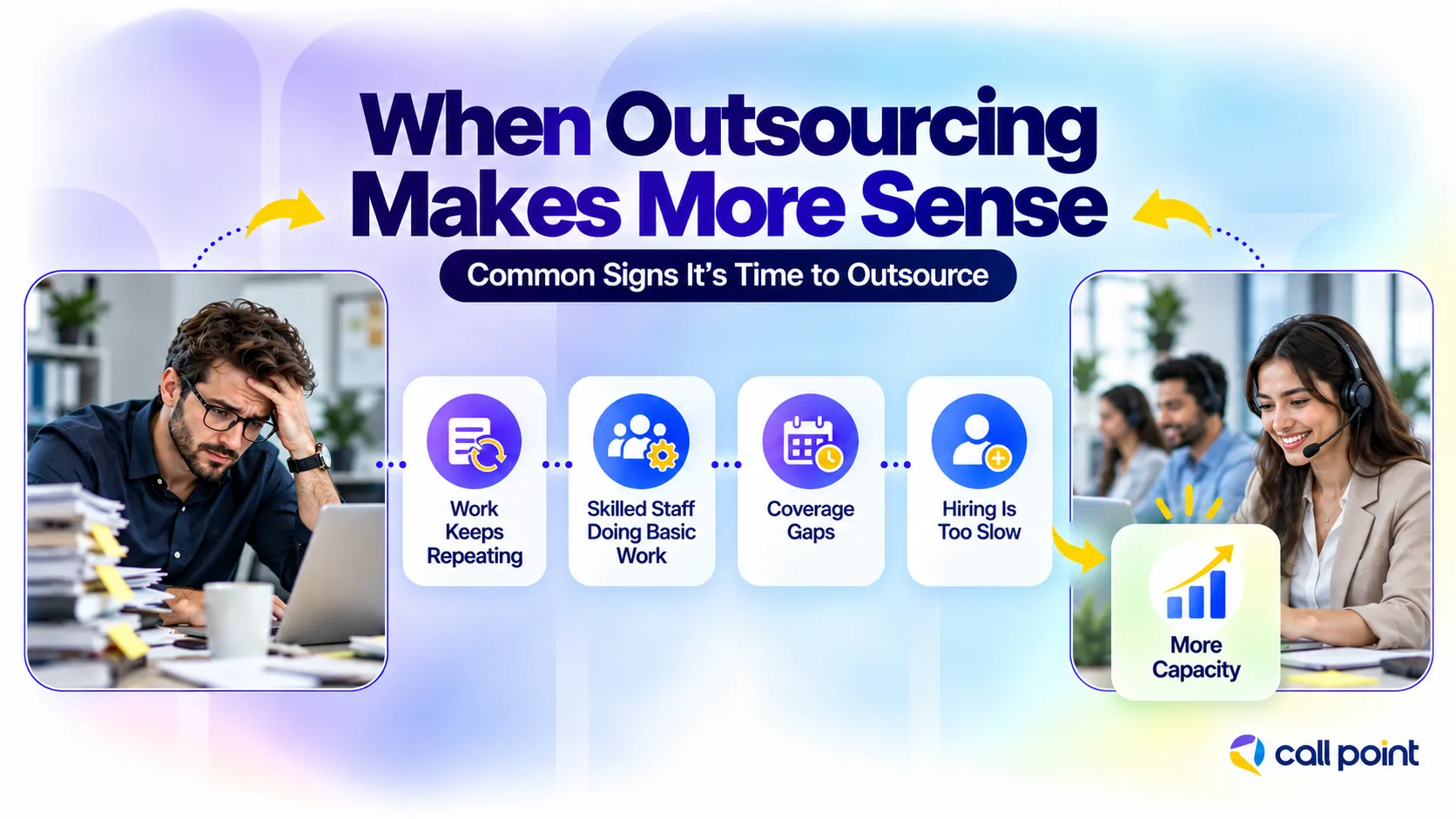
Outsourcing is worth evaluating when a defined workload exceeds your team’s capacity and a provider can meet the required schedule and standard. First check whether the shortage comes from work volume or from an inefficient process. Extra staff will not necessarily resolve missing information or repeated approval delays.
The Workload Keeps Coming Back
A recurring backlog can indicate that demand has outgrown the current team. Review incoming work, completion times and the cases that remain unresolved. If employees are waiting for approvals or correcting incomplete records, address those delays first. Once the process is workable, compare the capacity available from another hire with the support an external provider can offer.
Experienced Employees Are Doing Basic Work
Senior employees are spending time on tasks that a support role could handle. A sales manager updating contact records has less time to review opportunities or coach the team. Moving those updates can be useful when the instructions are clear and exceptions are manageable. Check how much supervision the transferred work will require before assuming that all of the manager’s time will be recovered.
One New Employee Will Not Solve the Coverage Problem
A business receiving enquiries from 8 a.m. to 10 p.m. needs coverage beyond one standard shift. Weekends, leave and demand peaks add further staffing requirements. Map enquiry volume by time of day before choosing an arrangement. An outsourced team fits the schedule, but the proposal must specify coverage, response expectations and what happens when an assigned agent is unavailable.
Recruitment Is Slowing the Business Down
Outsourcing provides another staffing option when a suitable local hire is difficult to find. Ask how the provider selects people for your role, whether they have relevant experience and how training will be completed. A quick start is only useful if the team can perform the agreed work. Internal hiring is still preferable when the position needs close daily collaboration across the business.
Which Business Tasks Should Stay In-House or Be Outsourced?
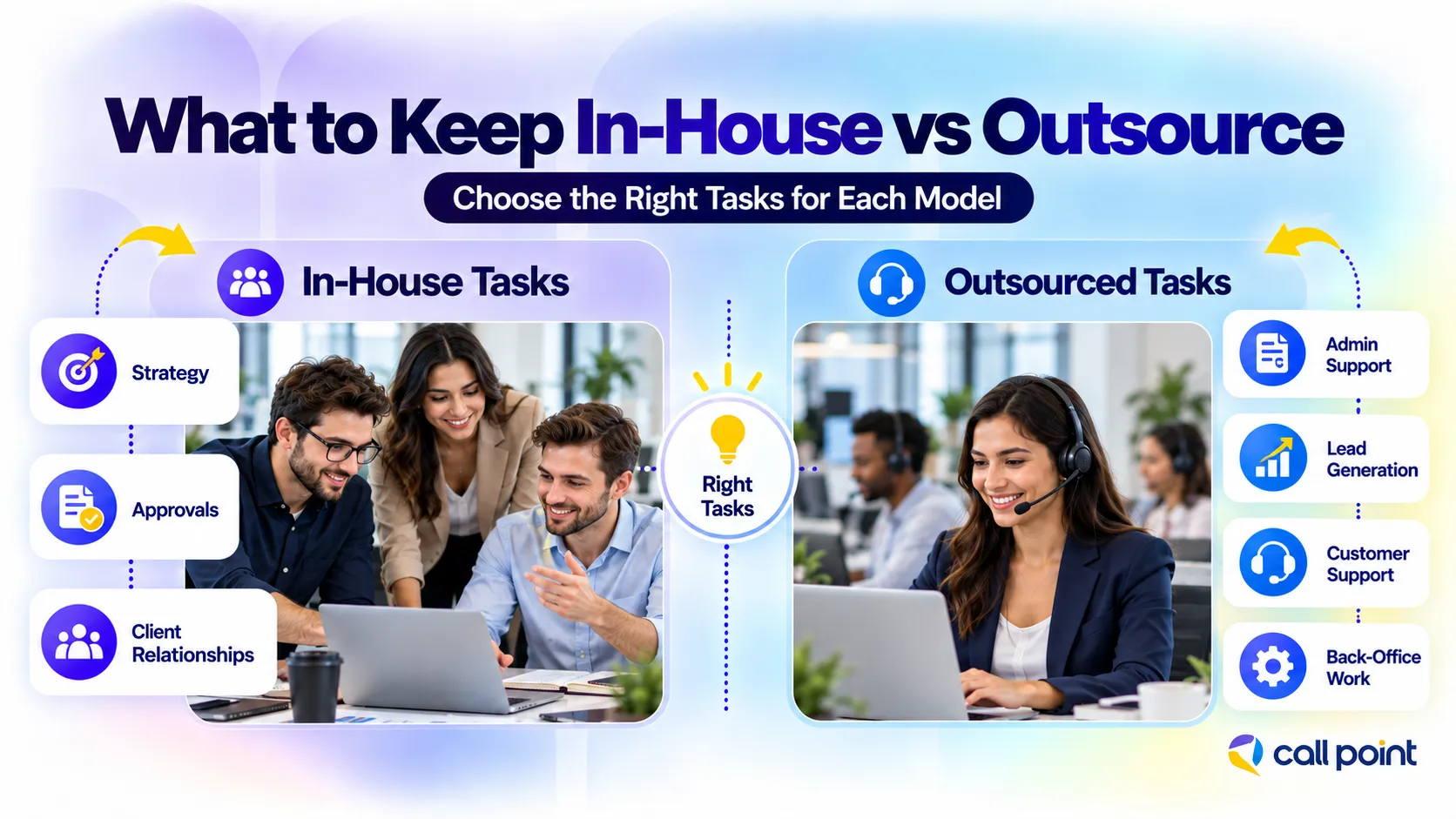
Keep responsibility close to your team when the work involves business direction, sensitive approvals or relationships that depend on internal expertise. Tasks with clear inputs, instructions and review criteria are easier to assess for outsourcing. The boundary can sit within a department rather than around it.
| Often Better Kept In-House | Common Outsourcing Candidates |
| Company strategy | Customer support |
| Executive decisions | Call handling |
| Final financial approval | Bookkeeping support |
| Key client relationships | Accounts administration |
| Product strategy | Data entry |
| Proprietary decision-making | CRM updates |
| Final sales negotiations | Prospect research |
| High-level brand decisions | Lead qualification |
| Sensitive escalations | Appointment setting |
| Work requiring physical presence | Level 1 help desk support |
These are starting points, not fixed rules. Routine tasks can still involve confidential information or costly errors. For example, invoice entry is suitable for external support, but the team needs permission limits and a way to flag discrepancies before payment is approved.
Physical presence is another consideration. A remote provider cannot perform an on-site task, although a local external contractor may be able to. Decide whether you need employment, remote support or a specialist service based on the work itself.
How Do You Decide Between In-House and Outsourcing?
Choose by defining the work, comparing complete costs and checking whether each arrangement can meet your operating requirements. Ask the person responsible for the process to describe a normal week, including exceptions, approvals and delays.
Work through these steps before committing:
- Define the scope: List the tasks, expected volume, working hours and required skills.
- Identify retained decisions: Record what needs internal approval and who will provide it.
- Set quality measures: Specify how completed work will be checked, such as record accuracy or response quality.
- Compare complete costs: Include setup, management, technology and backup coverage for both options.
- Plan the handover and exit: Decide how instructions, records and access will be managed if responsibilities change.
In-house hiring can be easier when priorities change frequently and the employee needs continuous contact with several departments. Outsourcing can fit a more defined service, but changes may require new instructions, retraining or a revised agreement. Neither arrangement removes the need for accountable management.
Consider a Hybrid Team
A hybrid team divides work between internal employees and an external provider. For example, your salespeople might retain discovery calls and proposals while external staff research prospects and confirm appointments. The arrangement needs agreed qualification criteria, complete CRM notes and a contact for questions. When handovers are frequent or instructions change daily, the extra coordination may outweigh the benefit of splitting the work.
How Call Point Helps Businesses Transition to Outsourcing
One of our real estate clients was spending too much internal time on lead follow-up, CRM updates, appointment scheduling, and routine administrative work. These tasks still had to be done, but they were taking attention away from property enquiries, client relationships, and higher-value sales activity.
Call Point helped move the repeatable work into an outsourced workflow. Our team supported prospect follow-up, appointment setting, CRM management, research, and day-to-day administration using the client’s existing process and approved systems. The client’s internal team kept control of property decisions, negotiations, and important customer conversations.
The change gave the business a clearer division of work. Routine tasks were handled more consistently, while the internal team had more time to focus on clients, opportunities, and property-related decisions.
Frequently Asked Questions
What Are the Disadvantages of In-House Services?
In-house services can give a business more direct control, but they also come with higher staffing responsibility. The company must handle recruitment, salaries, benefits, training, supervision, equipment, leave, and replacement hiring. Scaling can also take longer because adding capacity usually means recruiting more employees. For some businesses, this makes in-house teams less flexible when workload changes or specialist skills are needed quickly.
How Much Control Do You Keep After Outsourcing?
You can retain authority over scope, approval rules, access permissions and service standards, while the provider handles the responsibilities assigned in the agreement. You have less direct involvement in daily staffing decisions than with an employee. Specify what the team can decide independently, what needs approval and how service problems will be escalated before work begins.
Why Do Some Outsourcing Arrangements Fail?
Outsourcing can fail when the provider receives incomplete instructions, conflicting priorities or inadequate training. A team might follow a written refund policy correctly and still disappoint a manager who expected an undocumented exception. Establish one approved process and a contact for questions. Review early work promptly so misunderstandings can be corrected before they become routine.
Is a Hybrid Team Better Than Fully In-House or Fully Outsourced?
A hybrid team can suit work that combines internal decisions with defined support tasks, but it is not automatically better. An internal finance manager might approve payments while external staff prepare invoice records. That division works only if information moves reliably between them. For a small role with frequent exceptions, keeping responsibility with one internal employee may be simpler.
Can an Outsourced Team Work During U.S. Business Hours?
Yes, if the provider offers and agrees to that schedule. Confirm the specific time zone, daylight saving arrangements, holiday coverage and any charges for evenings or weekends. Businesses serving customers across several U.S. time zones should map their requirements before requesting staffing. Put the agreed hours and backup arrangements in the service agreement.
Can an Outsourced Team Use Our Existing CRM and Business Software?
An outsourced team can often use client systems when licensing, technical requirements and access controls permit it. Assign individual accounts where possible and restrict permissions to the work. Someone updating contact records does not need database export access. Name the person responsible for approving permissions and removing access when a team member’s responsibilities end.
In-House or Outsourcing: Which Should You Choose?
Hire internally when the role needs close integration with your business and you have the capacity to train and manage it. Consider outsourcing when the work is defined and the provider’s staffing, service standards and contract fit your needs. A hybrid arrangement is useful when you can divide responsibilities without creating excessive coordination.
Bring your task list, service hours and approval requirements to the comparison. Those details will tell you more than salary figures or headline provider rates alone.
Contact Call Point Business Solutions to discuss your workload and request a proposal for the support your business needs.