

B2B telemarketing is phone outreach to people who buy or influence purchases for a business. A team can use it to find suitable prospects, answer questions, follow up on interest, and arrange sales conversations. The hard part is knowing which conversations are worth handing to sales.
A meeting looks promising on the calendar. Then your salesperson joins and finds that the prospect expected a brochure, has no current need, or works at a site that cannot choose its own suppliers. Better calling starts before the appointment is booked: with the right account, an honest question, and a clear reason to speak again.
Relevance matters to buyers. In a Gartner survey of 632 B2B buyers, 73% said they actively avoid suppliers that send irrelevant outreach. The research also found that buyers often want a seller’s input when deciding whether an offer suits their company. A useful phone call can help with that decision.
What Is B2B Telemarketing?

Business-to-business telemarketing covers sales-related phone conversations between companies. A caller might contact a new account, return an inquiry, check whether an existing lead is still interested, or speak with a former customer. The next step depends on what the buyer needs. It could be more information, a product demo, a site visit, or no further contact.
Suppose a commercial cleaning company calls an office building. The facilities manager may know what the current service gets wrong, but procurement may approve new contracts. The caller needs to understand both roles before deciding who should attend a meeting.
Cold calling is one way to do this work. It means contacting a prospect with whom you have no established relationship. Telesales usually focuses on making the sale over the phone. Many B2B telemarketing calls happen earlier, when the team is still learning whether the offer fits.
Our guide to what telemarketing is covers the broader channel.
What Are the Types of B2B Telemarketing?
The two main types describe who starts the call. The campaign goal, such as lead generation or appointment setting, sits within either type.
Outbound B2B Telemarketing
Your business places an outbound call. That could mean introducing an offer to a new account, calling back someone who asked for a quote, or checking in with a former customer. The caller should use the history available to them. A person who requested pricing expects an answer to that request; someone hearing from you for the first time needs to know why you called. A callback is still an outbound call, even when an inbound inquiry prompted it.
Inbound B2B Telemarketing
A potential buyer starts an inbound sales call after seeing your website, an ad, or a referral. Answer their question first. If they ask for pricing, you may need to know which service they want, where they operate, and how much work is involved before giving a useful answer. The aim is to help them take an appropriate next step. Routine customer support belongs with the support team unless the conversation turns to a new purchase.
What Can B2B Telemarketing Help You Do?

Set one main goal for each campaign. A team tasked with finding new accounts will work differently from a team following up on existing inquiries, and the results should be judged accordingly. The phone can also uncover questions that form and email replies leave open. Use what callers hear to improve the offer and contact list, while remembering that a handful of calls does not represent the whole market.
Find and Qualify New Leads
The caller starts with businesses that match your target market, then checks whether the contact has a relevant need and some role in addressing it. Reaching a person is progress, but it does not make the account a sales lead. If the contact says decisions are made at head office, update the record and find the appropriate team. Those notes save the next caller from repeating the same mistake.
Arrange Sales Meetings
A qualified appointment has a purpose that both sides understand. The buyer knows what they will discuss, and your salesperson receives enough context to prepare. For a cleaning provider, a facilities manager reviewing service ahead of a contract renewal has a reason to meet. Someone who only agreed to receive general information should not be booked as though they had requested a proposal.
Follow Up and Reconnect
Calls also help when a business has already shown interest. A prospect may have asked for details after a webinar, postponed a decision, or used your service in the past. Refer to that history and ask what has changed. A former customer might now need a different service, while a previous inquiry may no longer be relevant. Either answer is more useful than another generic “just checking in” message.
When Does B2B Telemarketing Make Sense?
A call earns its place when a buyer needs help assessing a business purchase and you can offer useful context. Managed IT services, for example, often require a discussion of current systems, service hours, and who handles issues internally. The buyer cannot judge fit from a price alone.
That distinction appears in Gartner’s buyer research. Respondents generally preferred to research basic information on their own, but they sought seller input for questions such as whether a solution would work for their company. The finding supports helpful sales conversations; it does not mean every buyer wants an unsolicited call.
Consider the cost before you scale. Prospect research, calling, training, and follow-up all take time. If the value of a typical customer cannot support that work, a broad calling campaign is unlikely to make financial sense. Start with a focused group of accounts and a specific offer you can explain clearly.
How Do You Set Up a B2B Telemarketing Campaign?
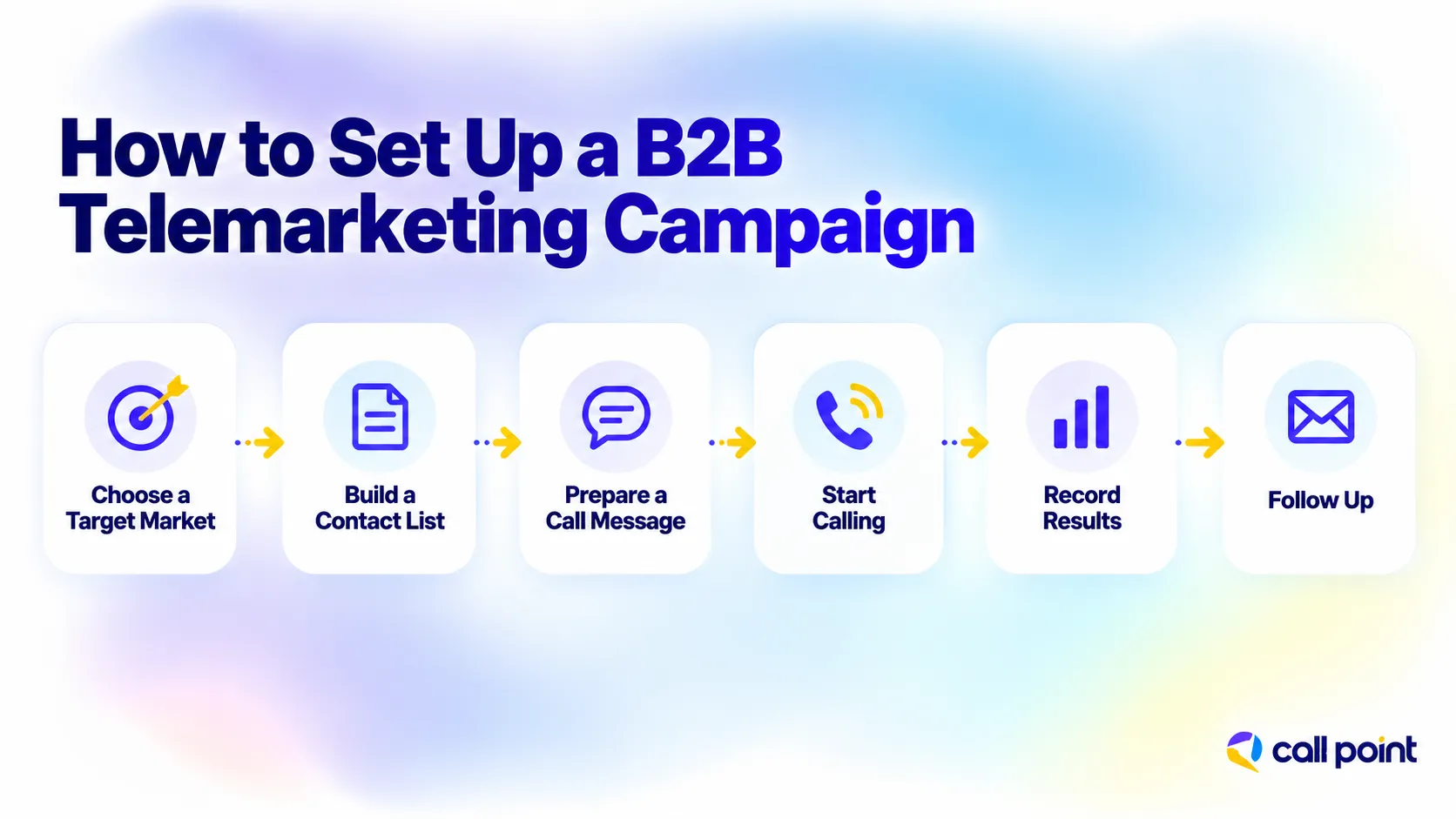
Write down what the caller needs to know, what they need to learn, and who takes over when a prospect is ready. A shared customer relationship management system, or CRM, keeps the conversation from starting over at every handoff.
- Choose the accounts. Define the industries, locations, company sizes, and service needs that fit your offer. This is your ideal customer profile. Note the businesses you cannot serve as well.
- Find the people involved. The person who uses a service may not manage its contract. Find out who raises the need, evaluates suppliers, and approves the purchase.
- Decide what counts as progress. A site assessment, demo, or discovery meeting can all be useful next steps. Agree on the information needed before the team offers one.
- Prepare the callers. Give them accurate answers to common questions and a route to a specialist when they need one. A short opening helps; a script that ignores the buyer’s answer does not.
- Record and review the outcome. Keep the buyer’s words, unanswered questions, agreed follow-up date, and sales owner in the CRM. Review rejected meetings with the calling team so they know what was missing.
Check the contact list throughout the campaign. Job titles change, numbers get reassigned, and people ask to stop receiving calls. A duplicate list upload must not bring an opted-out contact back into the queue.
What Should a B2B Telemarketing Call Sound Like?
Tell the person who you are and why you called. Then pause for an answer. Here is a hypothetical opening from a commercial cleaning provider:
“Hi, Jordan. I’m Sam from [Company]. We provide office cleaning in [Area]. Are you the person who handles cleaning contracts for this building?”
If Jordan says yes, Sam could ask when the service is normally reviewed or whether any requirements have changed. If someone else owns the contract, Sam can ask whom to contact. There is no need to deliver the full company pitch before learning that.
Suppose Jordan has a provider and is happy with the work. Accept that answer. If Jordan mentions a review later in the year and is open to a follow-up, record the date and the reason for calling again. If Jordan asks you to stop, record that request instead.
This example shows how the conversation can move. It is not a Call Point client story or evidence of campaign results.
What Makes a B2B Lead Qualified?
A qualified lead fits the business you can serve and has a reason to continue the discussion. Interest on its own is not enough. A manager could like your offer while working at a location outside your service area, or they may have no part in choosing a supplier.
Before passing a meeting to sales, establish what the buyer wants to discuss, who should attend, and what is known about timing. Record the current arrangement and any questions that need a specialist. Leave unknowns as unknowns. A first call rarely settles every detail of a complex purchase.
Some teams use BANT (budget, authority, need, and timeline) to organize what they learn. Salesforce’s BANT guide explains the framework and its limits when several people share a decision. Use those four areas to spot gaps in your notes, not as a questionnaire the buyer must complete before speaking to sales.
Why Do B2B Telemarketing Campaigns Fail?
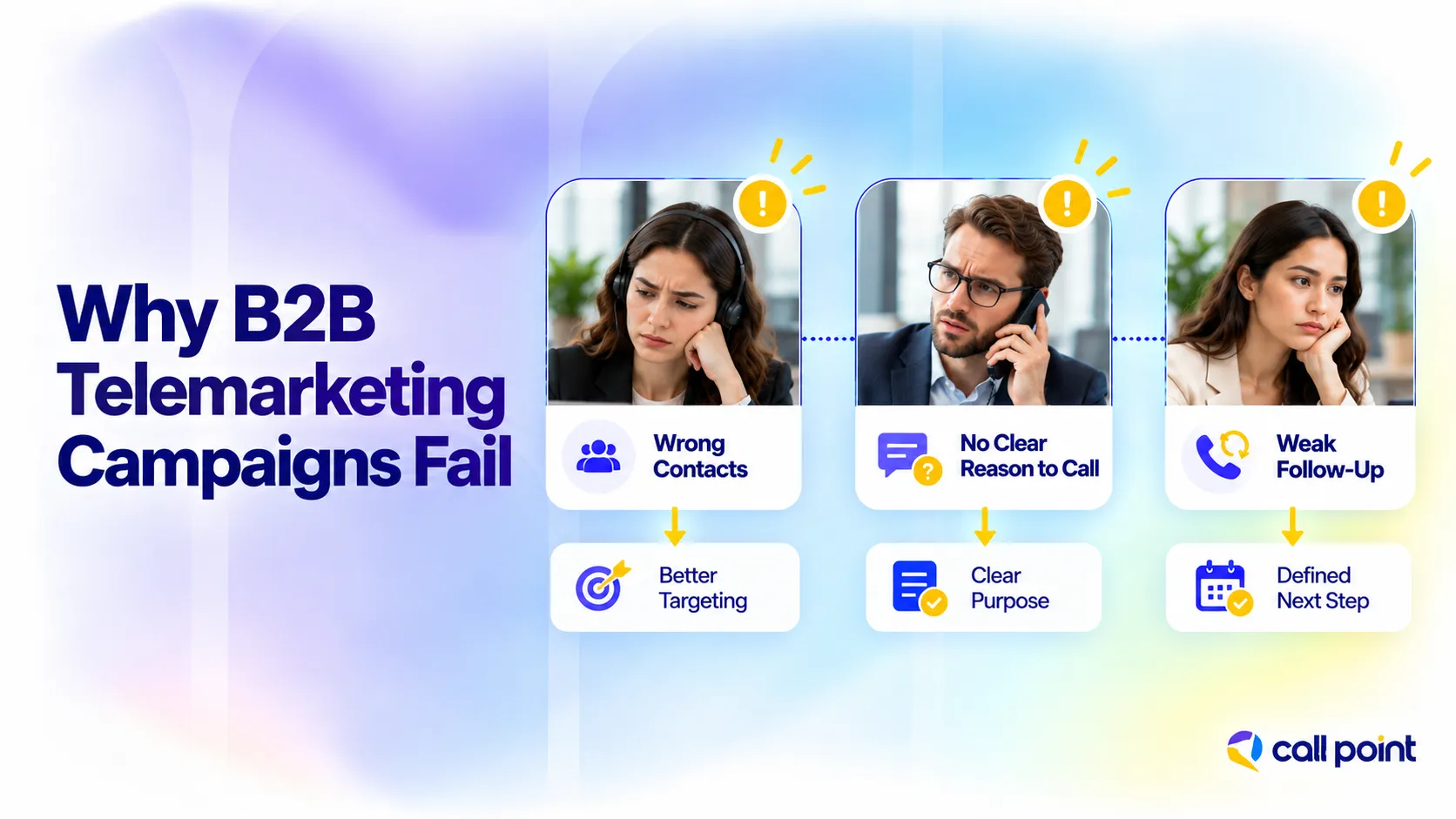
Poor results usually leave clues. Before asking for more calls, look at the accounts reached, the conversations held, and what happened after each handoff.
The List Reaches the Wrong People
The company may fit your target industry while the person on the list has no role in the purchase. A branch manager, for instance, cannot choose a supplier if contracts are controlled by head office. Track wrong-contact responses and the referrals callers receive. Then update the roles you target. More attempts against the same mismatched list only repeat the problem.
The Call Has No Useful Reason Behind It
A prospect can read a general service description on your website. The caller needs a reason tied to the business they reached, without pretending to know about an unverified problem. If suitable contacts keep asking why you called them, listen to those conversations before rewriting the script. The offer or the target audience may need work.
The Next Step Falls Apart
A prospect agrees to talk about a need, then receives a meeting invitation with no agenda. Your sales rep joins without the notes, or nobody follows up on a promised answer. Agree on the meeting’s purpose while the prospect is still on the phone, assign an owner, and pass the details along. Sales should tell callers when a meeting did not meet the agreed criteria.
How Do You Measure B2B Telemarketing Results?
Count calls, but follow what they produce. A campaign that makes many calls to unsuitable contacts can look busy while giving sales little to work with.
Start with these measures:
- Relevant conversations: Calls that reached someone involved in the service or problem.
- Qualified meetings booked: Meetings that met your criteria when they were scheduled.
- Meetings held and accepted: Appointments that took place and passed sales review.
- Opportunities and customers: Accepted meetings that moved further through the sales process.
Define each measure before reporting it. A booked meeting can be canceled, and a held meeting may reveal a poor fit. Keep those outcomes separate so you can see where the campaign needs attention.
For cost per accepted meeting, divide the full campaign cost by the number of held meetings your sales team accepts. Include the callers, contact research, tools, and management. If several channels helped bring in a customer, decide how to credit them before calculating a return. An open opportunity is not revenue.
How Much Does B2B Telemarketing Cost?
The cost depends on the accounts you want to reach and the work required on each one. A current list and a straightforward offer take less preparation than a technical service sold to several people within each company.
Budget for callers, training, contact research, phone tools, supervision, reporting, and follow-up. Compare the full scope of provider quotes. An appointment fee means little until you know whether you pay for a booking, a meeting that takes place, or one your sales team accepts.
Here is a hypothetical calculation: a $4,000 campaign produces 40 held meetings that sales accepts. The cost per accepted meeting is $100. Ask how a proposal handles no-shows, duplicate contacts, setup work, cancellations, and ownership of the records. Call Point provides custom proposals based on the agreed scope.
Is B2B Telemarketing Legal in the United States?
Yes, businesses can use telemarketing in the United States. The rules that apply depend on who receives the call, the number used, and how the call is placed.
The Federal Trade Commission says most calls soliciting sales from a business are exempt from its National Do Not Call provisions. In a 2024 update, it extended prohibitions on misrepresentations to B2B telemarketing. Callers must still be accurate about the business, offer, and terms.
Wireless numbers and calling technology require separate review. Under FCC rules, telemarketing calls to wireless numbers using a legally defined automatic telephone dialing system or an artificial or prerecorded voice generally require prior express written consent, subject to exceptions. The FCC has also classified AI-generated voices as artificial voices under the TCPA.
State requirements and call recording rules can affect the plan too. Have qualified counsel review the actual markets, numbers, and calling methods before launch. Make sure requests to stop calling reach everyone who uses the list.
In-House vs. Outsourced B2B Telemarketing
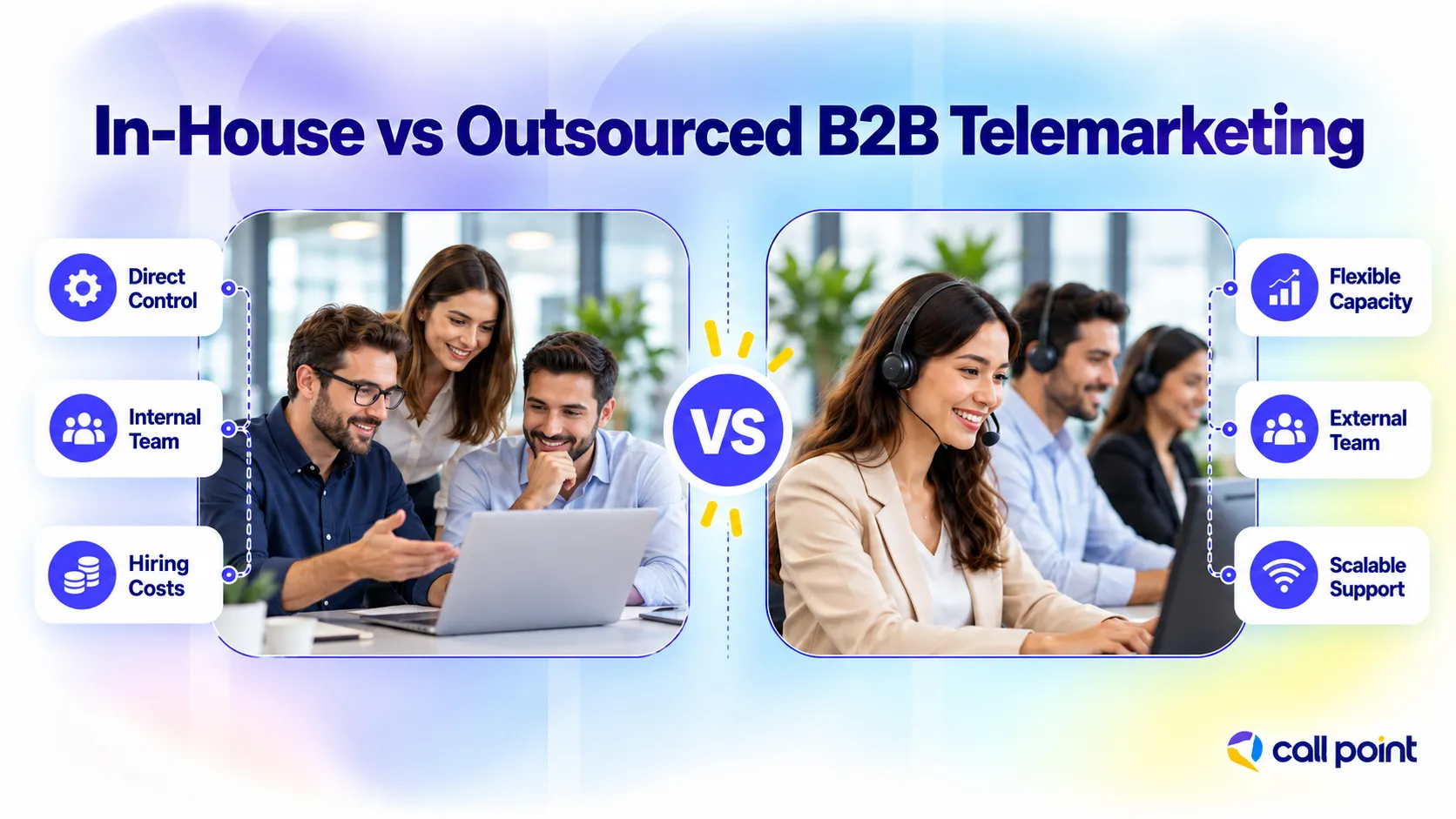
The better arrangement depends on your product knowledge requirements, management capacity, and calling workload.
| Factor | In-house team | Outsourced team |
| Product knowledge | Direct access to internal specialists | Requires structured training and escalation |
| Recruitment and supervision | Managed by your business | Managed within the provider’s agreed scope |
| Capacity | Depends on hiring and existing workloads | Depends on the contracted staffing arrangement |
| Data and reporting | Controlled through internal systems | Access, ownership, and reporting must be agreed |
| Cost | Includes employment, tools, training, and management | Includes provider fees and any additional agreed costs |
An in-house team can suit an offer that changes frequently or requires specialist judgment throughout the conversation. Outsourcing can add dedicated prospecting capacity when internal salespeople are occupied with discovery, proposals, and closing.
A hybrid model also works: an external team handles agreed outreach and initial qualification, while internal specialists take the detailed sales discussion. Both teams need the same acceptance criteria and a clear feedback process.
When evaluating a provider, ask to review its training approach, reporting, data-access controls, and meeting qualification process. The proposal should explain responsibilities on both sides.
How Call Point Supports B2B Telemarketing
For a commercial cleaning client, our agents call businesses that may need a cleaning provider. They find the right contact, ask about current needs, qualify interested prospects, and book appointments for the client’s sales team. The team gets conversation notes it can use to follow up and move those opportunities through its pipeline.
Before calling, we train agents on each client’s services, target buyers, and criteria for a qualified lead. Clients receive weekly and monthly reports on campaign activity, leads, and appointments. That gives them a clear view of what is entering the pipeline and what needs follow-up. Learn more about our telemarketing and telesales services.
Frequently Asked Questions
Can a Small Business Use B2B Telemarketing?
Yes, if it has a clear target audience, an offer that can support the cost of outreach, and someone ready to handle interested prospects. Start with a manageable group of accounts so you can review conversations before expanding. Include the owner’s or salesperson’s follow-up time when assessing the cost. A small campaign still needs a clear process for quotes, questions, and appointments.
What Is the Best Time to Call Business Prospects?
The best time depends on the contact’s role, work schedule, and time zone, as well as applicable calling rules. Try suitable windows and compare useful conversations, not just answered calls. If a prospect gives you a preferred time, record it. That instruction is more valuable than putting the person back into a general calling schedule.
How Many Times Should You Follow Up?
Follow up when you agreed to do so. If the prospect did not set a date, use a contact policy that accounts for their response and your reason for calling again. Each attempt should serve a purpose, such as answering a question they raised. Record a request to stop calling immediately and remove that contact from future outreach.
Final Thoughts
A useful B2B telemarketing campaign reaches businesses that fit the offer, gives buyers a reason to talk, and carries what was learned into the next sales conversation. Look beyond the number of calls and bookings. The details behind a qualified meeting tell you whether the work is helping your sales team.
Discuss your target market and telemarketing requirements with Call Point Business Solutions.