

Your sales representatives spend much of their week on discovery calls, proposals, and client discussions. Prospecting gets pushed aside, follow-ups become irregular, and fewer new conversations enter the sales pipeline.
Appointment setting outsourcing allows businesses to delegate prospect outreach, lead qualification, follow-up, and meeting scheduling to an external team. The provider handles agreed early-stage sales activities, while internal representatives focus on discovery meetings, demonstrations, and closing deals.
Outsourcing works best when you define the target audience, agree on what qualifies as an appointment, and establish clear responsibilities. The following guide explains how to prepare, compare providers, understand costs, and measure the results.
How Does Appointment Setting Outsourcing Work?
Appointment setting outsourcing involves hiring an external provider to manage specific activities that lead to sales meetings. Depending on the service agreement, the provider may assign dedicated appointment setters or manage a broader outbound campaign.
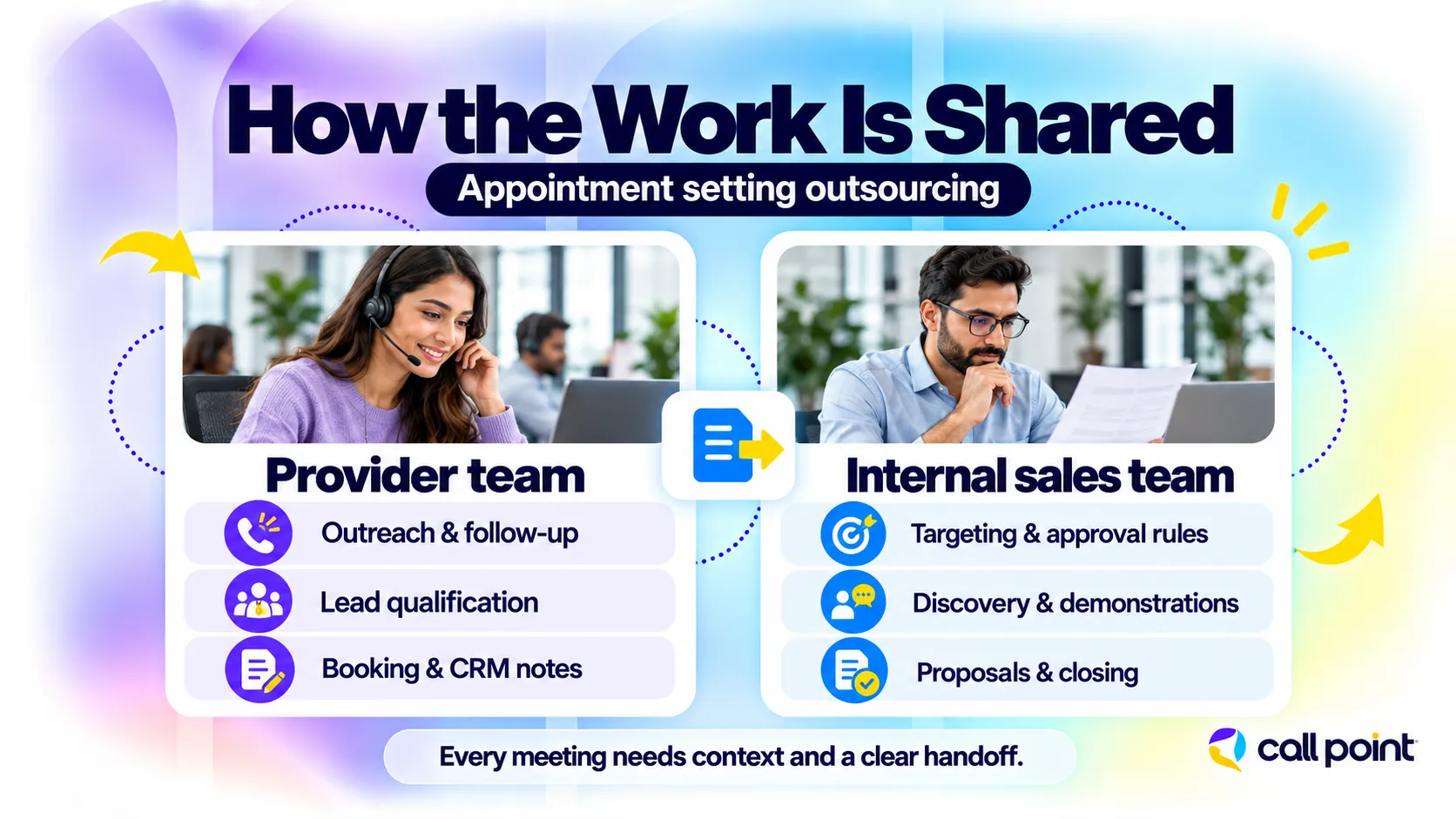
A typical arrangement divides responsibilities between the provider and the client’s sales team.
| Outsourced Appointment-Setting Team | Internal Sales Team |
| Contacts prospects within approved target markets | Defines the ideal customer profile |
| Conducts initial conversations and follow-ups | Supplies product knowledge and approves messaging |
| Qualifies prospects against agreed requirements | Sets appointment acceptance criteria |
| Schedules meetings and records relevant CRM notes | Conducts discovery calls and demonstrations |
| Reports outreach activity and meeting outcomes | Manages proposals, negotiations, and sales decisions |
These responsibilities can vary. Some providers handle prospect research and data preparation, while others work from lists supplied by the client. The important part is the handoff. Before each meeting, your salesperson should know who the prospect is, why they agreed to talk, and what was discussed during outreach.
For a more detailed explanation of the underlying process, see our guide on what appointment setting is and how it works.
When Should You Outsource Appointment Setting?
Outsourcing is worth considering when your sales team has capacity for additional meetings but cannot maintain consistent prospecting.
Common situations include:
- Irregular prospecting: Sales representatives concentrate on active opportunities and have limited time for new outreach.
- Delayed follow-up: Interested prospects wait for callbacks because no one manages the follow-up schedule.
- Limited SDR capacity: The business needs additional prospecting support without recruiting a complete internal sales development team.
- New market expansion: Sales teams need outreach coverage in different industries, regions, or time zones.
- Growing agency campaigns: Agencies need additional appointment-setting capacity for client accounts.
Outsourcing can make these activities more consistent by assigning them to a team with a defined workload and schedule. However, additional calling capacity will not fix an unclear offer or poor targeting. If prospects regularly reject your product, or salespeople cannot attend the meetings already booked, address those problems first. In-house appointment setting may be more suitable when early conversations require extensive technical knowledge, sensitive account relationships, or frequent involvement from senior sales specialists.
In-House vs. Outsourced Appointment Setting: Which Is Better?
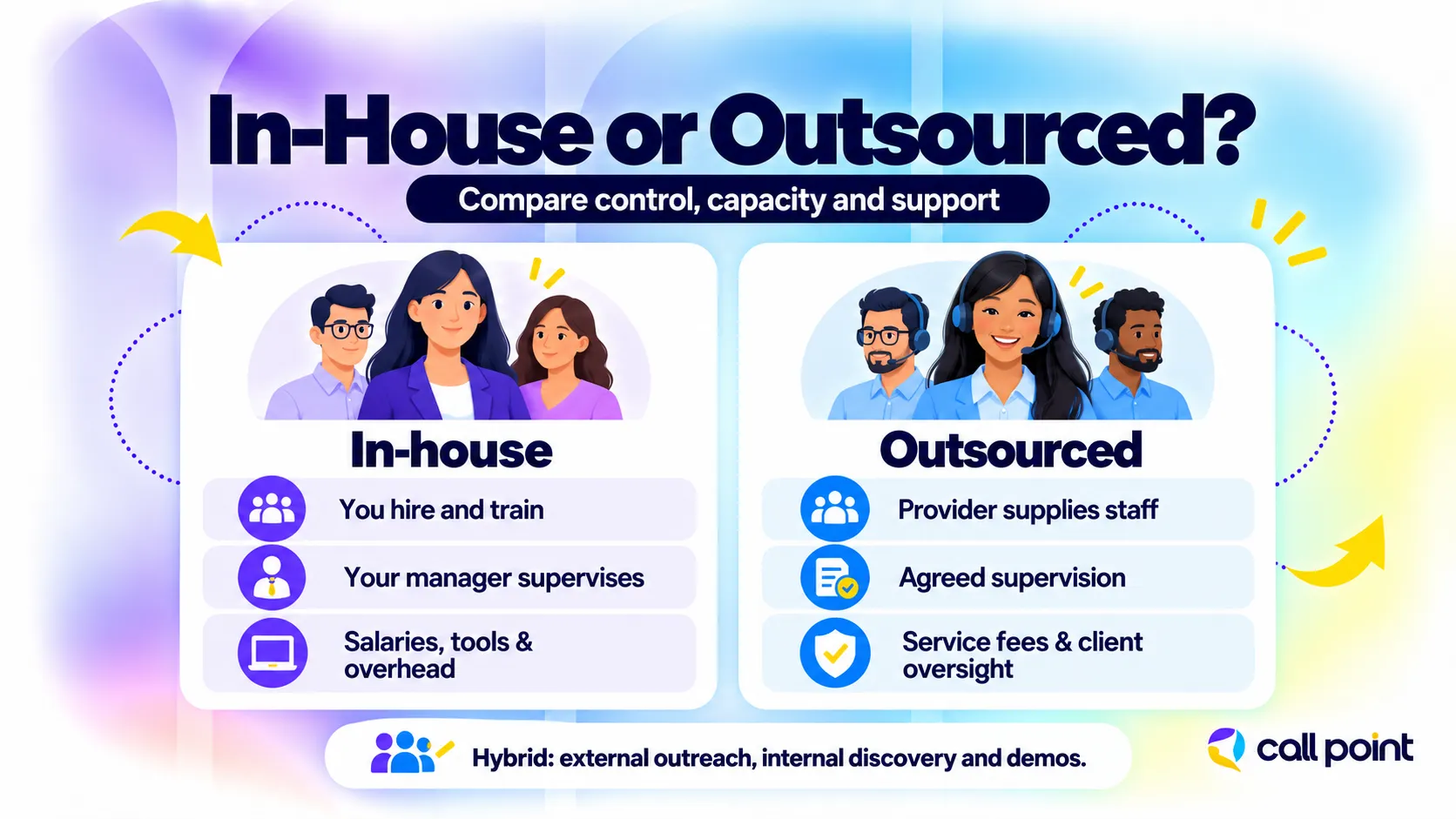
In-house appointment setting provides direct control over employees, training, and daily priorities. Outsourcing shifts some staffing and operational responsibilities to a provider but still requires client involvement.
| Factor | In-House Team | Outsourced Team |
| Recruitment | Your business hires employees | Provider typically supplies personnel |
| Training | Managed internally | Shared according to the service agreement |
| Daily supervision | Internal sales manager | Provider or shared management |
| Costs | Salaries, benefits, tools, and overhead | Contract fees plus any additional client expenses |
| Campaign changes | Managed directly | Coordinated with the provider |
| Quality control | Internal reviews | Provider monitoring and client feedback |
Outsourcing services also differ in how they are delivered. A dedicated outsourced appointment setter works on your assigned campaigns. A managed appointment-setting service may include campaign supervision, reporting, quality reviews, and other agreed responsibilities. Dedicated staff can also operate within a managed arrangement.
A hybrid structure is another option. For example, an external team can contact prospects and arrange introductory meetings while internal account executives handle technical questions and demonstrations. Choose based on the work involved. If your sales process changes daily or depends heavily on specialized knowledge, keeping more responsibility in-house may simplify coordination.
Our in-house vs. outsourcing comparison explains the broader staffing and management trade-offs.
How to Outsource Appointment Setting in 6 Steps
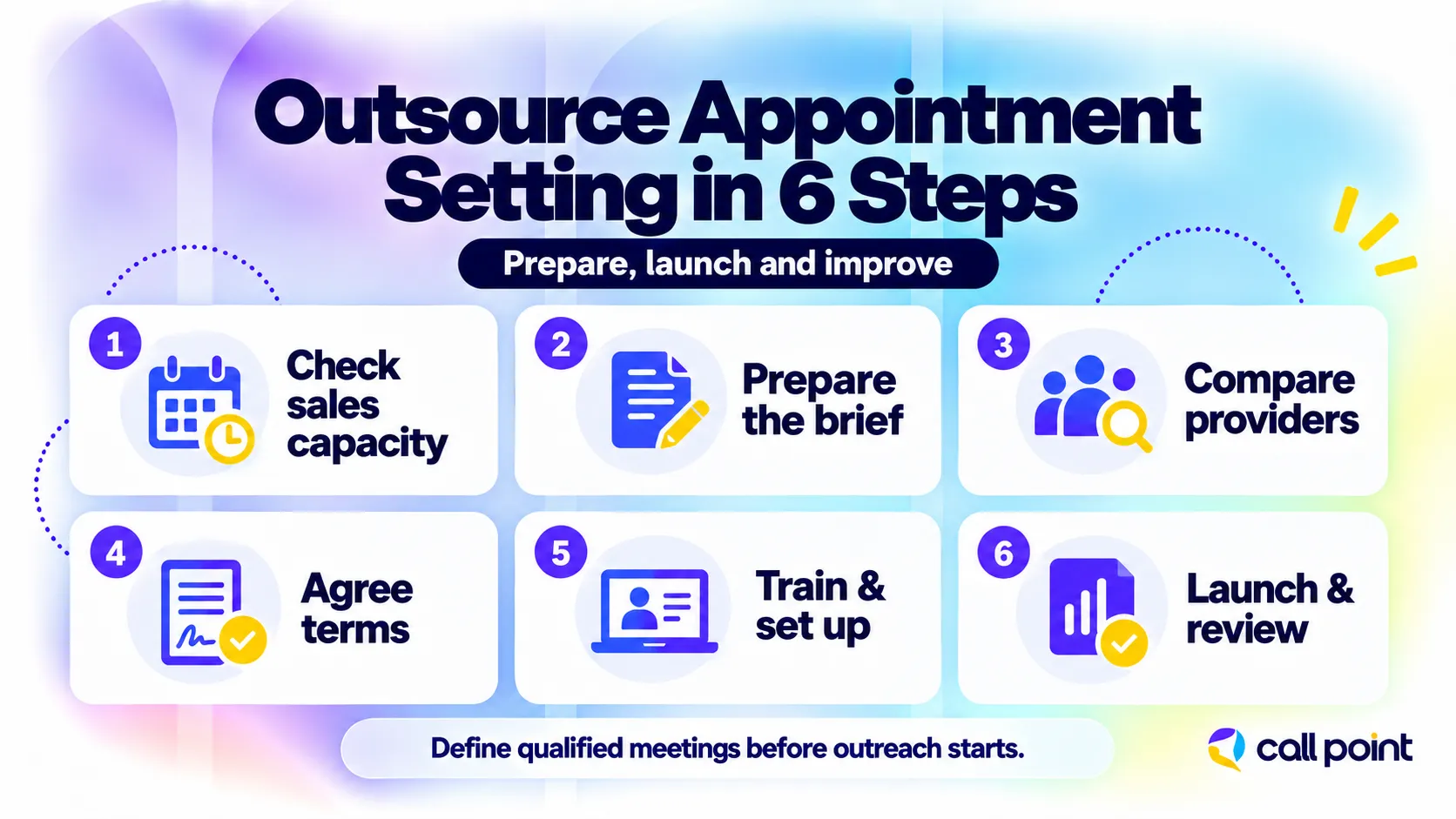
Outsourcing requires more preparation than selecting a provider and supplying a contact list. Both teams need to agree on campaign goals, responsibilities, booking requirements, and reporting before outreach begins.
1. Review Your Sales Capacity and Goals
Start with your current sales workload. Check how many prospecting activities your team completes, where follow-ups are delayed, and how many additional meetings sales representatives can realistically handle. Define the type of meeting you want to generate, such as a discovery call, product demonstration, or consultation. This gives providers a clear objective when preparing proposals.
2. Prepare Your Campaign Brief
A campaign brief helps prospective providers understand the work before pricing it.
Include:
- Target industries, company sizes, and geographic markets
- Buyer roles and excluded prospect categories
- Product or service information
- Required outreach channels and working hours
- Appointment qualification requirements
- Expected CRM updates and reporting needs
For example, a commercial cleaning company might target facilities managers at offices and warehouses within its service area. The provider needs those boundaries before researching contacts or making calls.
3. Compare Providers and Delivery Models
Shortlist providers with relevant experience and a clear appointment-setting process. Ask whether they provide dedicated representatives, managed campaigns, or both. Review how they train staff, monitor outreach, handle prospect data, and communicate with clients.
Request an example of the reports or appointment handoff records they provide. A provider that explains its process clearly is easier to evaluate than one that offers an appointment target without describing how meetings will be qualified.
4. Agree on Deliverables and Contract Terms
Before signing, define the responsibilities each party will handle. Confirm who supplies prospect data, approves scripts, updates the CRM, confirms bookings, and manages rescheduling. The agreement should also specify what counts as an accepted appointment, how rejected meetings are reviewed, and which activities are included in the fee. These details are especially important when payment depends on the number of appointments delivered.
5. Complete Training and System Setup
Your provider needs enough business knowledge to represent your offer accurately. Provide approved messaging, product details, common buyer questions, qualification rules, and instructions for handling objections.
Set up the necessary CRM and calendar access using appropriate permissions. Agree on who can edit records, view prospect information, and approve changes. Before launching, review a sample appointment record. It should contain the contact details, qualification notes, meeting purpose, and relevant discussion history.
6. Launch With Regular Performance Reviews
Begin with an agreed campaign scope and reporting schedule. During the initial delivery period, compare booked meetings with attendance and sales feedback. Check whether prospects match the target profile and understand why they are meeting your sales team.
If unsuitable contacts appear repeatedly, review the targeting rules. If prospects attend but show little interest, examine the qualification questions and outreach messaging. Make adjustments using actual campaign findings rather than increasing activity without identifying the problem.
What Counts as a Qualified B2B Appointment?
A qualified B2B appointment is a scheduled sales conversation with a prospect who meets the agreed customer criteria and has a relevant reason to discuss the offer. A calendar booking alone does not establish qualification.
Before launching an outsourced campaign, agree on a checklist such as:
- Company fit: The business matches the approved industry, market, size, or other customer criteria.
- Relevant contact: The prospect has a suitable job role or influence in the buying process.
- Business relevance: There is an identified reason for exploring the product or service.
- Meeting agreement: The prospect has agreed to a specific conversation and understands its purpose.
- Complete handoff: The appointment includes accurate contact details and relevant discussion notes.
Not every campaign needs the same requirements. A first meeting with a department manager may be valuable even if the manager cannot approve the final purchase.
For example, a meeting with a warehouse supervisor could be relevant to a commercial cleaning provider if the supervisor helps evaluate vendors. A meeting with an unrelated employee who cannot explain the need would be less useful.
How Should No-Shows and Rejected Appointments Be Handled?
Agree on cancellation, rescheduling, and rejection rules before the campaign begins. Clarify whether a booking remains billable when the prospect does not attend. Also, document what happens when an appointment falls outside the agreed qualification criteria. Your sales team should record why it rejects a meeting. A simple reason, such as an incorrect job role or unsuitable company size, helps the provider improve future qualifications. This process also makes pricing and performance reports easier to evaluate.
How Much Does Appointment Setting Outsourcing Cost?
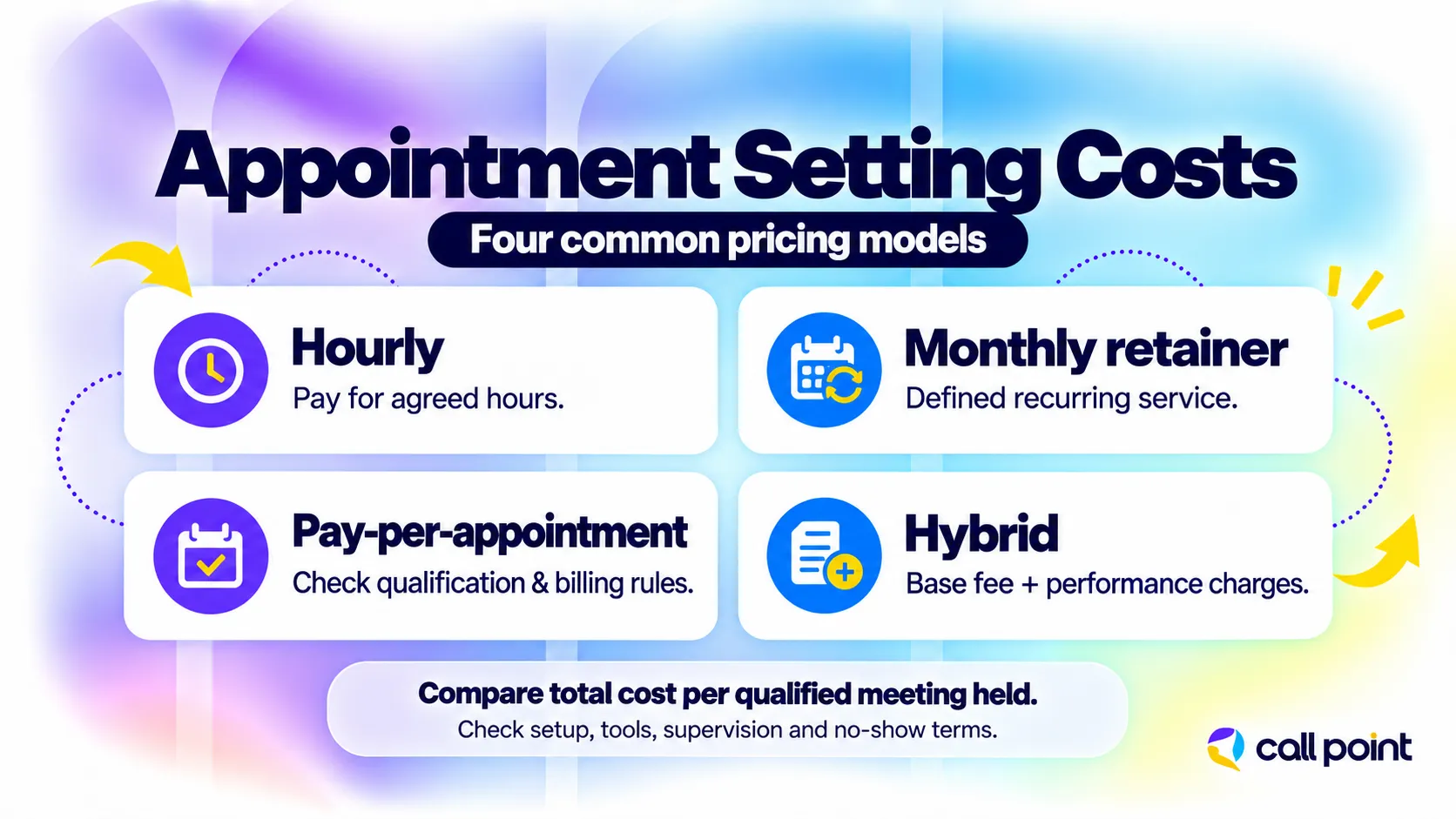
Appointment setting outsourcing costs vary according to the staffing model, campaign complexity, target audience, service hours, and activities included in the contract. Providers commonly use hourly fees, monthly retainers, performance-based charges, or a combination.
| Pricing Model | How It Works | What to Check |
| Hourly | Charges for agreed working hours | Supervision, productive hours, tools, and minimum commitments |
| Monthly retainer | Fixed recurring fee for defined services | Campaign scope, staffing, reporting, and additional charges |
| Pay-per-appointment | Charges for appointments meeting agreed billing rules | Qualification, attendance, rejection, and replacement policies |
| Hybrid | Combines a base fee with performance-related charges | Billing conditions and total potential expenditure |
The cheapest booking price is not necessarily the most economical arrangement. A provider offering a lower per-appointment fee might charge for meetings that never take place. Another provider may have a higher recurring fee but include research, management, and detailed reporting.
When reviewing proposals, confirm whether the price includes:
- Prospect-list sourcing and verification
- Calling software and CRM tools
- Agent training and campaign setup
- Supervision and quality monitoring
- Reporting and client meetings
- Additional outreach channels or working hours
Also check minimum contract periods, cancellation rules, and fees for changing the campaign scope. A useful comparison is the total cost per qualified meeting held. Divide the agreed campaign expenditure by the number of meetings that took place and met your qualification standard. For a fair comparison, use the same cost inclusions and meeting definitions across providers.
How Do You Choose an Appointment Setting Outsourcing Company?
Choose a provider that can explain how it identifies suitable prospects, manages outreach, qualifies meetings, and reports results. Industry experience is useful, but a clear delivery process matters just as much.
Before hiring an appointment-setting company, ask these questions:
- How do you find and verify prospects? Understand whether the provider uses your data, its own sources, or a combination.
- Who trains and supervises the appointment setters? Confirm how product knowledge, call quality, and agent performance are reviewed.
- Can we approve scripts and qualification criteria? Your team should know how the offer will be represented.
- What reporting will we receive? Ask for an example covering contact outcomes, booked appointments, attendance, and rejected meetings.
- How are CRM records and data access managed? Clarify ownership, permissions, confidentiality, and data handling after the contract ends.
- What happens when campaign performance falls below expectations? Discuss review procedures, coaching, and corrective actions.
- What do the contract terms include? Check setup charges, minimum commitments, cancellation terms, and any conditions affecting appointment billing.
Ask the provider to walk through a sample appointment handoff. It should be clear why the prospect agreed to meet and what your salesperson needs to know. Be cautious of providers promising guaranteed sales or large numbers of qualified appointments without explaining how those outcomes are defined. For international campaigns, also confirm how the provider handles applicable calling, email marketing, privacy, and contact-preference requirements in the markets being targeted.
Check Outreach Compliance and Data Responsibilities
International appointment-setting campaigns need procedures that reflect the applicable rules in each target market. For example, the UK’s Information Commissioner’s Office explains requirements for B2B marketing calls, including relevant preference-service checks and objections. Canada’s CRTC also distinguishes B2B calls from consumer do-not-call rules while retaining other telemarketing obligations.
Before launching, confirm who is responsible for contact-data sourcing, suppression lists, opt-outs, lawful outreach practices, and record handling. Requirements vary by jurisdiction and communication channel.
How Call Point Supports Outsourced Appointment Setting
Call Point Business Solutions provides B2B appointment setting through its telemarketing and outsourced sales support services. Based on the agreed scope, our team handles activities such as outbound calling, lead qualification, prospect follow-up, meeting scheduling, CRM updates, and campaign reporting.
One example from our outbound sales work involved a janitorial lead provider serving cleaning companies in the United States. The client needed targeted outreach to businesses in specific regions. Our dedicated team supported the calling and appointment-setting work, while the client received booking updates and reviewed appointment activity. The published account describes the outreach and handoff process rather than claiming a particular revenue increase.
Our operational quality process includes call monitoring, task reviews, KPI tracking, supervisor checks, client feedback, and coaching. We align campaign delivery with the client’s approved target market, service requirements, and sales workflow.
Frequently Asked Questions
Can You Outsource Only Lead Follow-Up?
Yes. Some outsourcing arrangements focus on existing leads rather than new cold outreach. The team can follow up with previous inquiries or prospects who requested another conversation, provided the scope and contact permissions are appropriate.
Who Owns Prospect Data After the Outsourcing Contract Ends?
Ownership and access rights should be defined in the agreement. Clarify who controls CRM records, what restrictions apply to third-party prospect data, and how information will be exported, retained, or deleted after the contract.
How Long Does It Take to Start an Outsourced Appointment-Setting Campaign?
The timeline depends on campaign requirements, staff preparation, prospect data, training, system access, and client approvals. Ask the provider for an implementation schedule with clear milestones before agreeing to a start date.
Can Outsourced Appointment Setters Work in Different Time Zones?
Yes, when the contracted team supports the required schedule. Confirm target-market calling hours, local holidays, calendar availability, and reporting times so outreach and appointments align with your sales team.
How Do You Measure Outsourced Appointment Setting Performance?
Measure outsourced appointment setting performance by tracking qualified appointments booked, meetings held, attendance rate, and sales-accepted meetings. Also monitor cost per qualified meeting held and how many meetings turn into sales opportunities. Review CRM reports and sales team feedback regularly to identify poor-quality leads, missed meetings, and opportunities to improve targeting and follow-up.
Final Thoughts
Appointment setting outsourcing is most useful when your business has a defined target audience, a sales team ready to handle more meetings, and clear standards for appointment quality. Before choosing a provider, compare the complete service scope, pricing terms, reporting methods, and responsibilities on both sides.
If you’re considering external support, discuss your appointment-setting requirements with Call Point Business Solutions. Share your target market, expected meeting type, and outreach needs so we can discuss a suitable service arrangement.