
Customer emails keep arriving after your team clocks out. Phone calls interrupt employees who are already handling other work. Meanwhile, hiring more people adds another round of recruiting, training, and supervision.
Customer service outsourcing gives an external team responsibility for an agreed share of those requests. You can add coverage for a specific channel, a busy period, or a broader support operation.
The decision also affects how customers experience your business. In PwC’s 2025 Customer Experience Survey, 29% of surveyed US consumers said poor customer experience had caused them to stop using or buying from a brand.
Choosing the right arrangement means looking at the work, the complete cost, and the way service quality will be managed.
What Is Customer Service Outsourcing?
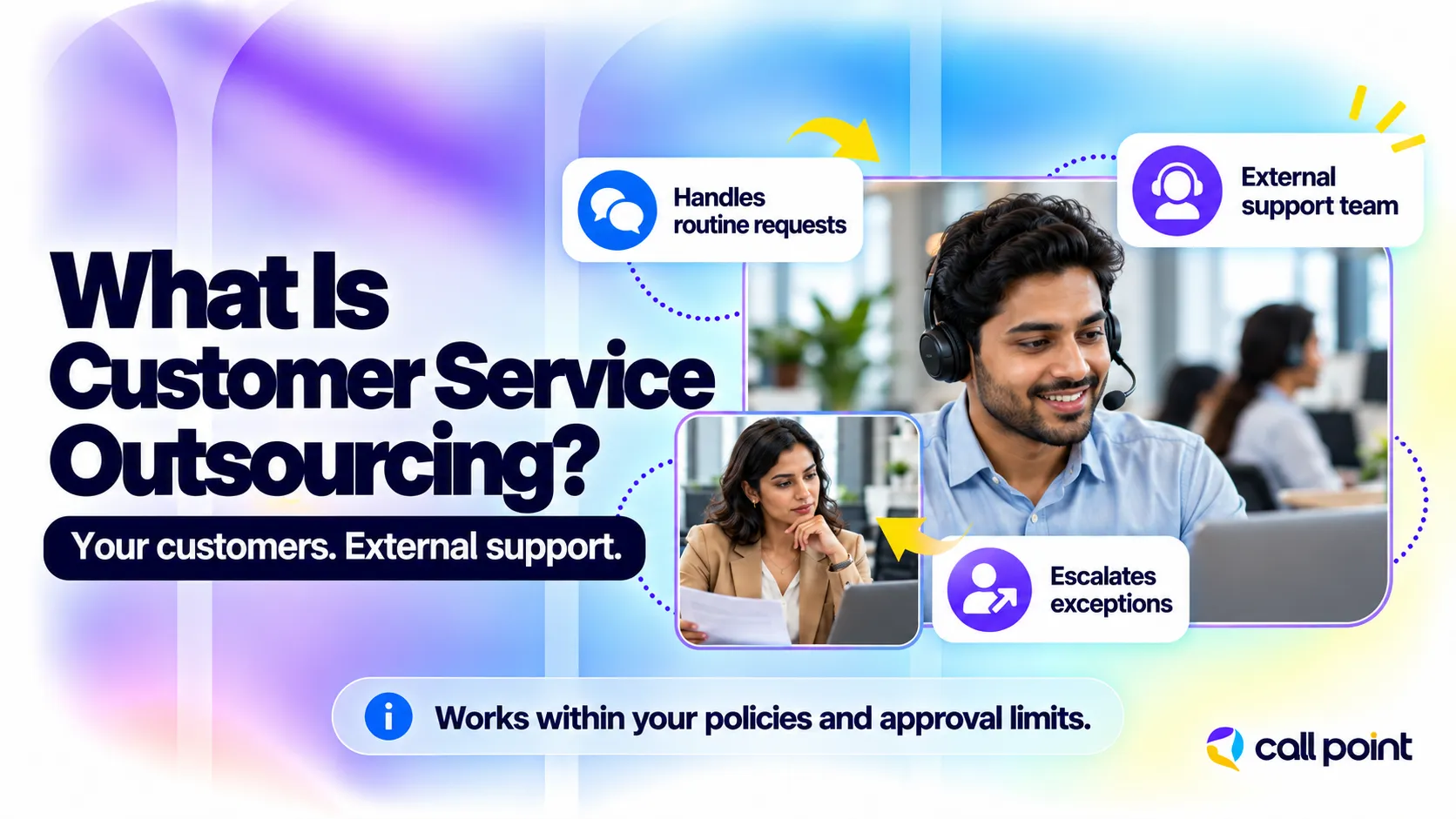
Customer service outsourcing means hiring an external provider to handle some or all customer interactions on your company’s behalf. It can include phone calls, email, live chat, social messages, order inquiries, and technical assistance. The team uses your product information and follows the procedures agreed upon for the service.
The provider is often a business process outsourcing company, or BPO. Its responsibilities may include recruiting agents, scheduling shifts, supervising daily work, and reviewing quality.
Your business retains the decisions assigned to it. For example, an agent may process a standard return while your manager approves an exception. Our guide to what customer support includes explains the wider support function.
How Does Customer Service Outsourcing Work?
An outsourced team receives customer requests, checks the relevant information, and resolves issues within its authority. Cases requiring specialist knowledge or approval move to a designated internal contact. Agents record the action and next step so another person can continue the conversation.
The daily workflow follows four stages:
- Receive the request: Calls and messages enter the appropriate queue based on the channel, schedule, or issue type.
- Review the context: The agent checks the account, order details, and previous conversations before responding.
- Resolve or escalate: The agent follows the approved procedure or sends the case to the person authorized to decide.
- Document and review: The ticket records what happened. Supervisors review interactions and address recurring mistakes.
For example, a software support agent might guide a customer through documented setup instructions. If those steps reveal a product bug, the agent records what was attempted and sends the case to the technical team.
Where AI Assistance Fits
AI tools can help route tickets, find knowledge-base articles, summarize conversations, or draft replies. Decide which tools may access customer information and which actions require human review.
A tool might suggest a refund policy, while an authorized agent checks the customer’s eligibility. Customers also need a clear route to a person when automation cannot resolve the request.
What Customer Service Tasks Can You Outsource?
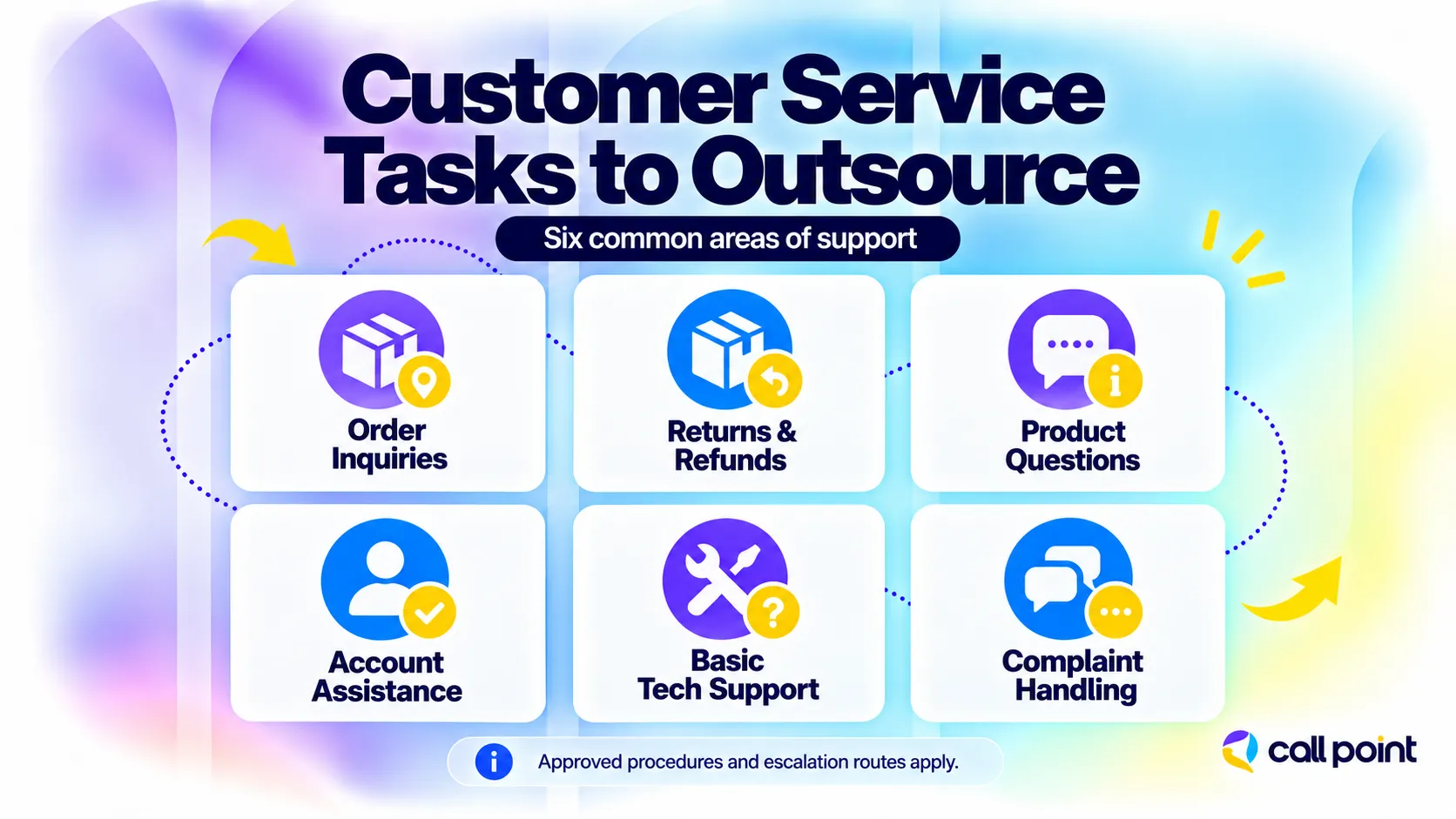
Businesses commonly outsource requests with clear procedures, suitable system access, and an escalation route. These include:
- Order inquiries: Check shipping status and explain delivery updates.
- Returns and refunds: Confirm eligibility and process authorized requests.
- Product questions: Answer from current specifications, FAQs, and policies.
- Account assistance: Follow identity checks and documented account procedures.
- Basic technical support: Complete known troubleshooting steps and record unresolved faults.
- Complaint handling: Document the problem, communicate next steps, and track progress.
These requests can arrive through phone, email, chat, messaging, or social media. When a customer changes channels, agents should be able to see the relevant conversation history.
Specialized work can also be outsourced when the provider has the required expertise. Confirm the skills and permissions needed for that work before including it in the agreement.
Customer Service Outsourcing Models
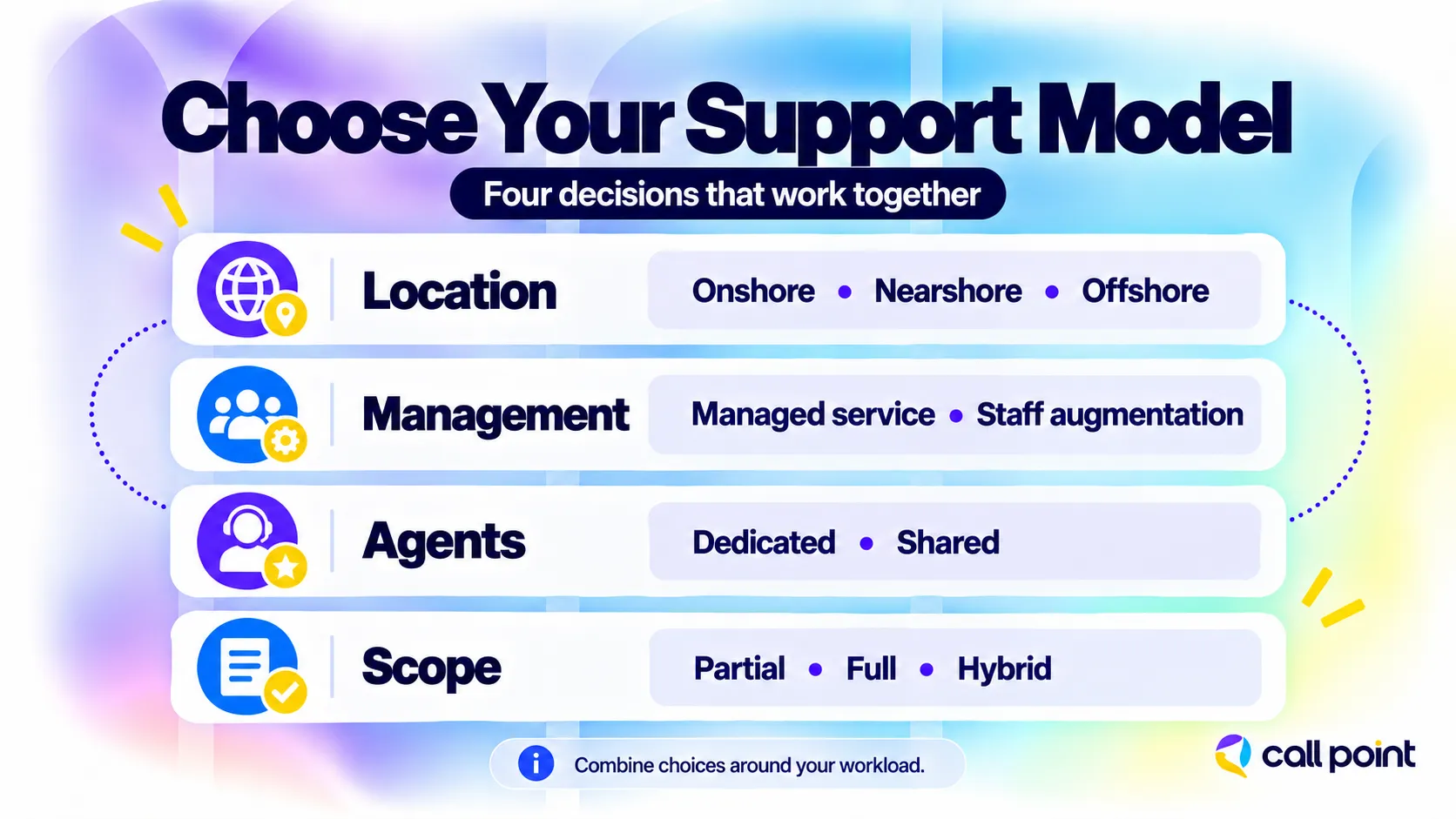
Outsourcing models describe where agents work, who manages them, whether they serve other clients, and how much work you transfer. These are separate decisions that can be combined around your support needs.
Onshore, Nearshore, and Offshore Delivery
- Onshore: The provider’s team works in your country.
- Nearshore: The team works in a nearby country or region.
- Offshore: The team works in a more distant country.
For a US business, a team operating from Bangladesh is offshore. Compare the proposed shift overlap, communication skills, relevant experience, data requirements, and price. Location alone does not establish service quality.
Our outsourcing vs. offshoring guide explains the difference between hiring an external provider and moving work overseas.
Managed Service or Staff Augmentation
In a managed service, the provider handles agreed operations such as scheduling, supervision, and quality reviews. Your business sets the requirements and supplies current product and policy information.
With staff augmentation, external agents join a process your managers continue to direct. Confirm who will manage daily work; hiring a dedicated agent does not automatically include a management service.
Dedicated or Shared Agents
Dedicated agents focus on your account. Shared agents serve several clients and may suit a smaller workload with straightforward instructions.
Separately, decide the service scope. Partial outsourcing might cover after-hours email or seasonal overflow. Full outsourcing transfers the agreed support function, while a hybrid model divides work between external agents and your internal team.
Advantages of Outsourcing Customer Service
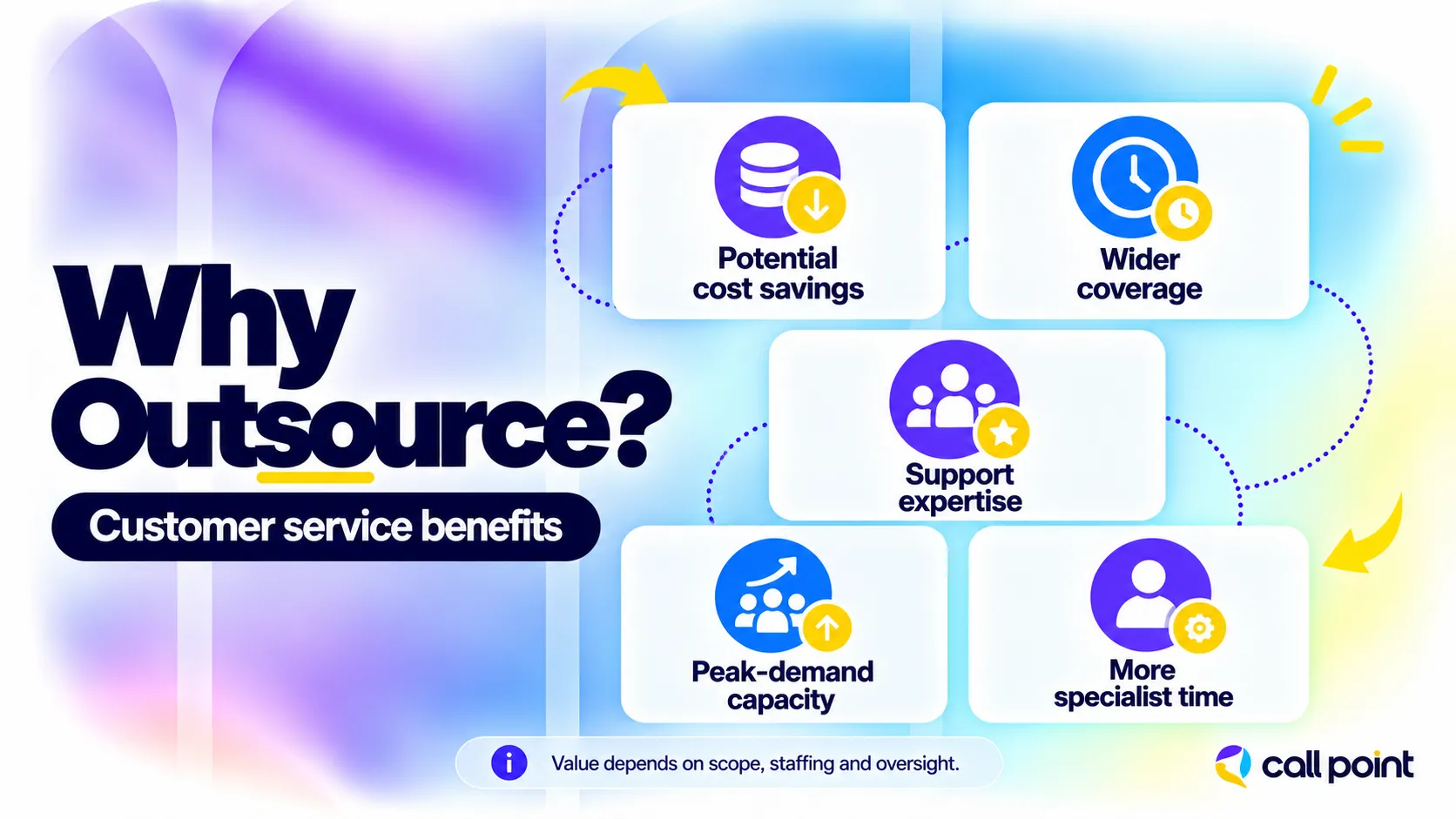
The advantages of outsourcing customer service include lower internal staffing overhead, wider coverage, and access to support resources. The value depends on the operating problem you need to solve.
Lower Recruiting and Operating Costs
A provider can take responsibility for recruitment, workspace, scheduling, and supervision. Offshore delivery may also reduce labor-related costs compared with building an equivalent local operation. Include the management work that remains with your team when comparing the total expense.
Access Support Skills and Quality Resources
Outsourcing can provide agents, supervisors, and quality-review resources without creating every role internally. Look for relevant experience and evidence that agents can handle representative customer requests.
Extend 24/7 Coverage
An external team can cover evenings, weekends, or other shifts your employees cannot staff. Coverage can extend to 24/7 service when the agreement and staffing plan support it. Plan each channel separately: overnight email needs a different setup from an urgent technical phone queue.
Add Capacity for Busy Periods
A provider can help prepare for promotions, product launches, or growing request volumes. Agree on notice periods and training before demand increases. Contract minimums also matter when the extra workload is temporary.
Give Internal Specialists More Time
Moving routine questions to a frontline team lets specialists spend more time on difficult cases. A technical employee can investigate an integration failure while another agent handles standard setup questions and account inquiries.
How Much Does Outsourcing Customer Service Cost?
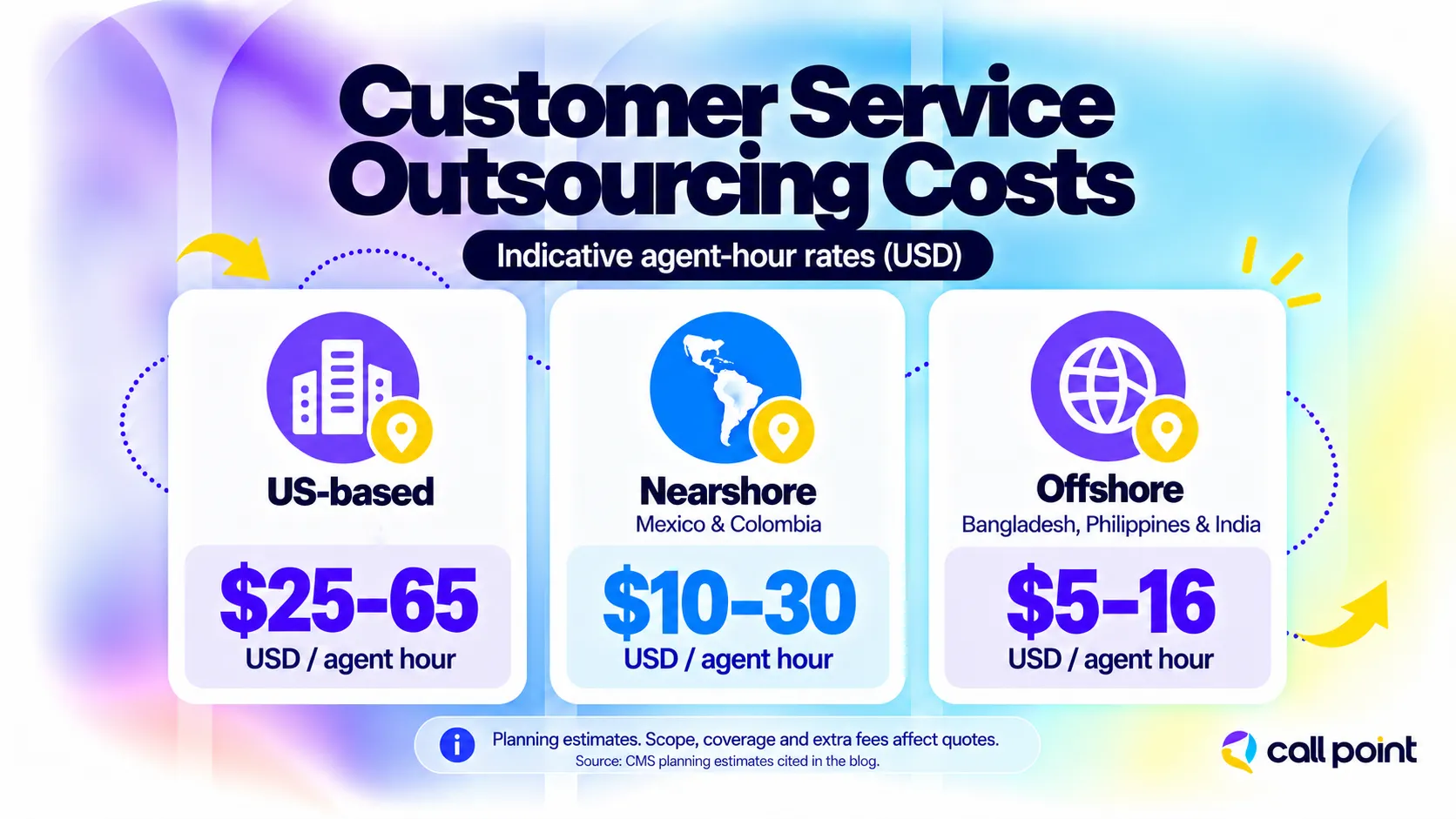
Customer service outsourcing costs depend on location, skills, channels, coverage, and the work included. Basic answering services may charge a base fee plus usage. Staffed support teams may charge hourly, per ticket, per interaction, or through a monthly team retainer.
| Service or delivery model | Published price reference | Context |
| Basic answering service | $44 per month plus $1.54 per minute | Specialty Answering Service’s Economy plan |
| US-based contact center support | 25-65 per agent hour | CMS onshore planning estimate |
| Nearshore contact center support | 10-30 per agent hour | CMS planning estimate for locations such as Mexico and Colombia |
| Offshore contact center support | 5-16 per agent hour | CMS planning estimate for locations such as Bangladesh, Philippines and India |
Before comparing quotes, confirm:
- Included work: Message-taking differs from resolving product, billing, or technical issues.
- Additional charges: Check training, software, supervision, extra coverage, and overages.
- Contract terms: Review minimum fees, commitments, and staffing-change notice.
Compare equivalent workloads, hours, and quality requirements. Call Point provides a custom quotation based on the required service.
Customer Service Metrics and Customer Support KPIs
Customer service metrics describe performance. Customer support KPIs are the measures selected to track your business goals, such as reducing response delays or improving resolution. Review speed, accuracy, customer feedback, and cost together.
| Metric | What it measures | What to investigate |
| First response time | Time to the first agent reply that counts under your reporting rules | Coverage gaps, routing, and arrival patterns |
| First contact resolution, or FCR | Share of included cases resolved in one contact | Product knowledge, decision authority, and repeat requests |
| Full resolution time | Time from ticket creation to final resolution | Approval delays, handoffs, and reopened cases |
| Customer satisfaction score, or CSAT | Positive survey responses ÷ valid responses × 100 | Feedback themes, sample size, and response rate |
| Quality assurance, or QA, score | Performance against the agreed review criteria | Accuracy, policy adherence, documentation, and communication |
| SLA attainment | Share of measured service commitments met | Misses by channel and priority |
| Backlog age | How long unresolved requests remain open | Overdue work and cases waiting on another team |
| Cost per resolved issue | Comparable operating cost ÷ unique issues resolved | Cost trends alongside quality and repeat contacts |
Define What Each Number Includes
Agree on business versus calendar hours, replies that count, duplicate tickets, and reopened cases. Zendesk’s first reply time documentation, for example, explains how business-hour and calendar-hour reporting differ.
FCR also needs a repeat-contact window. If 80 of 100 included cases are resolved in one contact without returning within that window, FCR is 80%. Keep unresolved cases visible in resolution reports so difficult work remains part of the review.
Put Service Commitments in Writing
A service-level agreement, or SLA, records the commitments the provider must meet. It should identify:
- Covered channels and operating hours.
- Priority definitions and response commitments.
- Business-hour or calendar-hour timing.
- Escalation owners and customer-update expectations.
- Review and corrective action after a missed commitment.
Set targets from customer needs and the operation’s starting performance. A quicker first reply accompanied by more repeat contacts may point to incomplete answers. Longer resolution times with accurate responses may instead reveal an approval bottleneck.
Risks and Quality Controls
Outsourcing can create inconsistent answers, weak handoffs, or unnecessary access to customer information. Product guidance, practical training, controlled access, and regular review help manage those risks.
Keep Product Knowledge and Brand Guidance Current
Assign an internal owner for product and policy updates. Give agents examples of accurate replies, including cases that require an exception. Training should show whether an agent can apply the guidance to a customer’s situation.
Brand guidance should explain how to communicate, too. For example, agents need to know how to explain a delay, acknowledge a complaint, and give a realistic next step.
Check Accuracy Alongside Speed
A useful QA review asks:
- Did the agent understand the problem?
- Was the answer accurate and the action authorized?
- Were the record and next step clear?
- Was escalation handled correctly?
A friendly, fast reply promising an unauthorized refund is still an error. Use the finding to coach the agent and correct any unclear instructions.
Control Access and Case Ownership
Use approved accounts, role-based permissions, and secure credential handling. Confirm how access ends when an agent leaves. Review any subcontractors or AI tools that will handle customer information.
Every escalated case should have an owner and an expected follow-up. Otherwise, transferring the ticket can leave the customer waiting while both teams assume someone else is responsible.
When Should You Outsource Customer Service?
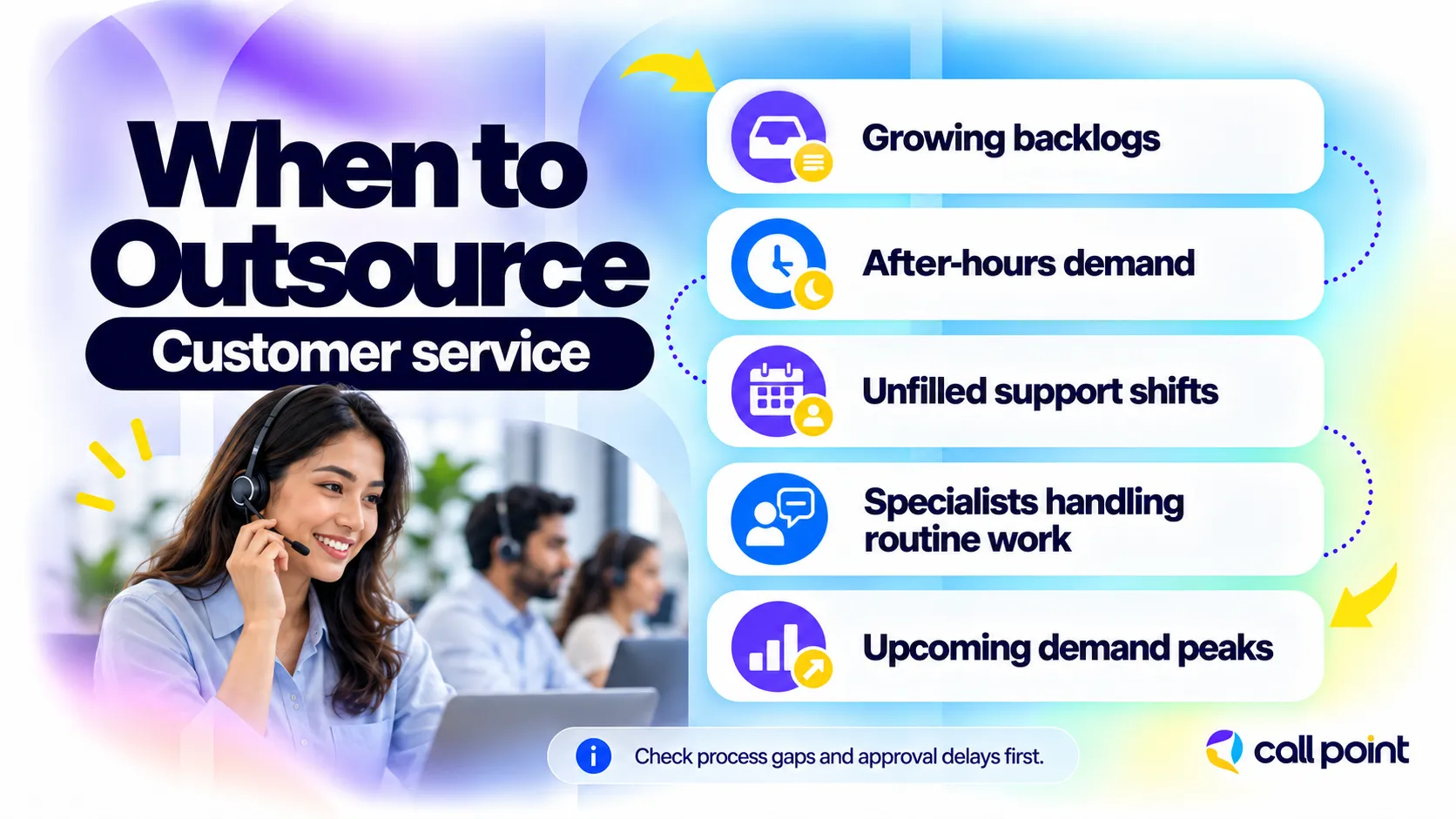
Consider outsourcing when a documented support process needs more capacity, different service hours, or skills your team cannot provide efficiently.
Common signs include:
- Backlogs grow because requests exceed available agent time.
- Customers need help outside your current schedule.
- Hiring delays leave recurring shifts uncovered.
- Specialists spend substantial time answering routine questions.
- Promotions or expansion will increase demand.
Check what is causing the delay first. Missing product information or slow approvals will also hold up an external team. Fix those gaps before adding people.
A hybrid arrangement can suit businesses that need frontline coverage while keeping complex cases with internal specialists. Our in-house vs. outsourcing guide explains the broader staffing tradeoffs.
Choosing a Customer Service Outsourcing Company
Ask shortlisted providers to explain who manages the agents, how exceptions are handled, and what the fee includes. Request evidence relevant to your workload.
- Define the service: Confirm channels, schedules, skills, expected volume, and exclusions.
- Identify the managers: Establish who owns scheduling, coaching, product updates, and reporting.
- Review representative work: Request anonymized examples, sample reports, and relevant references where available.
- Discuss difficult cases: Test how the provider handles incomplete information and decisions outside a standard policy.
- Check continuity: Ask about absence coverage, replacement training, and system outages.
- Read the agreement: Review the complete price, change terms, record ownership, and exit arrangements.
For a small workload, compare the minimum fee with the capacity you need. For a dedicated team, find out how the provider maintains coverage when an agent is absent or leaves.
Frequently Asked Questions
Can Small Businesses Outsource Customer Service?
Yes. Small businesses can outsource selected requests, channels, or hours. Compare the provider’s minimum fees and contract terms with your workload, and check how much supervision stays with your team. A limited, well-documented scope can be easier to evaluate than transferring every customer request at once.
Can Outsourced Agents Use Our Existing CRM or Help Desk?
Yes, when platform compatibility, licenses, permissions, and the service agreement allow it. Agents need the customer information required for their tasks and a way to record actions. Confirm who approves access, how credentials are handled, and how permissions are removed when someone leaves the account.
How Long Does Setup Take?
Setup timing depends on scope, staffing, training materials, system access, and client approval. Ask the provider to explain each stage and test representative customer requests before the team takes over the queue. Technical access alone does not show that agents are ready to handle the work.
What Happens to Customer Records if We Change Providers?
Agree on record ownership, export access, open-case handover, and retention before signing. The transition should preserve the information needed to continue customer conversations and remove access that is no longer required. Confirm how provider-held copies will be handled, including records in subcontractor systems or approved automation tools.
How Call Point Supports Customer Service Outsourcing
Call Point Business Solutions provides customer support through offshore teams in Bangladesh. We manage phone, email, live chat, and tickets using client workflows, with agent monitoring, reporting, and coaching.
For example, an online store preparing for a promotion could assign its email and chat queue to Call Point. Agents could answer delivery questions and handle approved returns, while the store manager reviews exceptions. The owner could then spend more time managing stock and shipments.
Choose a customer service outsourcing partner that fits your workload, coverage hours, and quality expectations. Compare the complete cost, then track whether customers receive accurate answers and complete resolutions.
To explore support options for your business, contact Call Point for a custom quote.