

The main types of call centers by call direction are inbound, outbound, and blended. Other categories describe who manages the team, where agents work, which technology they use, and how they communicate with customers. These models can overlap within one operation.
That distinction matters when you compare services. An inbound call center could also be outsourced, offshore, and cloud-based. Each label answers a different question about how the work gets done.
For your business, the starting point is the work you need help with. Are customers waiting for answers? Are prospects missing follow-up calls? Do you need both? Once you define the problem, you can choose the right combination of people, coverage, and systems.
Types of Call Centers at a Glance
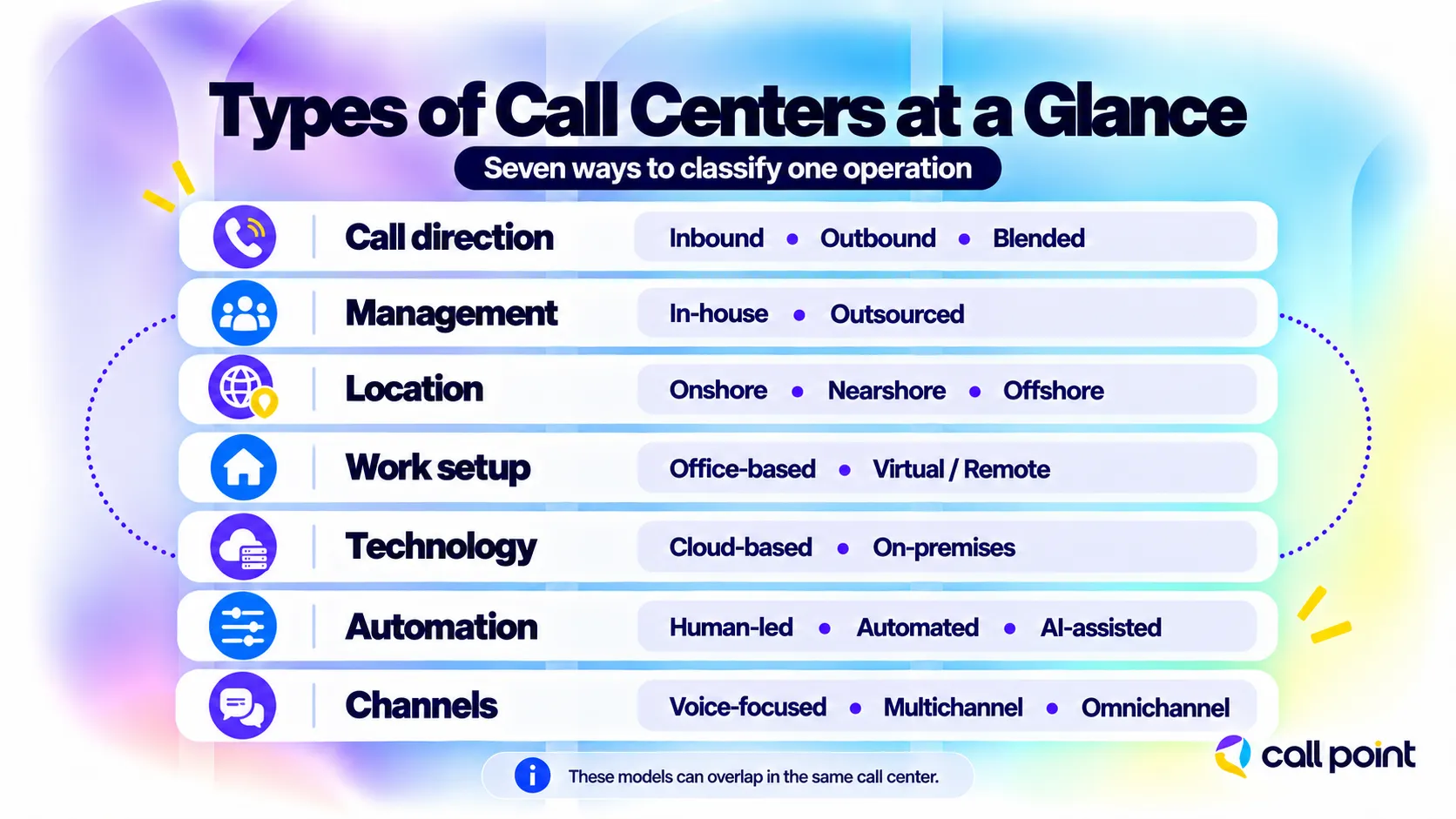
A call center is a business operation that handles incoming calls, outgoing calls or both. The table below separates common call center models by the decisions they describe.
| Classification | Common models | What it tells you |
| Call direction | Inbound, outbound, blended | Who starts the conversation. |
| Management | In-house, outsourced | Who employs and manages the team. |
| Delivery location | Onshore, nearshore, offshore | Where the work happens relative to your business. |
| Work arrangement | Office-based, virtual or remote | Whether agents work together or across locations. |
| Technology | Cloud-based, on-premises | How calling infrastructure is hosted and maintained. |
| Automation | Automated, AI-assisted, human-led workflows | Which tasks systems handle and when people step in. |
| Communication channels | Voice-focused, multichannel, omnichannel | Which channels customers use and how information moves between them. |
For example, a US retailer could hire a Bangladesh-based provider to answer customer calls from an office using cloud software. That operation would be inbound, outsourced, offshore, office-based, and cloud-based.
What Are the Main Types of Call Centers by Call Direction?
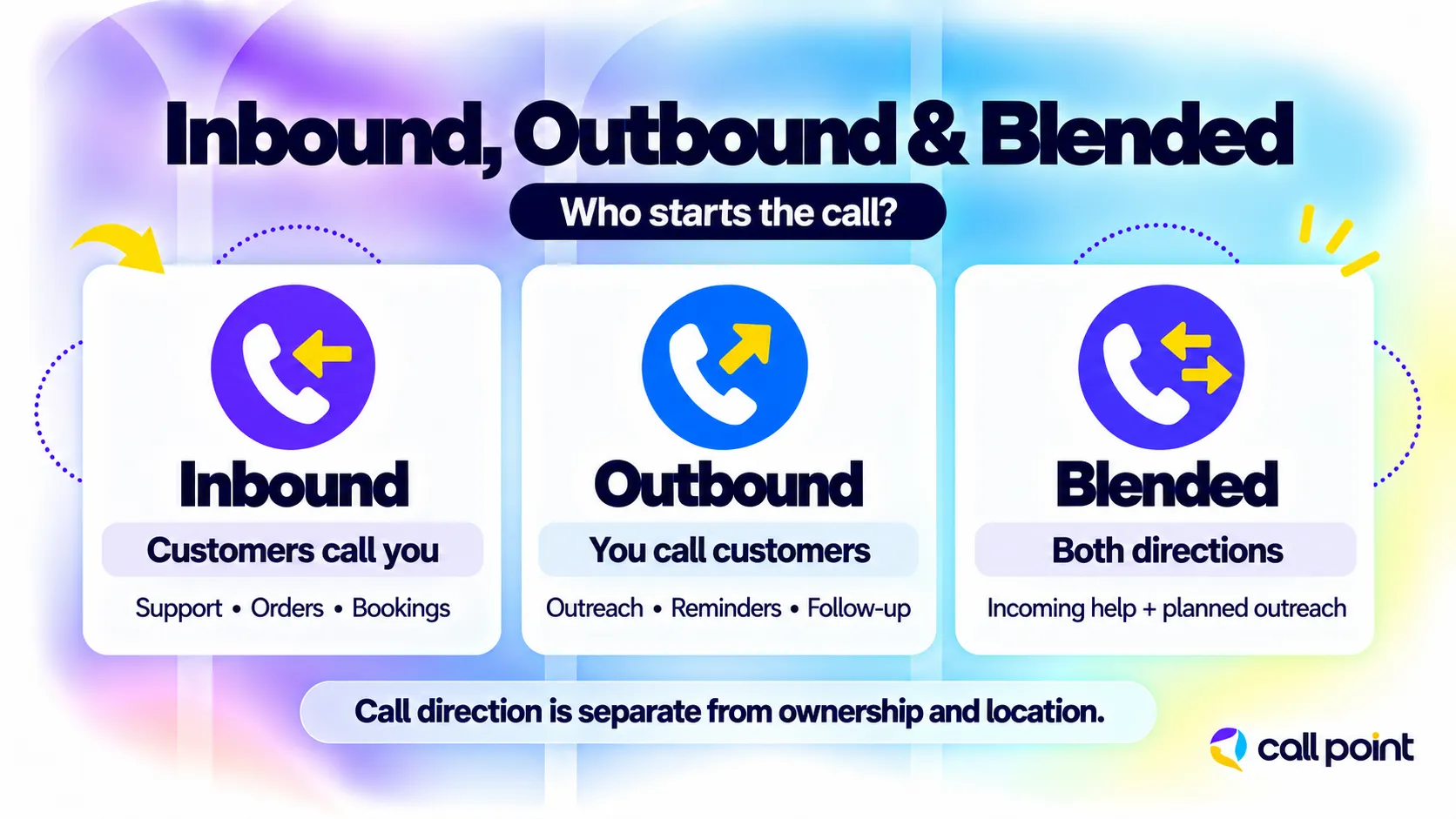
Inbound call centers receive calls, outbound call centers place calls, and blended call centers handle both. The difference is who initiates contact, rather than whether the conversation involves service or sales.
Inbound Call Centers
An inbound call center handles calls initiated by customers, prospects, or other people seeking assistance. The work can include customer service, technical support, reservations, and inbound sales.
Common tasks include:
- Answering product and account questions.
- Checking orders and delivery status.
- Helping customers troubleshoot a problem.
- Handling billing inquiries.
- Taking bookings or appointment requests.
A real example is Hilton’s reservation service. Its Help Center lists calling Hilton Reservations and Customer Care as one way to book a stay. This illustrates an inbound sales function: the guest starts the call because they want to make a reservation.
Inbound teams need enough coverage for the times customers call. They also use automatic call distribution (ACD) to route calls to the appropriate agents. Interactive voice response (IVR) lets callers select options or provide information before reaching someone.
However, routing cannot resolve a staffing shortage or an unclear policy. Agents also need current information and a clear path for questions they cannot answer.
Outbound Call Centers
An outbound call center initiates calls to prospects or existing customers for a defined purpose. That purpose might be sales, appointment setting, research, reminders, or follow-up.
For example, consider a software company whose salespeople struggle to follow up with demo inquiries. An outbound team could contact those prospects, check their requirements, and arrange suitable meetings. The salespeople would then handle the deeper product discussion.
Other outbound tasks include:
- Qualifying prospective customers.
- Following up on earlier conversations.
- Contacting customers about renewals.
- Conducting structured surveys.
- Confirming appointments.
Agents use a dialer to place calls and a customer relationship management (CRM) system to record notes and next steps. However, more calls do not automatically mean better results. Accurate targeting, useful conversations, and clear qualification criteria matter.
For sales-led work, our guide to B2B appointment setting explains what should happen before a meeting reaches your sales team.
Blended Call Centers
A blended call center combines inbound and outbound work within one operation. Depending on the setup, agents may switch between activities or work in coordinated groups.
Consider a service company that receives support calls and needs to follow up on upcoming renewals. A blended operation could answer incoming questions while scheduling outbound renewal calls around the expected workload.
The challenge is protecting incoming service. An agent cannot answer a new support call while already speaking with someone about a renewal. Managers therefore need staffing plans and priority rules that account for both activities.
A blended model can suit businesses with both needs, but it requires more than giving every agent two task lists. For a deeper comparison of the functions, see our inbound and outbound call center guide.
In-House and Outsourced Call Centers: Who Runs the Team?
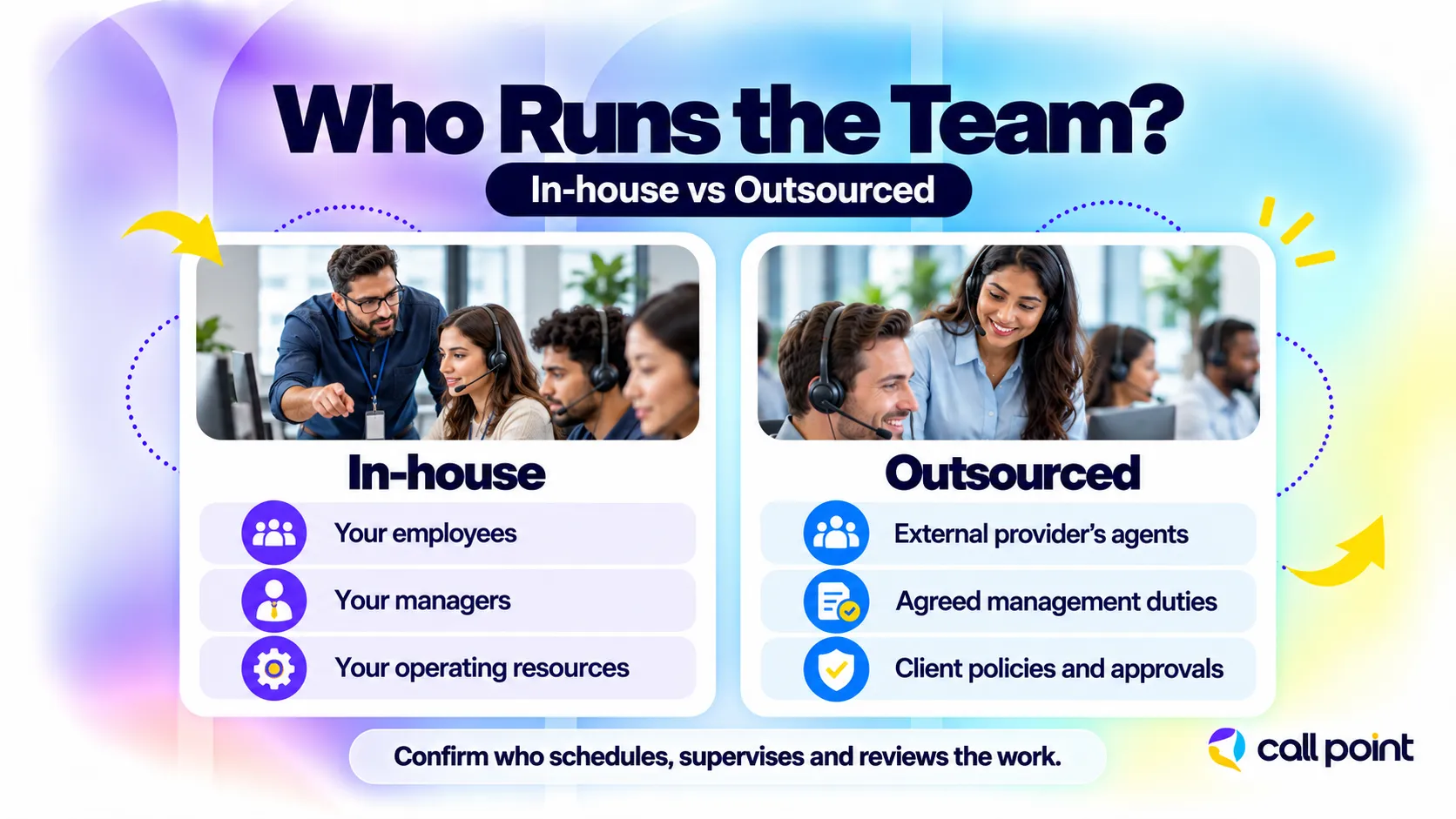
An in-house call center is staffed and managed by your business. An outsourced call center assigns agreed work to an external provider. This choice affects recruitment, supervision, and accountability, regardless of call direction.
In-House Call Centers
An in-house call center gives your company direct responsibility for its agents and operating processes. Your managers set priorities, deliver training, review performance, and handle staffing needs.
This arrangement can suit work that depends on specialized internal knowledge or frequent access to your decision-makers. For instance, you may want employees to handle complex account disputes that require detailed knowledge of your policies.
You also need resources for hiring, scheduling, absence coverage, technology, and coaching. Direct control is useful only when someone has the time and knowledge to exercise it.
An in-house team can work in your country or overseas. It can also operate from an office or remotely.
Outsourced Call Centers
An outsourced call center delivers agreed calling activities through a third-party provider. The contract should explain the tasks, working hours, management responsibilities, and service expectations.
Some providers manage recruitment, scheduling, supervision, and quality reviews. Other arrangements supply agents while leaving more daily management with you. Clarify which service you are buying.
Your business still needs to supply product information, approve policies, and assign someone to answer questions. For example, a provider might handle routine return requests while your manager approves refunds outside the standard policy.
Also ask whether agents are dedicated or shared. Dedicated agents work on an assigned client account, while shared agents support multiple accounts. That allocation does not tell you who employs them or how much supervision is included.
Our in-house vs outsourcing comparison explores the wider staffing and management decision.
Onshore, Nearshore, and Offshore Call Centers: Where Is the Work Delivered?
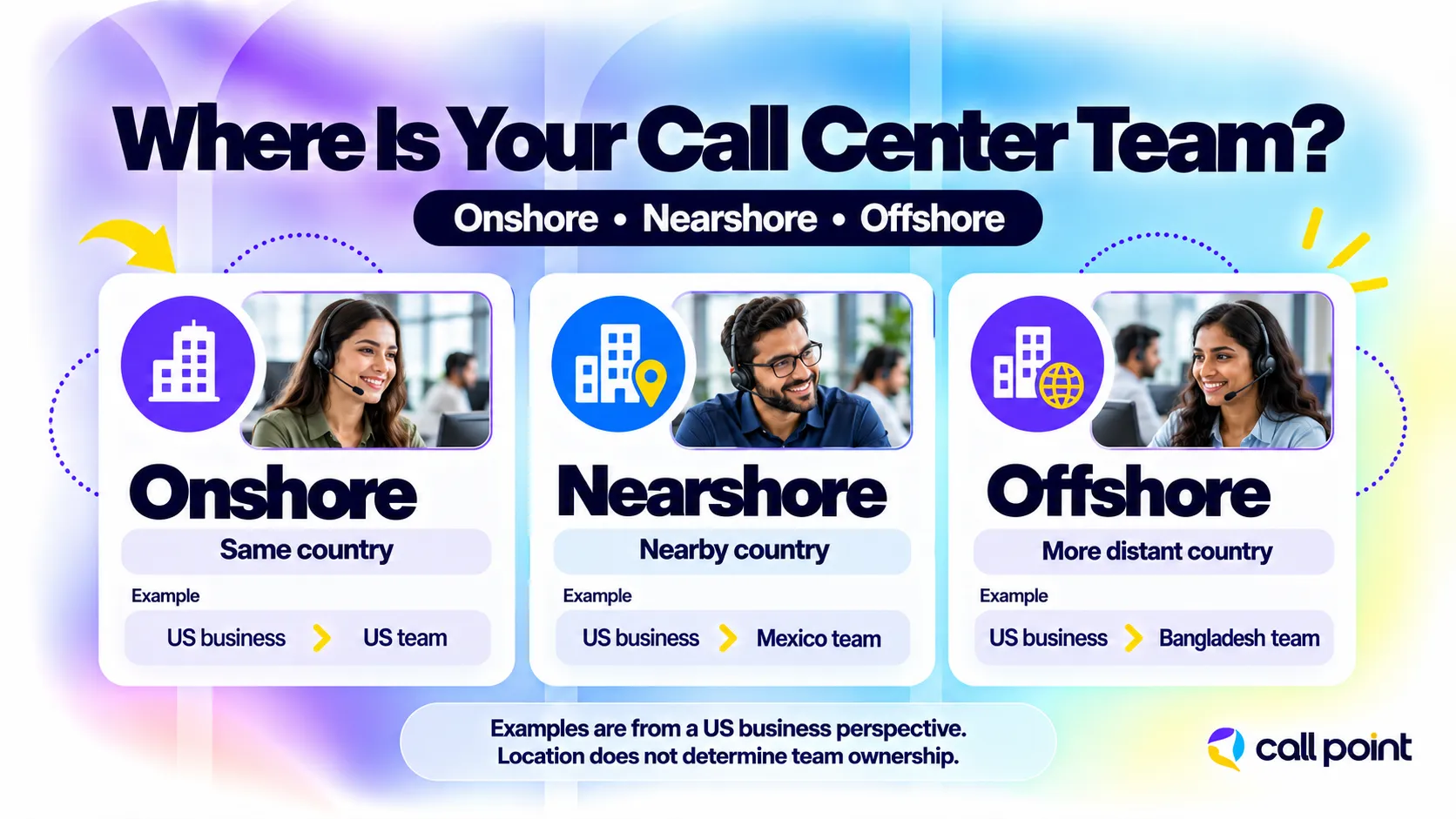
Onshore, nearshore, and offshore describe delivery location relative to your business. They do not establish who owns the team or how well it performs.
Onshore Call Centers
An onshore call center operates in your business’s home country. For a US business, a US-based support team is an onshore arrangement.
Local delivery may help when the work requires particular market knowledge or a domestic operating location. However, you should still check training, hours, reporting, and staffing continuity. Being nearby does not guarantee that those requirements are met.
An external US provider would be both onshore and outsourced.
Nearshore Call Centers
A nearshore call center operates in a nearby country. Businesses often consider this arrangement when time-zone overlap makes coordination easier.
For example, a US company working with a team in Mexico would commonly describe that delivery as nearshore. The company would still need to assess the team’s language skills, product knowledge, systems, and available hours.
Offshore Call Centers
An offshore call center operates overseas. In business comparisons, the term often describes more distant delivery locations, while nearby countries are discussed as nearshore.
A Bangladesh-based team supporting a US company is an offshore example. The team could belong to the US company or work for an external provider. Offshore does not automatically mean outsourced.
An offshore arrangement offers a different labor and operating cost base. Still, the practical questions remain: Can the team handle your work, communicate clearly, follow your policies, and cover the required hours?
An overseas location also does not create 24/7 service by itself. Continuous coverage requires an appropriate staffing schedule. Our outsourcing vs offshoring guide explains how location and external delivery fit together.
How Do Virtual, Cloud-Based and Automated Call Centers Differ?
Virtual describes where agents work, cloud-based describes the infrastructure, and automated describes how systems complete tasks. These terms address separate parts of a call center’s setup.
Office-Based and Virtual Call Centers
An office-based call center brings agents together in a shared workplace. A virtual call center connects agents working across locations, such as homes or separate offices.
A virtual arrangement can widen the locations from which a business recruits. However, managers need ways to deliver training, review calls, answer agent questions, and maintain access controls remotely.
Before choosing a distributed team, check connectivity, backup arrangements, and how supervisors support agents during difficult conversations. These details affect day-to-day delivery more than the remote label alone.
Cloud-Based and On-Premises Systems
A cloud-based call center uses calling infrastructure hosted by a service provider. An on-premises setup relies on infrastructure maintained at the organization’s premises. Some businesses combine elements of both. Cloud software can serve agents in one office or across many locations. Therefore, a cloud-based call center is not necessarily a virtual team.
Intuit provides a real example of cloud adoption. An AWS case study describes how the company moved from legacy on-premises contact center technology to Amazon Connect. The case links the change to seasonal capacity needs and the goal of integrating customer interactions.
The distinction for a buyer is straightforward: a platform supplies technology. A managed service supplies people and agreed operational responsibilities. Check both when comparing proposals.
Automated and AI-Assisted Call Handling
Automated call handling uses systems to complete defined steps without an agent carrying out each action. Examples include an IVR menu, call routing, and self-service information. Some systems use AI to interpret requests or assist agents; others follow fixed rules.
For example, a caller might check an order status through self-service. If the shipment is missing, the system should offer a suitable route to a person who can investigate.
Privacy also deserves attention. Qualtrics‘ consumer trends research found that 53% of consumers worried about privacy risks from AI-enabled support. Its research covered more than 20,000 consumers across 14 countries.
When evaluating automation, ask what information it accesses, how answers are checked, and what happens when it cannot help. Apply those checks to the actual system rather than assuming an AI label establishes its capabilities.
When Do You Need a Contact Center Instead of a Call Center?
A contact center appropriate when customers need support across phone and digital channels. A traditional call center focuses primarily on voice, while a contact center can also manage email, live chat, messaging, and social inquiries.
The next distinction is how those channels work together.
Multichannel Contact Centers
A multichannel contact center supports several communication channels. Customers might call, send an email, or start a chat. However, information sharing can vary. A phone agent may not automatically see a conversation from another channel. Before choosing a setup, check where records are stored and who owns an unresolved issue.
Omnichannel Contact Centers
An omnichannel contact center connects customer context and workflows across supported channels. The aim is to let customers continue an issue without restarting the explanation at every handoff.
Consider a customer who reports a damaged item through chat and later calls about the replacement. With connected history, the phone agent can review the earlier conversation and continue from there.
Multiple channels alone do not establish that capability. Ask the provider to demonstrate how a conversation moves between channels and how the next agent receives the relevant information.
Which Call Center Model Fits Your Business?
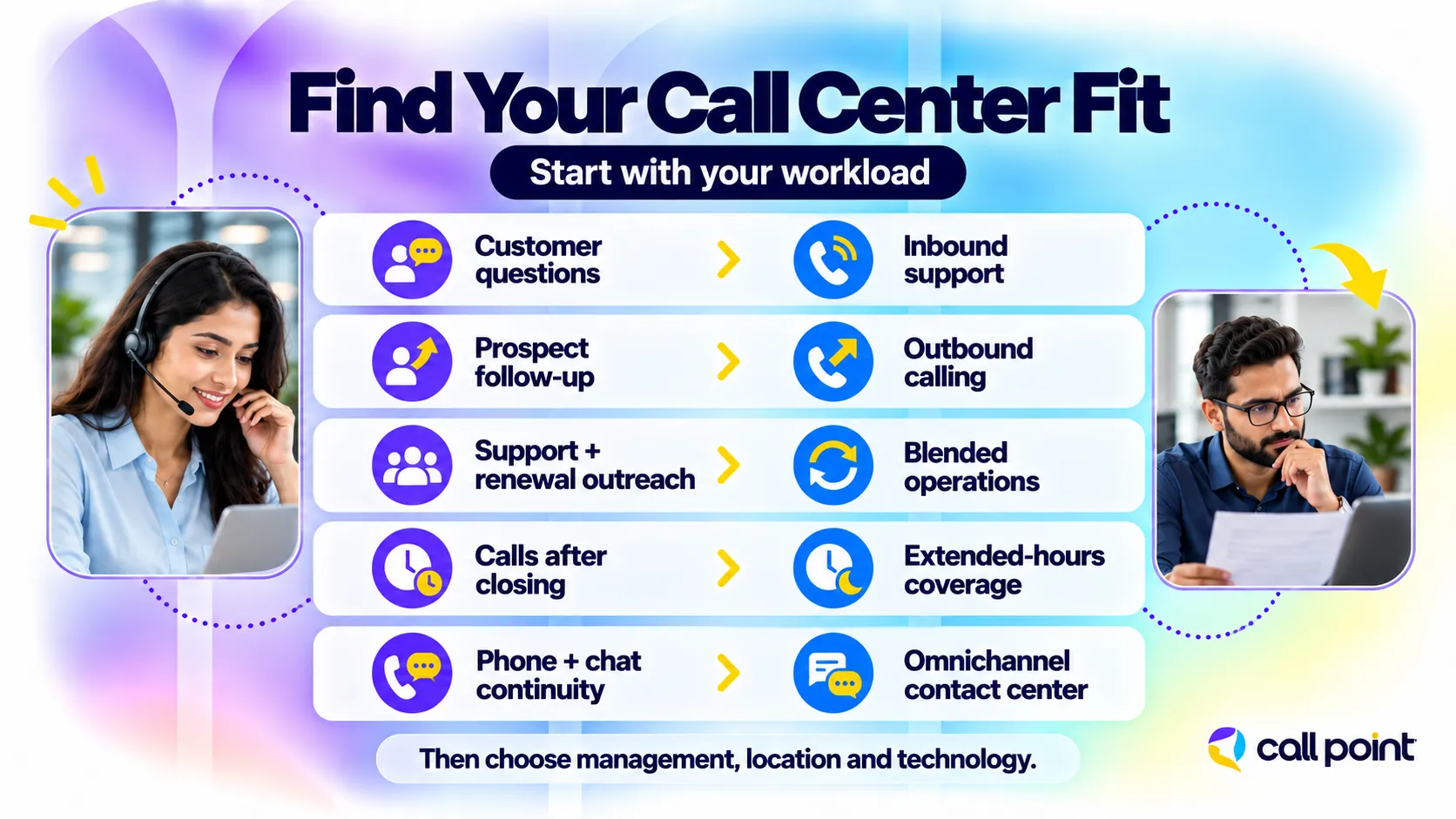
The right call center model depends on your workload, service expectations, and available management capacity. Start with the problem, then compare combinations that could address it.
| Your situation | Models to evaluate | What to confirm |
| Customers cannot get answers about orders | Inbound support, delivered in-house or through an outsourcing provider | Peak coverage, product knowledge, and escalation rules. |
| Prospects receive inconsistent follow-up | Outbound calling with assigned campaign capacity | Qualification criteria, CRM notes, and sales handoffs. |
| You need service calls and planned renewal outreach | Blended operations | Staffing and priorities that protect incoming service. |
| Calls arrive after your office closes | Additional shifts or a provider covering those hours | Contracted hours, backup coverage, and urgent contacts. |
| Customers repeat themselves across phone and chat | Omnichannel contact center capabilities | Shared history, permissions, and case ownership. |
Before requesting proposals, work through these six steps:
- Define the tasks: Separate routine inquiries, sales activities, and decisions that require internal authority.
- Measure demand: Review volume by hour or day, common call reasons, complexity, and busy periods.
- Set coverage requirements: Specify hours, languages, channels, and response expectations.
- Assign responsibilities: Decide who trains agents, supervises work, checks quality, and approves exceptions.
- Check operating requirements: Confirm system access, continuity arrangements, and responsibility for applicable calling rules.
- Agree on success measures: Define the results you will review before increasing the scope.
Measures should match the work. For inbound support, consider first-contact resolution, customer satisfaction, and the proportion of calls abandoned before an answer. For outbound campaigns, review qualified opportunities or attended meetings alongside calling activity.
Define each measure clearly. A lower average handle time is not necessarily an improvement if customers must call again because their issue remains unresolved.
What Affects the Cost of Different Call Center Models?
Call center costs depend on workload, skills, coverage, channels, technology, and management. A useful comparison includes the full cost of delivering the same work to the same standard.
For an in-house team, assess wages, benefits, recruitment, training, systems, supervision, and facilities where needed. In an August 2026 update, the US Bureau of Labor Statistics reported a median hourly wage of $21.53 for customer service representatives. That is an occupational wage measure, not the total cost of employing an agent or an outsourced service rate.
For outsourced work, review provider fees, onboarding charges, excluded tools, additional coverage, and the time your employees retain for coordination. Ask what the quoted unit covers, whether it is an agent, hour, minute, or interaction.
Compare equivalent requirements before judging price. A lower rate may cover fewer hours or leave more supervision with you. For a closer look at pricing factors and performance measures, see our customer service outsourcing guide.
How Call Point Supports Different Call Center Needs
At Call Point Business Solutions, we provide BPO services through our operational team in Dhaka, Bangladesh. Established in 2017, we support businesses that need additional capacity for customer communication and sales-related work.
Our customer support outsourcing services can cover phone inquiries and digital support within the agreed scope. For outbound needs, our telemarketing services can support prospect outreach, lead qualification, appointment setting, and follow-up.
We align the team with your approved workflows, product information, and escalation rules. Our quality process includes supervisor checks, call and task reviews, KPI tracking, coaching, client feedback, and reporting. The proposal defines responsibilities, service hours, training needs, access, and fees. Your business supplies the product knowledge and approval decisions needed to keep delivery aligned with your policies.
Frequently Asked Questions
Is a BPO Company the Same as a Call Center?
A BPO company may offer call center services, but business process outsourcing also includes work such as administration, accounting support, and data management. A call center describes a calling operation. BPO describes the broader practice of hiring an external provider to carry out business processes.
Do Small Businesses Need a Full Call Center Team?
Small businesses can start with the coverage their workload requires. A limited answering service may suit occasional calls, while more complex inquiries may need assigned agents and supervision. Compare your call volume, required hours, and the provider’s minimum commitment before deciding how much capacity to buy.
Can One Platform Handle Inbound and Outbound Calls?
Some platforms support both. Confirm that the selected plan includes the routing, dialing, CRM connections, permissions, and reporting your team needs. The same platform may support both activities while using different workflows for incoming service and outbound campaigns.
Final Thoughts
Choose call center models around the work your business needs to complete. Begin with call direction, then decide who should manage the team, where it should operate, and which systems and channels it needs. Clear responsibilities make those choices easier to evaluate.
If you need additional support, share your call volume, required hours, channels, and current workflow with Call Point. Request a customized proposal to discuss customer support or outbound calling built around those requirements.