

A new lead asks for pricing while your salesperson is on a discovery call. Two callbacks are waiting, and a proposal needs to go out before the day ends. When the same people handle every step, follow-up can slip.
Sales outsourcing means hiring an external agency or specialist team to manage part or all of your sales operations. That can include answering inquiries, researching prospects, making calls, qualifying leads, and arranging appointments. Some providers also handle proposals, negotiations, and closing.
The right arrangement depends on where your team needs help. Understanding the service types, inbound and outbound workflows, costs, and reporting will help you decide what to outsource and what to keep internally.
What Is Sales Outsourcing?
Sales outsourcing is a service arrangement in which a business assigns specific sales responsibilities to an external provider. The provider supplies the people and agreed management support, while the client supplies product knowledge, target-customer requirements, and approval rules. The contract determines the tasks, deliverables, fees, and point at which the client’s employees take over.
For example, a commercial cleaning company could outsource prospecting and appointment scheduling while its own managers conduct site assessments and prepare quotes. The external team creates opportunities for sales conversations; the cleaning company remains responsible for assessing the work and securing the contract.
Lead generation is one part of that process. Finding an interested contact is a different deliverable from completing a sale.
Types of Sales Outsourcing
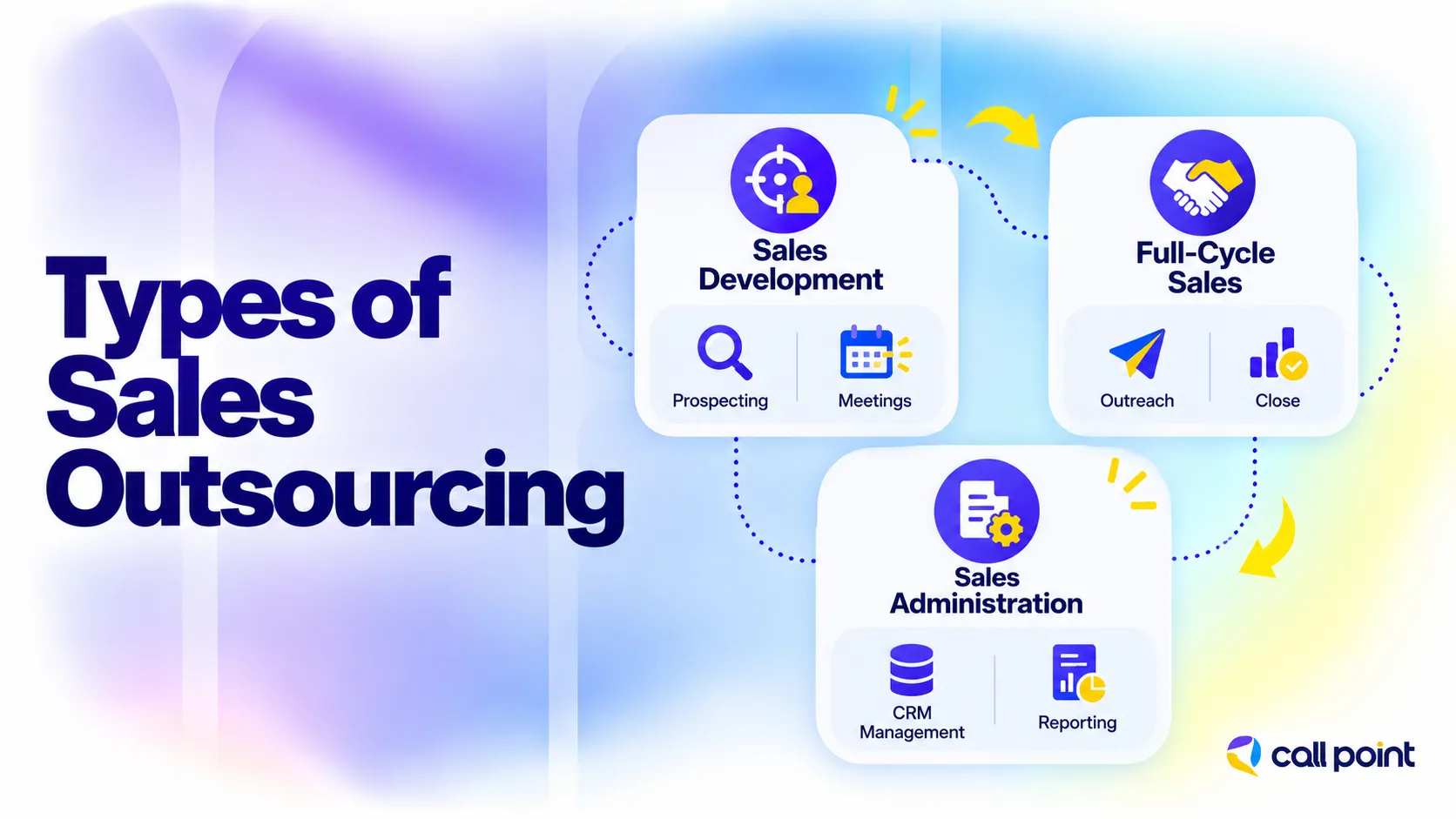
You can outsource a particular sales stage, the wider sales cycle, or the administration supporting your representatives. Providers combine these services differently, so ask for a task list rather than relying on a package name.
Sales Development
Sales development outsourcing covers prospect research, initial contact, lead qualification, and meeting booking. Sales development representatives, or SDRs, check whether a prospect matches your target customer and has a reason to continue the conversation. They then pass the opportunity to an account executive or business owner. This model fits a company with people available to conduct discovery and close deals, but limited time for consistent prospecting.
Full-Cycle Sales
Full-cycle sales outsourcing gives an external team responsibility from prospecting through discovery, proposals, negotiation, and closing. Representatives need detailed product training and authority to discuss commercial terms. Specify who can approve discounts, change the scope of an offer, and sign agreements, especially when your product requires technical or industry-specific advice.
Sales Administration
Sales administration support keeps records, calendars, and follow-up tasks organized. It can include updating a customer relationship management (CRM) system, assigning inquiries, confirming appointments, preparing reports, and maintaining contact details. This is a practical starting point when your salespeople can handle customer conversations but spend too much time scheduling meetings or correcting incomplete records. More advanced sales operations work, such as forecasting or CRM design, requires a separate scope and skill set.
Inbound and Outbound Sales Outsourcing
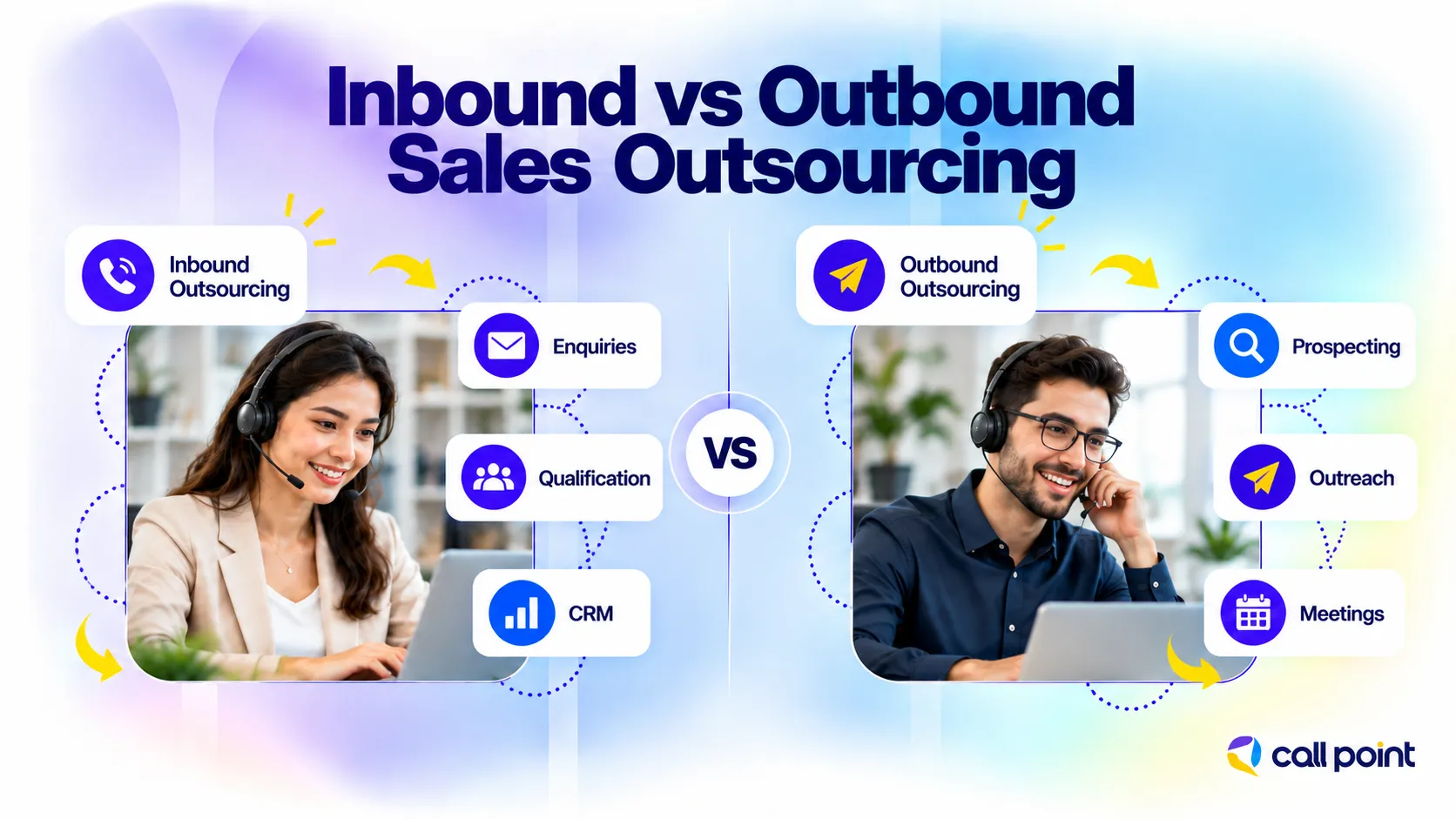
Inbound sales outsourcing handles interest customers have already expressed. Outbound sales outsourcing involves contacting selected prospects to establish interest. Both need qualification and follow-up, but the first conversation has a different starting point.
Inbound Sales Outsourcing
An outsourced inbound sales team responds to calls, website forms, quote requests, and other purchase inquiries. Representatives answer initial questions, collect requirements, check fit, and arrange the next step. For example, a homeowner asks a solar installer about a consultation. The representative confirms the property location, checks the service area, records the request, and books an appointment with an adviser. Technical recommendations remain with qualified staff. Calling the homeowner back is still part of the inbound sales process, even though the phone call is outgoing.
Outbound Sales Outsourcing
An outsourced outbound team researches and contacts potential customers who have not requested that sales conversation. Its work can include list building, contact verification, cold calling, email outreach, qualification, and appointment setting. An IT provider, for instance, could ask representatives to approach businesses of a particular size within its service area. The team identifies relevant contacts and explores whether a discovery call would be useful. The IT provider then handles technical assessment and proposals. A defined audience and credible reason for contact are central to the outbound sales process.
A business can use both approaches. Record the original lead source in the CRM so inbound inquiries and outbound-generated opportunities remain distinguishable throughout the sales cycle.
How Does Sales Outsourcing Work?
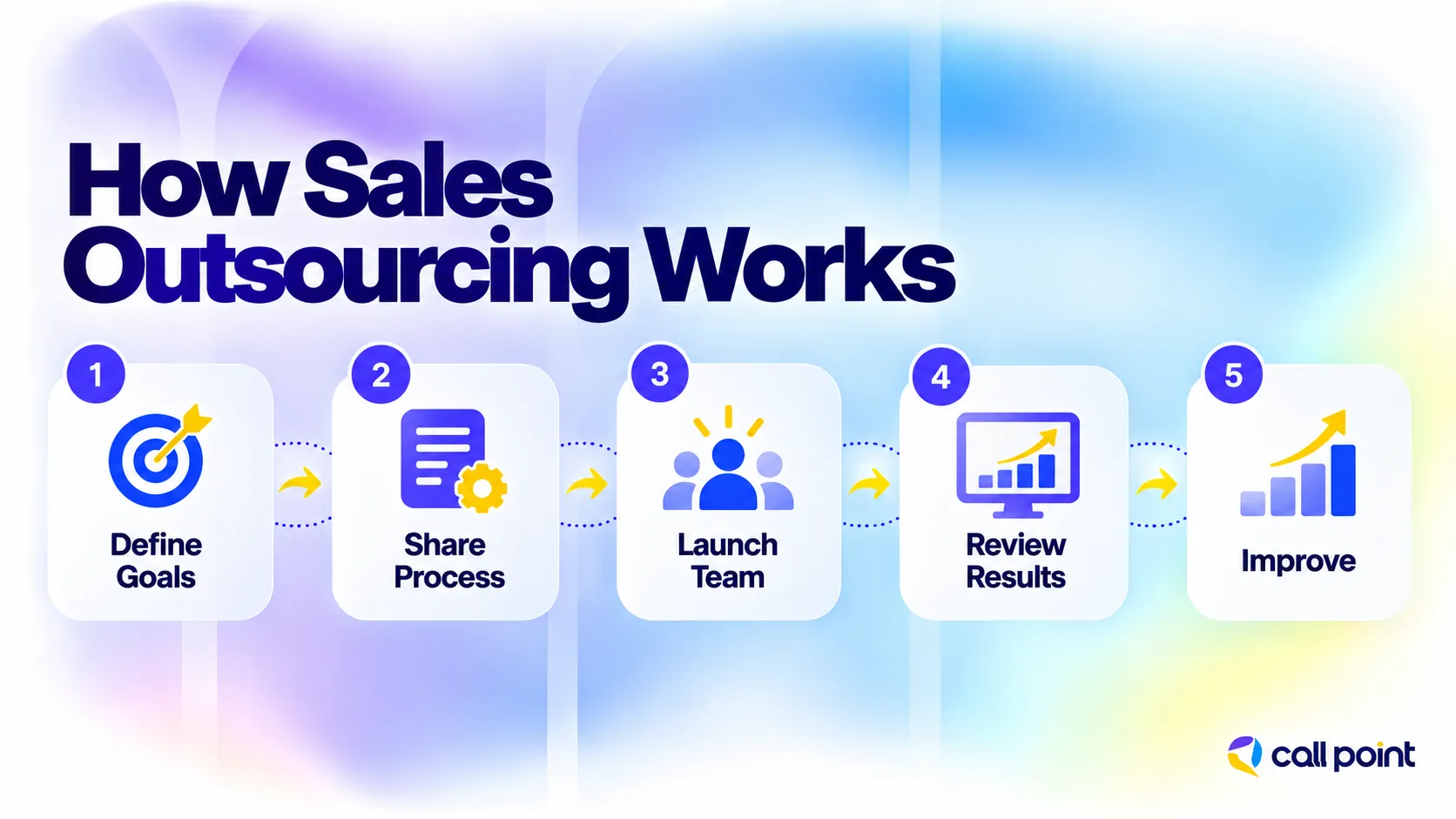
You and the provider define the work, prepare the representatives, launch the activity, and review results. The team usually follows your approved messaging and records conversations in agreed systems so your salespeople can continue them.
- Find the workload gap. Identify whether inquiries, prospecting, qualification, or follow-up are getting delayed.
- Agree on the audience and deliverables. Define target customers, exclusions, coverage hours, assigned tasks, and what qualifies an opportunity.
- Train the representatives. Share product information, approved scripts, common objections, escalation instructions, and system access. Use practice conversations to check understanding.
- Start contacting and qualifying prospects. Record outcomes, complete follow-up, and schedule meetings that meet your criteria.
- Review the work with your sales team. Discuss unsuitable leads, missed appointments, recurring objections, and opportunities that move forward.
Your salesperson should receive enough information to continue each conversation. A useful handoff includes the contact’s role, requirements, timing, questions, and agreed next action.
For appointment setting, also define what happens when a meeting is canceled, duplicated, or outside the qualification criteria. A calendar booking alone tells you little about the commercial opportunity.
What Are the Benefits of Sales Outsourcing?
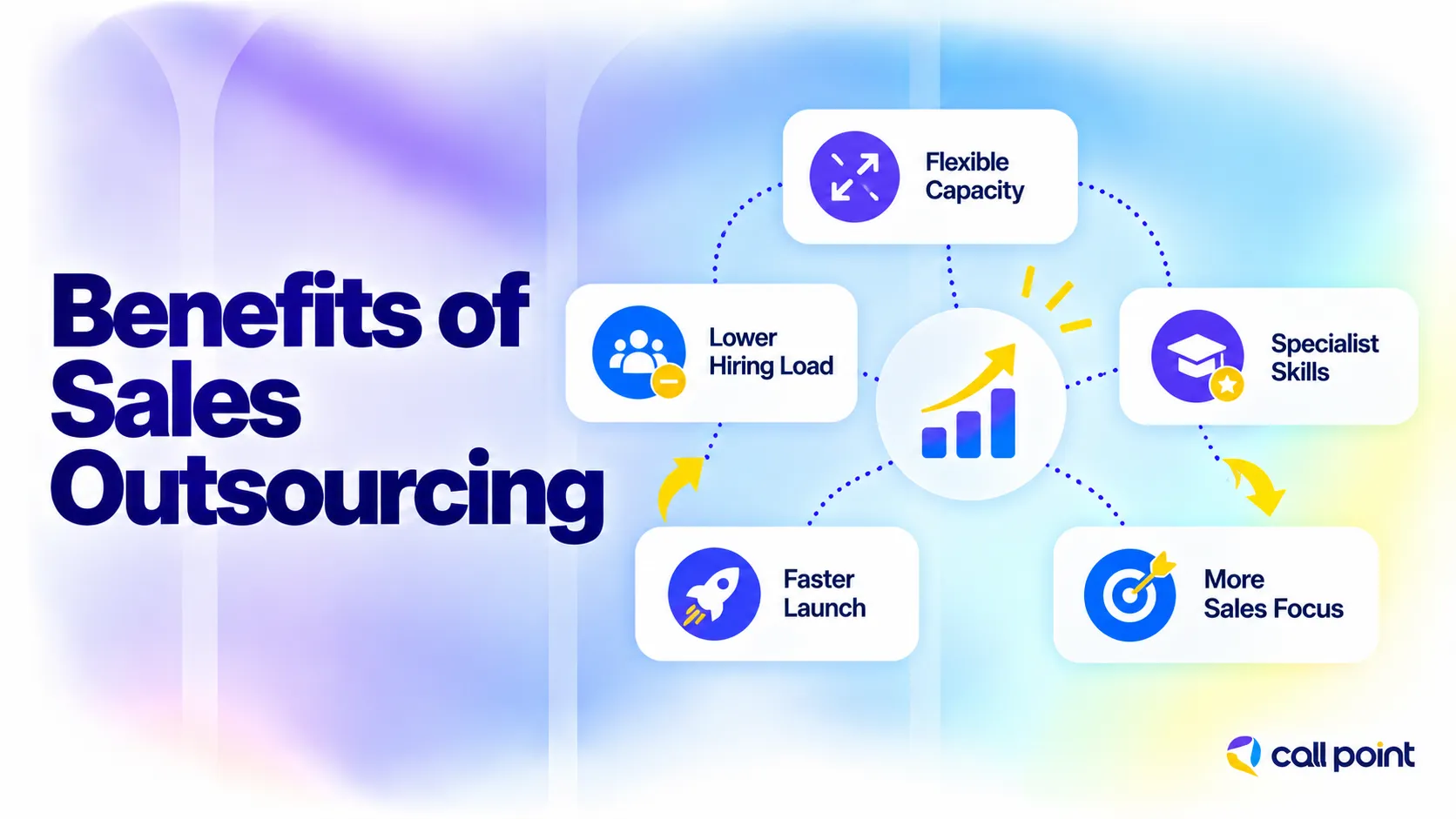
Sales outsourcing adds capacity for defined work and can reduce the recruitment and supervision your managers handle directly. The most useful benefit is often a better division of work between initial sales support and specialist conversations.
The workload is substantial. Salesforce’s February 2026 research found that sellers spend an average of 40% of their time selling. The survey covered 4,050 sales professionals across 22 countries. It provides context for reviewing how your own team spends its time.
Practical benefits include:
- More time for discovery and proposals: An external representative can handle research and scheduling while your salesperson assesses requirements and prepares an offer.
- Consistent follow-up ownership: Inquiries and callbacks sit with an assigned team instead of relying on whoever finds time between meetings.
- Additional coverage: A provider can staff agreed business hours or time zones that your existing team cannot cover.
- Access to managed support: Depending on the package, supervision, coaching, prospect research, and reporting can be included alongside representatives.
Outsourcing also creates an option for adding campaign capacity as demand changes. Confirm staffing availability, notice periods, and contract commitments before planning an increase or reduction.
When Should You Outsource Sales Team?
Consider outsourcing when you have a clear offer and an identifiable workload problem. You should be able to explain who the team will contact, what it should do, and how your business will handle the next step.
Signs that additional support could help include:
- Sales inquiries wait while employees attend meetings.
- Prospecting stops whenever proposal work increases.
- Qualified prospects receive inconsistent follow-up.
- Experienced salespeople spend hours researching contacts or updating records.
- Your business needs sales coverage during additional hours.
Prepare the basics before increasing activity. If your offer is still changing or you cannot explain why a customer would buy it, additional outreach will be difficult to evaluate. You also need someone available to handle qualified opportunities.
Risks to Address Before You Start
The main risks are poor targeting, inaccurate messaging, weak qualification, and missed handoffs. Each needs an operational control.
- Poor-fit prospects: Approve the ideal customer profile, exclusions, and sample target accounts.
- Inaccurate claims: Supply current product information and specify which questions require escalation.
- Low-quality appointments: Agree on qualification criteria and review meetings your salespeople reject.
- Lost context: Require notes that show what the buyer asked and what was promised next.
- Unclear data handling: Document access permissions, ownership, permitted use, and responsibilities for contact preferences and applicable campaign rules.
The quality of outreach matters. Gartner reported in June 2025 that 73% of surveyed B2B buyers actively avoid suppliers sending irrelevant outreach. Its survey covered 632 buyers in August and September 2024. Review whether the message gives that particular buyer a useful reason to respond.
How Much Does Sales Outsourcing Cost?
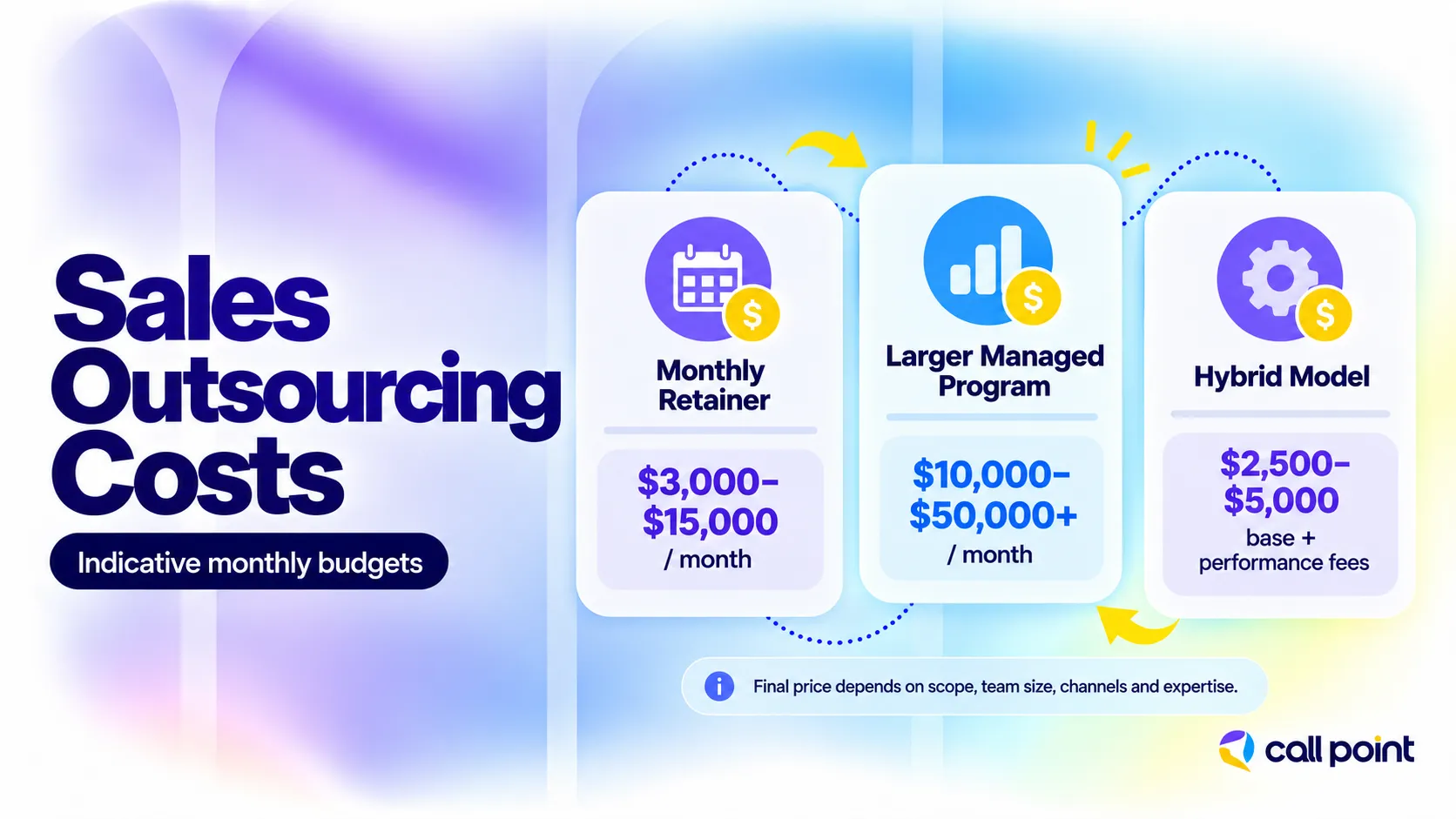
For budgeting, smaller sales outsourcing programs can range from $3,000 to $15,000 per month. Larger programs involving several representatives, multiple outreach channels, and campaign management can reach $10,000 to $50,000 or more per month.
These are indicative budgets in US dollars. The final price depends on the work included, team size, staffing location, and level of expertise required.
| Pricing model | Indicative budget | What to check |
| Monthly retainer | 3,000–15,000 per month | Representatives, outreach channels, supervision, tools, and data included |
| Larger managed program | 10,000–50,000+ per month | Team composition, research, channel coverage, reporting, and campaign management |
| Hybrid arrangement | 2,500–5,000 monthly base, plus performance fees | What triggers an additional payment and how results are verified |
Some providers charge separately for onboarding, training, prospect lists, or software. Ask for a complete breakdown before comparing proposals.
For pay-per-appointment services, confirm whether you pay for a meeting booked, a meeting attended, or an opportunity accepted by your sales team. Also check how cancellations, duplicates, and unsuitable appointments are handled.
When comparing outsourcing with an internal team, include recruitment, compensation, training, technology, and management time. Add any expenses your business will retain after outsourcing.
Call Point prepares custom quotations based on your required tasks, staffing, coverage hours, and campaign scope.
Is Outsourcing Cheaper Than an In-House Team?
Outsourcing can cost less when the provider’s complete fee is below the cost of running equivalent work internally. Compare compensation, recruitment, training, tools, data, and supervision on both sides. Include the management time and specialist sales work you retain. Our in-house vs. outsourcing guide explains the wider comparison. Savings depend on the scope and utilization of the team; a fixed percentage will not describe every business.
How to Choose and Measure a Provider
Choose a provider that can explain how it will carry out your work and demonstrate relevant experience. Request a sample qualification record, report, and training approach before judging the proposal on price.
Use these questions during evaluation:
- Who will work on the campaign, and who supervises them?
- How will the team learn our offer and handle unfamiliar questions?
- What counts as a qualified lead or appointment?
- Can we review contact history and receive complete handoff notes?
- What happens when a meeting is unsuitable or does not take place?
- Which fees, commitments, data rights, and exit arrangements apply?
Agree on the measures before launch. For inbound work, review meaningful response times, contact rates, qualification outcomes, and accepted opportunities. Record automated acknowledgments separately from representative responses.
For outbound work, track relevant conversations, qualified meetings held, accepted opportunities, and later sales. Keep inbound and outbound results separate because the starting points and acquisition costs differ.
For example, a $4,000 campaign producing 20 qualified meetings costs $200 per meeting. Those figures demonstrate the calculation, not a typical price. Follow the meetings through to opportunities and customers to assess their value.
How Call Point Supports Outsourced Sales
Call Point Business Solutions provides telemarketing and telesales support for inbound inquiry handling, outbound prospecting, cold calling, lead qualification, appointment setting, and follow-up within the agreed service scope.
We review your offer, target audience, campaign goals, qualification questions, and the point at which your employees take over. Representatives receive campaign training and access to approved systems. Supervisors review calls and tasks, track campaign performance, and coach agents when issues appear.
The division of work reflects your requirements. An external representative can collect information and arrange a consultation, while your authorized employees handle technical advice, special pricing, and contract negotiations.
Frequently Asked Questions
How Long Does Sales Outsourcing Take to Produce Results?
The timeframe depends on training, system access, the work assigned, customer demand, and your sales cycle. Inquiry handling can be assessed once trained representatives begin responding. Outbound revenue takes longer because prospects still need to engage, qualify, attend meetings, and make a buying decision. Agree on early service measures and a later review of commercial results. A launch date and a revenue milestone are separate commitments.
Can You Outsource Sales Without Outsourcing Marketing?
Yes. You can retain your marketing team while outsourcing selected sales activities. For example, your employees or agency can manage advertising and website content while an external team responds to inquiries and qualifies prospects. The teams still need shared information about campaign messages, offers, lead sources, and next steps so buyers receive consistent answers.
Who Owns the Leads and Customer Data?
Ownership and access should be stated in the contract before work begins. Specify who owns campaign records, where they are stored, who can use them, and how they will be returned or exported when the service ends. Also distinguish your customer records from information supplied under a provider’s third-party data license, since those usage rights can differ.
What Is the 3-3-3 Rule in Sales?
The 3-3-3 rule is an informal sales framework with various interpretations. It involves reaching out to a prospect three times using three different messages across three channels. Other versions may focus on research or timing. For an outsourced campaign, it’s important to document the actual sequence, timing, and conditions for ending contact, ensuring that everyone adheres to the same approach and respects the prospect’s communication preferences.
Final Thoughts
Start with the sales tasks your team cannot handle consistently. Define the work, compare complete costs, and decide how qualified prospects will reach the people responsible for closing.
If you need help with inbound inquiries, outbound prospecting, or follow-up, discuss your sales requirements with Call Point Business Solutions. We can review the workload and prepare a proposal for the support you need.