
When sales keeps rejecting leads, adding more names to the list can make the problem more expensive. Some companies fall outside your market. Others have no current need, or the person contacted has little involvement in the purchase.
Buyers also move between different ways of researching and contacting suppliers. McKinsey’s 2026 Global B2B Pulse research found that buyers use an average of 10 channels across their purchasing journey. That makes consistent information and conversation records useful as buyers move between your website, email, and sales team.
B2B lead generation identifies potential business customers and creates opportunities to engage them. To make that work, define suitable accounts, reach relevant people, check their requirements, and give sales enough context to continue the conversation.
What Is B2B Lead Generation?
B2B lead generation is the process of finding and engaging companies that could buy your products or services. It combines account research, marketing or direct outreach, and qualification to identify suitable prospects for further follow-up. The buyer is purchasing for a business, which may involve several stakeholders with different responsibilities.
An operations manager might assess a service, IT might review system requirements, and finance might approve the expenditure. Your outreach needs to reach people involved in that process. For a broader introduction, see our guide to lead generation fundamentals.
Keep the stages clear:
- Researched contact: Someone whose company and role appear relevant, but whose interest remains unconfirmed.
- Qualified lead: A prospect who meets your agreed fit or readiness criteria.
- Booked meeting: An agreed conversation with a stated purpose.
- Sales opportunity: A potential deal that sales has accepted for active evaluation.
A marketing-qualified lead (MQL) meets criteria agreed by marketing and sales for further attention. A sales-qualified lead (SQL) meets the team’s criteria for a sales conversation. A download or demo request can inform that decision, but neither automatically establishes qualification. Outbound prospects may move directly into sales qualification without becoming MQLs first.
How to Generate B2B Leads
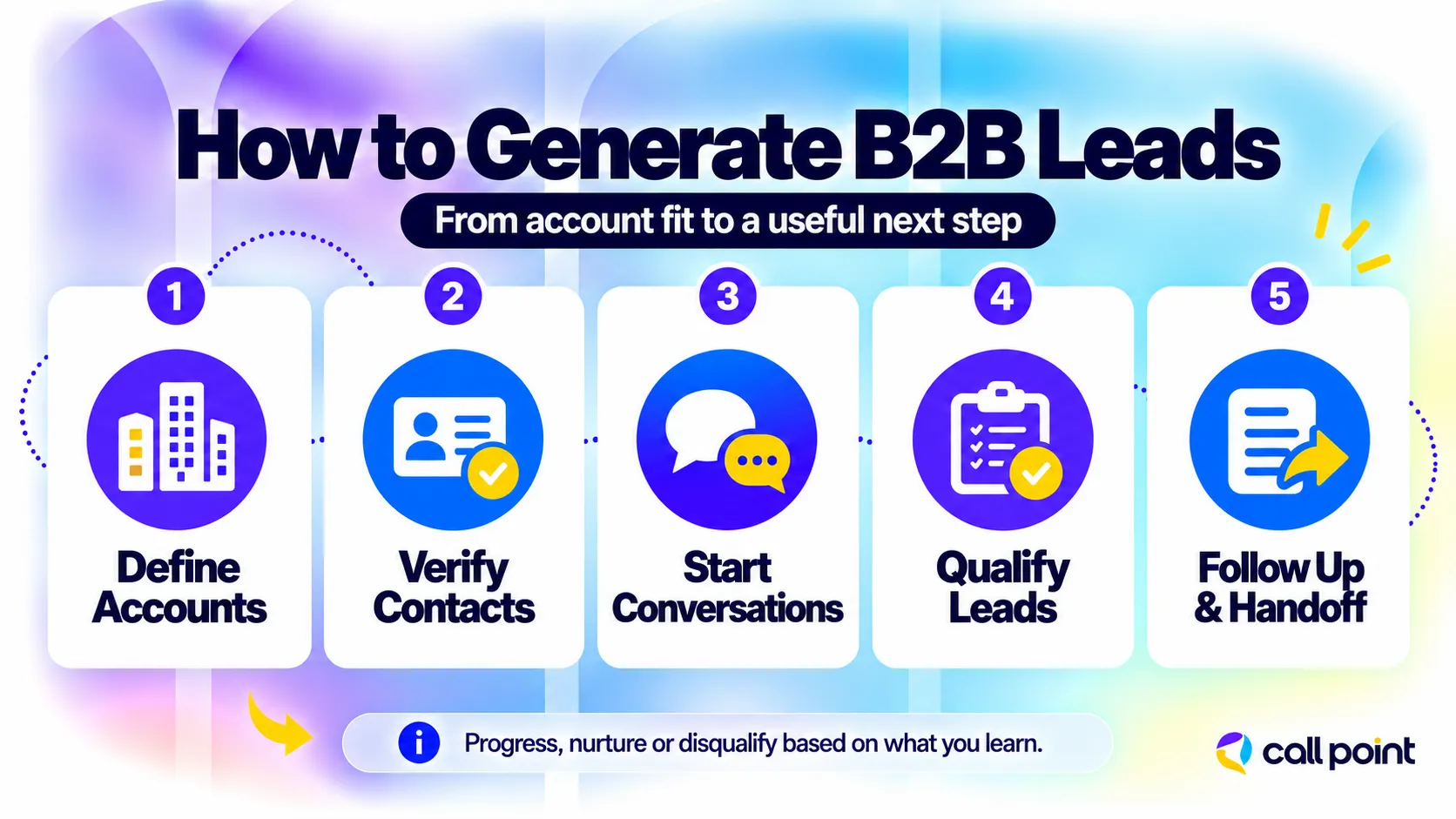
A practical B2B lead generation process starts with the accounts you can serve and ends with a clear next action. Each stage should produce information the next person can use.
1. Define the Accounts You Can Serve
Your ideal customer profile (ICP) describes a suitable company. A buyer persona describes a relevant person within that company, including their responsibilities and concerns. Start with company characteristics, also called firmographics, such as industry, location, and size. Add operational requirements that determine whether your offer fits.
Consider this hypothetical profile for a managed IT provider. These are example targeting choices, not industry benchmarks.
| Targeting factor | Example criteria |
| Industry | Accounting, consulting, and other professional-services firms |
| Location | US locations the provider can support |
| Company size | 25–150 employees |
| Operational requirement | Ongoing employee IT support and management of supported systems |
| Relevant roles | Operations director, IT manager, or managing partner |
| Exclusions | Organizations requiring systems or on-site coverage outside the provider’s scope |
The exclusions matter during list building. An account can look commercially attractive while requiring work your team cannot deliver. Use customer experience to refine the profile. Review which clients you serve successfully, what they needed when they contacted you, and which requirements created delivery problems.
2. Research Accounts and Verify Relevant Contacts
Account research checks whether the company fits. Contact research identifies who can discuss the requirement and explain the buying process. For the hypothetical IT provider, an operations director might describe employee support problems. An internal IT manager could assess technical compatibility, while a managing partner approves the contract.
Record the details needed to contact and qualify each account:
- Company name, website, and reason for inclusion.
- Contact name, current role, and relevant business contact details.
- Information source and date checked.
- Existing CRM history, including previous replies.
- Known exclusions, duplicate records, and contact preferences.
A customer relationship management system, or CRM, keeps these records together. Verified contact details help establish accuracy. You still need to learn whether the person has a relevant requirement and wants to continue the conversation. Review contact preferences and applicable outreach requirements before using the data.
3. Choose a Relevant Message and Next Step
An effective opening explains why you are contacting the person and gives them a manageable next step. Base the message on verified information or an openly framed question. Avoid claiming that a company has a problem you have not confirmed.
For example, a IT provider could write:
“We provide employee IT support for professional-services firms. Are you responsible for reviewing external support, or does that sit with someone else?”
Once the role is clear, a follow-up question can explore how support is currently managed. If there is a relevant requirement, a discovery conversation may be appropriate. Keep messages consistent across channels. A follow-up email should reflect what the prospect said on the phone. Record the conversation so another representative can continue it without restarting the discussion.
4. Qualify Fit, Need, and Buying Readiness
B2B lead qualification checks whether further sales work makes sense. Agree on the criteria before the campaign starts so representatives and sales managers evaluate leads consistently.
Useful questions include:
- Company fit: Can your business serve this account?
- Role: What responsibility does the contact have for the requirement?
- Need: What does the prospect want to resolve or improve?
- Current approach: How is the work handled today?
- Timing: Is there an upcoming review, project, or contract decision?
- Buying process: Who else needs to assess or approve a change?
- Next step: What has the prospect agreed to do?
Budget can be explored progressively. A contact may understand the requirement before funding has been approved. Record what is known and what still needs discussion.
Qualification should lead to a decision:
| Decision | When it makes sense |
| Progress to sales | The company fits, there is a relevant requirement, and the prospect agrees to a sales conversation |
| Nurture for later | The account fits, but timing or readiness requires further follow-up |
| Disqualify | The account falls outside your criteria or cannot use your offer |
For the hypothetical IT provider, a firm reviewing its support contract next quarter may enter nurture. A company requiring unsupported infrastructure would be excluded. These outcomes help the team decide where to spend time.
5. Follow Up and Hand Over Useful Context
Follow-up should reflect the conversation and agreed timing. A prospect who requests a service overview needs that information. Someone who asks to reconnect before a contract review needs a recorded follow-up date and owner. Lead nurturing means maintaining a relevant relationship while the prospect evaluates a requirement. Useful material might include a service explanation, implementation checklist, or approved case study.
When a lead is ready for sales, pass the context alongside the contact details. Here is a hypothetical handoff record for the IT provider: Appointment setting arranges the next conversation with a suitable prospect. Lead generation covers the wider work of finding and engaging potential buyers. Our guide explains how appointment setting works and what sales should receive before a meeting.
Which B2B Lead Generation Channels Should You Use?
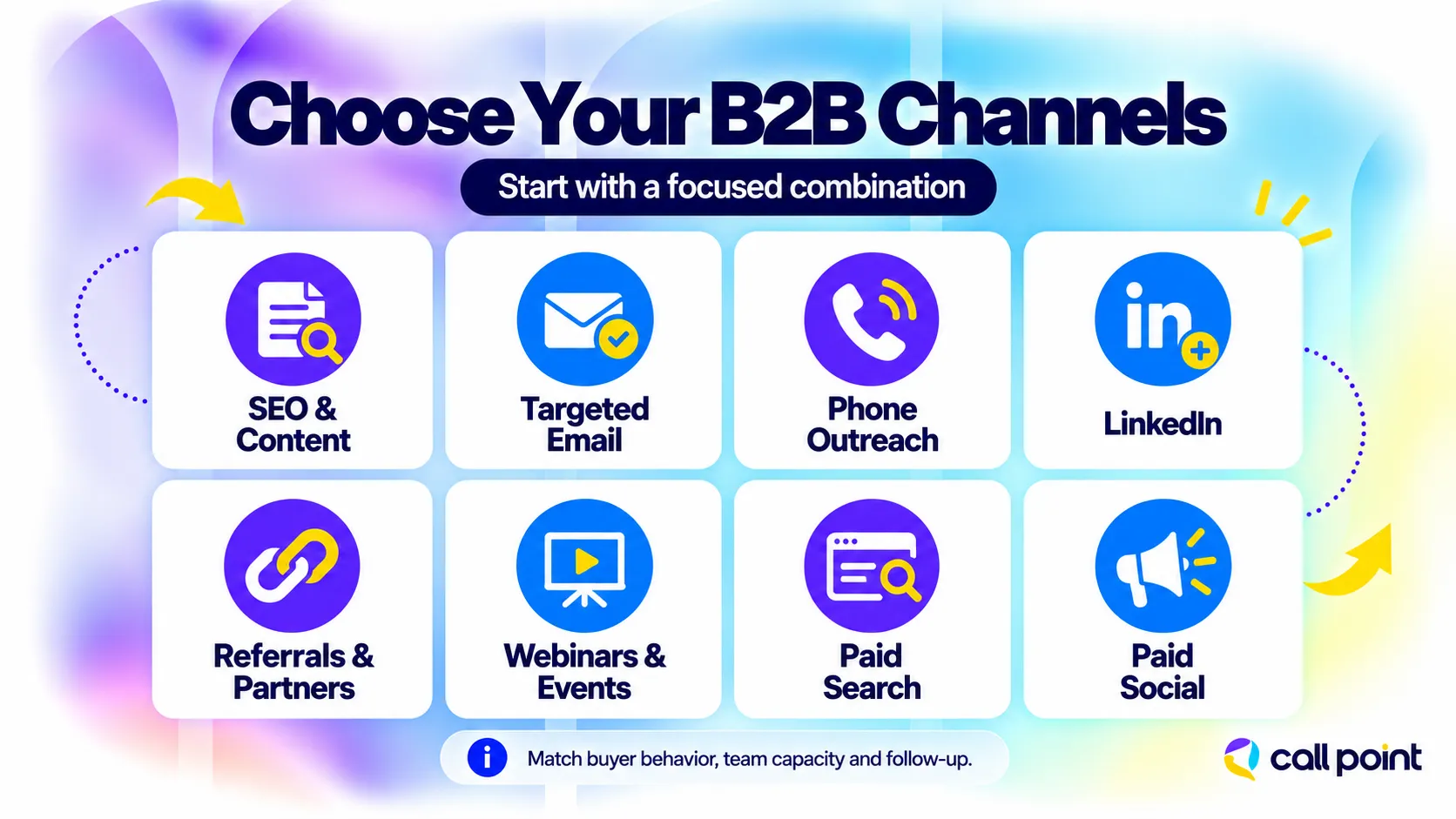
Choose channels based on where your buyers research, how you can reach them, and what your team can manage consistently. Start with a focused combination that you can evaluate.
| Channel | Suitable use | What you need | Practical limitation |
| SEO and useful content | Answering questions buyers search for | Relevant topics, expertise, and a clear inquiry path | Search visibility takes work and does not ensure qualified inquiries |
| Targeted email | Introducing a relevant offer to selected contacts | Accurate data, a clear message, and reply handling | Poor targeting and delivery problems can limit results |
| Phone outreach | Exploring a requirement through direct conversation | Prepared callers, relevant contacts, and qualification questions | Contacts may be unavailable or unwilling to engage |
| Learning about accounts and building professional relationships | Relevant participation and thoughtful messages | Connection requests alone reveal little about buying intent | |
| Referrals and partnerships | Reaching accounts through trusted introductions | Suitable partners and clear referral criteria | Timing and volume can be difficult to control |
| Webinars and focused events | Explaining a complex issue and answering questions | Useful expertise, promotion, and follow-up | Attendance does not automatically indicate purchase readiness |
| Paid search | Reaching people searching for a solution | Suitable keywords, landing pages, and conversion tracking | Broad queries can generate unsuitable inquiries |
| Paid social | Reaching selected audiences before they search | Audience targeting, useful creative, and budget | Audience fit does not establish an immediate need |
Inbound lead generation attracts buyers through sources such as search and useful content. Outbound B2B lead generation starts when your team contacts selected prospects. B2B cold calling is one outbound method.
Account-based marketing (ABM) organizes activity around selected companies and their stakeholders. It can combine content, events, advertising, and direct outreach. Buyers may research extensively before speaking with a representative. In its global research, 6sense’s 2025 B2B Buyer Experience Report found that first buyer–seller contact occurred 61% through the buying journey. This supports making useful information available before a meeting, including service scope, implementation details, and evidence of relevant experience.
Review what happens after each channel produces a response. The right channel is useful only when your team can assess the lead and handle the next step.
How Do You Measure B2B Lead Generation Performance?
Measure whether leads become suitable sales opportunities, alongside the activity required to generate them. Calls, messages, and form submissions help diagnose campaign performance. Qualifications and sales outcomes show whether the work is reaching the right accounts.
Use consistent definitions and denominators:
| Metric | Calculation | What it helps you assess |
| Qualified-lead rate | Qualified leads ÷ leads assessed × 100 | Whether assessed leads meet your criteria |
| Sales acceptance rate | Sales-accepted leads ÷ leads handed to sales × 100 | Whether the handoff meets sales expectations |
| Meeting attendance rate | Meetings held ÷ meetings due in the measured group × 100 | Whether scheduled conversations take place |
| Lead-to-opportunity rate | Sales-created opportunities ÷ leads in the defined cohort × 100 | Whether leads progress into active deals |
| Cost per qualified lead | Defined campaign cost ÷ qualified leads | The cost of generating leads that meet your criteria |
Let’s explore an example: imagine a $3,000 campaign that generates 20 qualified leads, translating to a cost of just $150 per lead! This scenario helps illustrate the concept, though it shouldn’t be viewed as a strict budget or benchmark.
As you plan, remember to factor in expenses like labor, data, tools, and advertising to ensure consistency in your analysis. Tracking pipeline value representing the estimated worth of active opportunities separately from actual revenue is a smart strategy.
Utilizing the same lead cohort is essential, along with noting progression times; leads generated earlier in the month typically have more potential to convert. Additionally, having your sales teams document rejection reasons can uncover valuable trends, guiding your targeting and timing strategies. Let’s turn insights into action.
Common Problems That Weaken B2B Lead Generation
These five problems can prevent suitable prospects from moving into useful sales conversations:
- Targeting companies you cannot serve. Broad lists can include businesses outside your service area, size requirements, or technical capabilities. Define account criteria and exclusions before building your list.
- Using outdated contact information. Incorrect details and former employees waste outreach time. Verify company information, current roles, and business contact details before starting a campaign.
- Sending generic messages. A message that only lists your services gives prospects little reason to respond. Connect your offer to the recipient’s responsibilities and ask a relevant question without assuming they have a problem.
- Leaving follow-up without an owner. Interested prospects can be overlooked when nobody is responsible for replying. Assign each inquiry, record the promised action, and set a follow-up date.
- Passing incomplete information to sales. Contact details alone leave salespeople guessing why a conversation matters. Include the prospect’s stated need, role, timing, previous discussion, and agreed next action.
Should You Handle B2B Lead Generation In-House or Outsource It?
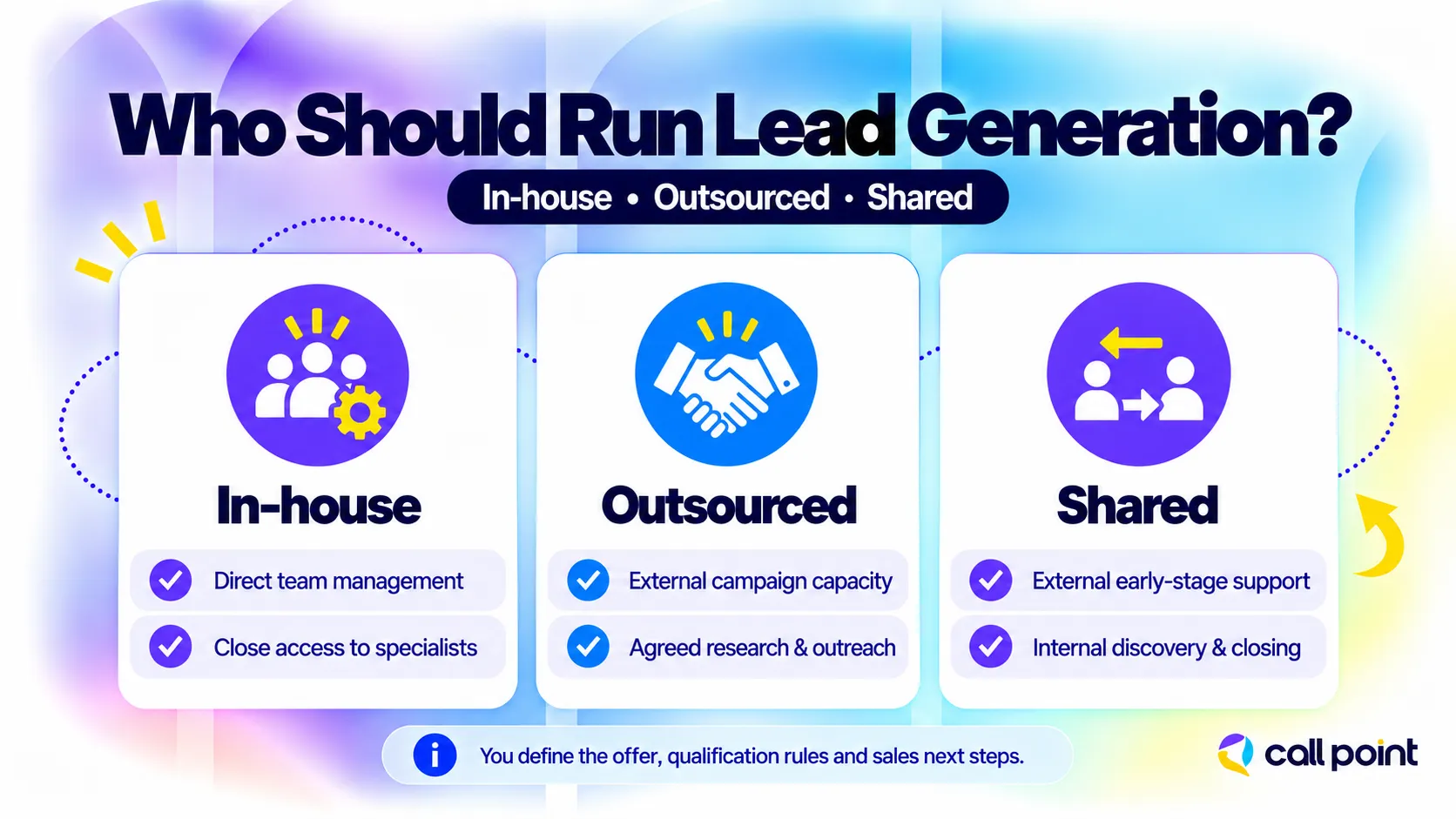
The right model depends on your offer’s complexity, available management capacity, and the work your team needs help completing.
An in-house team can suit a business that needs close access to product specialists and has managers available to train and coach representatives. You retain direct responsibility for staffing, research, systems, and daily execution.
Outsourced support can suit a defined offer and target market when research, outreach, or follow-up exceeds internal capacity. Evaluate how the provider trains representatives, records qualification details, and responds to sales feedback.
A shared model divides responsibilities. An external team might research accounts and manage initial conversations while internal specialists handle technical discovery, proposals, and closing.
Your company still needs to provide product knowledge, approve messaging, define qualification rules, and make salespeople available for accepted leads. Our guide to sales outsourcing options explains the wider responsibilities.
Costs depend on staffing, channels, data, tools, supervision, training, and campaign scope. When comparing proposals, check which items are included and what counts as a qualified deliverable.
How Call Point Supports B2B Lead Generation
Call Point Business Solutions provides lead generation and qualification support through its telemarketing and telesales services. Depending on the agreed scope, we can identify relevant business prospects, conduct outreach, qualify requirements, follow up, and arrange suitable sales conversations.
Before activity starts, we review your offer, target accounts, relevant roles, qualification criteria, approved messaging, and sales handoff. The assigned team receives campaign training and access to approved systems so conversations and outcomes can be recorded consistently.
Reporting, call and task reviews, supervisor checks, and client feedback guide campaign reviews and coaching. Your sales team uses the handoff to continue discovery, prepare proposals, and manage later sales stages according to the responsibilities agreed for the campaign.
Frequently Asked Questions
Can an Early-Stage B2B Company Start Without a Large Contact Database?
Yes. Start with a focused group of companies that match your offer and research the relevant people within them. Early conversations can help test your targeting and message. Expand the list once you understand which accounts and requirements justify further work.
Can Existing CRM Contacts Be Used in a New Campaign?
Existing CRM contacts may be suitable when their details, needs, and previous interactions are reviewed first. Check earlier replies, promised follow-up dates, current roles, opt-outs, and applicable outreach requirements. Exclude unsuitable records and explain the reason for reconnecting.
How Long Should You Test a B2B Lead Generation Campaign?
Set a review period that reflects the audience, channel, available activity, and typical sales cycle. Review data quality and execution early, then assess qualified leads and opportunities as enough results develop. Agree on checkpoints before launch so the campaign has clear evaluation criteria.
Does Every Qualified Lead Need to Be the Final Decision-Maker?
No. An operational stakeholder or internal champion may explain the requirement and help involve other buyers. Agree on acceptable roles before outreach begins. Record the contact’s responsibility and identify who else needs to participate before the purchase can move forward.
How Much Does B2B Lead Generation Cost?
B2B lead generation costs depend on your target market, outreach channels, staffing, data, tools, and qualification requirements. In-house costs include salaries, training, and supervision. Outsourced providers may charge a monthly retainer, per qualified lead, or per appointment. Compare what each fee covers and how the provider defines a qualified result. Track cost per qualified lead alongside accepted sales opportunities to assess value.
Final Thoughts
Before increasing outreach, write down what makes an account suitable and what sales needs before accepting a lead. Apply those criteria to a sample of recent inquiries and conversations. That review gives you a practical starting point for improving targeting, qualification, or follow-up.
If your team needs help carrying out that work, discuss your lead-generation campaign with Call Point.