
Accounting workload tends to grow quietly. A few extra supplier invoices become hundreds. Month-end reconciliations take longer. Someone has to chase missing receipts, update customer balances, check expenses, and prepare reports while still handling their normal finance responsibilities.
At that point, adding another employee is one option. Moving selected accounting work to an external team is another.
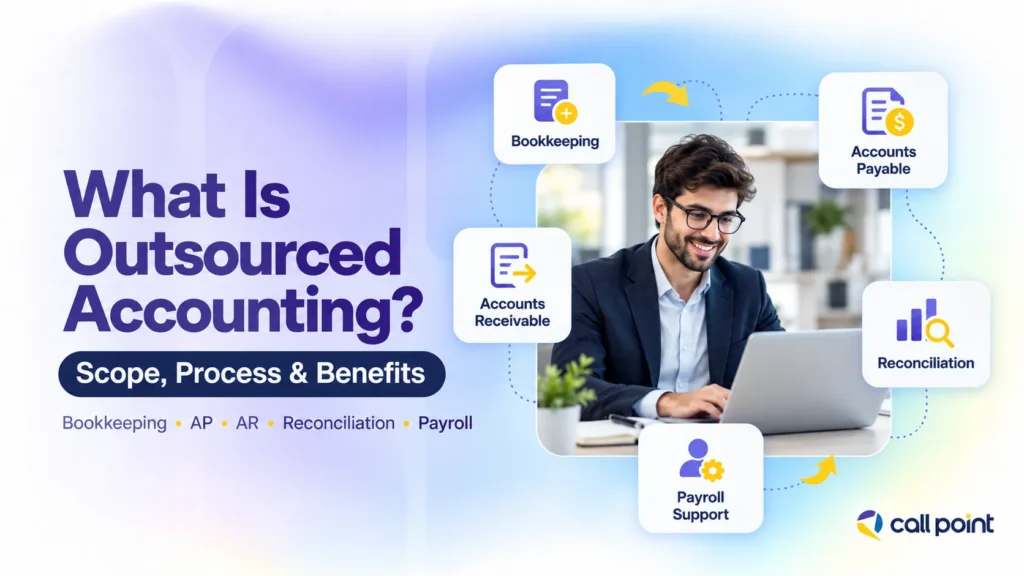
Outsourced accounting involves delegating specific financial tasks, such as bookkeeping, accounts payable, receivable and payroll administration to an external provider instead of managing everything in-house. The business still maintains responsibility for its financial decisions, and the aim of outsourcing is to transfer suitable tasks while retaining control and visibility over finances.
What Is Outsourced Accounting?
Outsourced accounting is an arrangement where a business uses an external team to perform agreed accounting tasks.
The scope can be small. A company may need help only with bookkeeping or monthly reconciliations. Another business may outsource much of its routine finance administration while keeping an internal finance manager, controller, CFO, accountant, or external adviser responsible for review and higher-level decisions.
That flexibility is one reason the term covers more than outsourced bookkeeping.
Bookkeeping mainly deals with recording and maintaining financial transactions. A broader accounting outsourcing arrangement can also include payables, receivables, reconciliations, payroll support, expense processing, month-end preparation, and reporting support.
There is no need to move the entire finance function outside the business.
For example, a growing company might keep financial planning and approval authority internally while using an external team to maintain day-to-day accounting records. Another business might retain its existing accountant but use outsourced staff to clear repetitive processing work that is taking up too much of the internal team’s time.
What Accounting Tasks Can Be Outsourced?
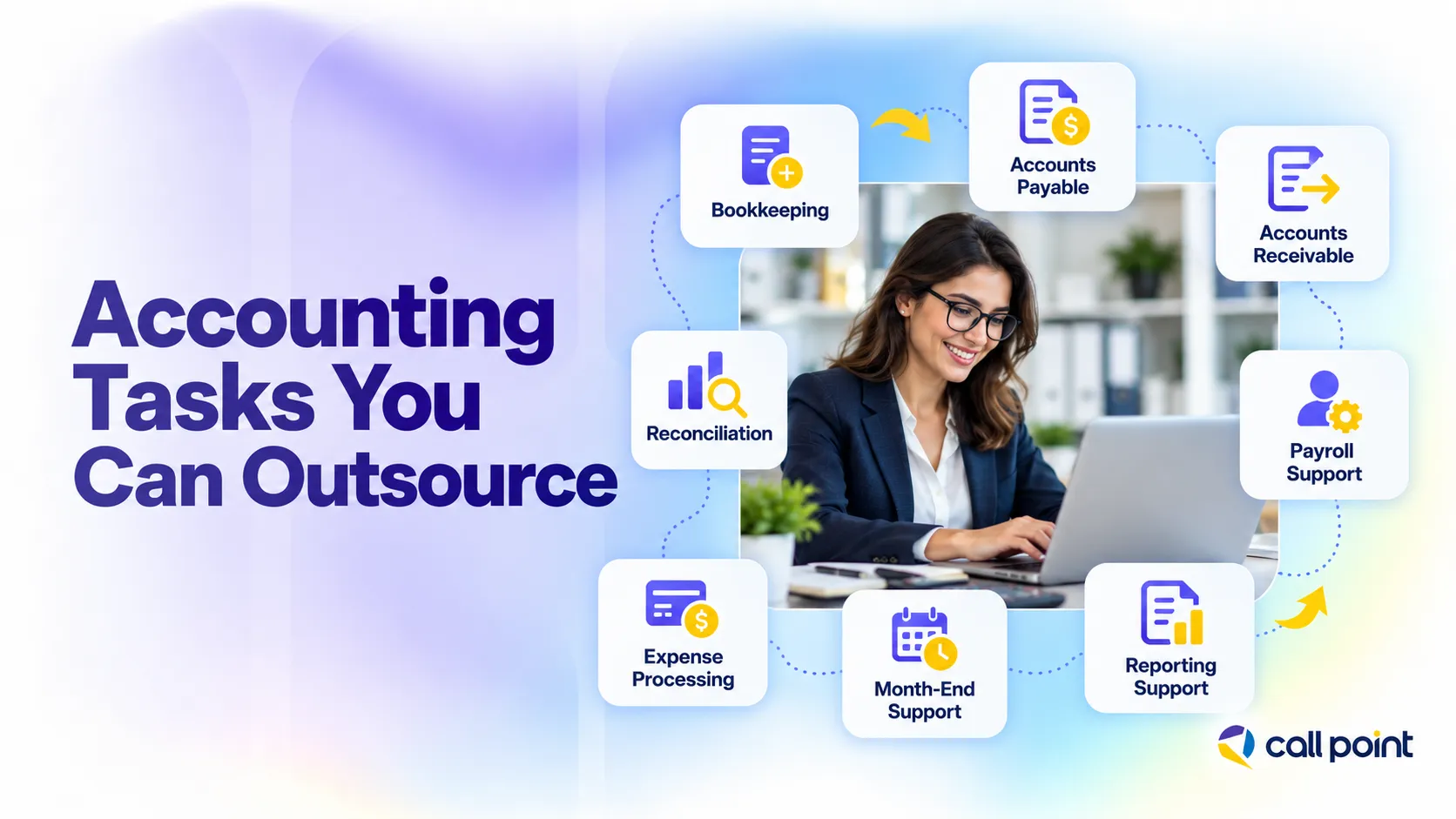
Accounting tasks are generally easier to outsource when the work follows a repeatable process, uses defined source documents, and can be reviewed against clear expectations.
Common areas include:
- Bookkeeping
- Accounts payable
- Accounts receivable
- Bank and credit card reconciliation
- Payroll support
- Invoice and expense processing
- Month-end support
- Management reporting support
The exact scope should depend on the business rather than on a provider’s standard service list.
A company handling a high number of supplier invoices may gain more from accounts payable support than from outsourcing several unrelated accounting activities. A professional-services business with relatively few transactions might need bookkeeping and month-end reconciliation but little AP support.
Bookkeeping
Bookkeeping is often one of the first accounting functions a business considers outsourcing because much of the work is recurring.
An external bookkeeper may record approved transactions, maintain general ledger information, organize source documents, classify expenses, and keep accounts ready for review.
The process becomes more valuable as transaction volume grows. Five company cards, several bank accounts, subscriptions, staff expenses, and hundreds of monthly transactions can create a sizeable workload even when no individual task is particularly complex.
What matters is having reliable records behind those entries. Outsourcing transaction processing does not solve missing invoices, unexplained transfers, or poor recordkeeping. Those issues still need a process inside the business.
Accounts Payable
Accounts payable outsourcing focuses on the money a company owes suppliers and vendors.
The outside team can receive invoices, check that required information is available, enter approved bills into the accounting system, match supporting documents, categorise expenses, update payable records, and prepare payment schedules.
Consider a facilities company receiving several hundred supplier invoices each month. Its outsourced accounting team could organise and enter the invoices as they arrive. Department managers could deal with disputed or unusual charges, while authorised people inside the company continue to review and approve payments.
That is more useful than simply telling an outside team to “manage AP.” Everyone knows where the routine work ends and where an exception needs attention.
Accounts Receivable
Accounts receivable support deals with customer invoices and outstanding balances. An external team may prepare invoices from approved billing information, record customer receipts, maintain account balances, update ageing reports, and identify overdue accounts.
Some businesses also allow an outsourced team to send approved payment reminders. If that is part of the service, the process should make clear what message can be used, when a balance should be escalated, and who deals with disputes.
A late invoice is an administrative problem. A customer disputing the amount may require a commercial decision. The workflow should recognise that difference.
Bank and Credit Card Reconciliation
A reconciliation checks whether internal accounting records agree with information from another source, such as a bank or credit card statement.
The work is not just about making two totals match.
If a deposit is missing, a transaction has been entered twice, or an old payment remains outstanding, the difference needs to be investigated and explained. An outsourced team can prepare the reconciliation and resolve routine issues while passing unusual items to the appropriate person for review.
For many businesses, this becomes particularly useful around month-end when several accounts need to be reviewed within a short period.
Payroll Support
Payroll administration can involve employee records, timesheets, approved pay information, payroll reports, and coordination with the company’s payroll platform or external payroll provider.
What an outsourced team can perform will depend on the systems being used and the country in which the business operates.
Payroll, tax, employment, and reporting obligations vary significantly between jurisdictions. A provider can support the administrative process, but businesses should confirm local legal and tax requirements with appropriately qualified professionals in the relevant country.
That distinction matters for a global audience. A payroll process suitable for an Australian employer may not satisfy the requirements of a company operating in the United Kingdom, Canada, New Zealand, the United States, or another market.
Month-End and Financial Reporting Support
Month-end often brings together work that has been happening throughout the month. Transactions need to be current. Accounts need to be reconciled. Unusual balances may need investigation. Supporting schedules have to be prepared before management can rely on the reports.
An outsourced team can support this preparation work by maintaining records, completing assigned reconciliations, updating schedules, and organising reporting data.
The value is not that an outside provider automatically makes better financial decisions. It is that the people responsible for those decisions can receive cleaner and more current information without doing every processing task themselves.
How Does Outsourced Accounting Work?
Good accounting outsourcing starts before the outside team touches the accounting system. The first job is to define the process.
A practical setup often follows this sequence:
- Identify the work. Decide exactly which activities are moving outside the internal team.
- Define ownership. State who prepares, reviews, approves, and resolves exceptions.
- Document the workflow. Record deadlines, systems, source documents, coding rules, and escalation points.
- Set access permissions. Give the team access to the systems and information required for its job, not everything the business owns.
- Transfer process knowledge. Walk through real transactions, common exceptions, and reporting requirements.
- Establish approval controls. Keep payment, banking, write-off, or other sensitive authority with the appropriate people.
- Start the service. Begin processing against the agreed timetable.
- Review exceptions and completed work. Do not judge service quality only by whether tasks were marked complete.
- Monitor the process. Review recurring errors, open items, reporting quality, communication, and changing workload.
The workflow matters more than the label.
Two companies might both say they outsource accounts payable while operating completely differently. One sends invoices by email once a week. Another uses purchase orders, approval software, department codes, three legal entities, and separate payment schedules.
What Are the Benefits of Outsourcing Accounting?
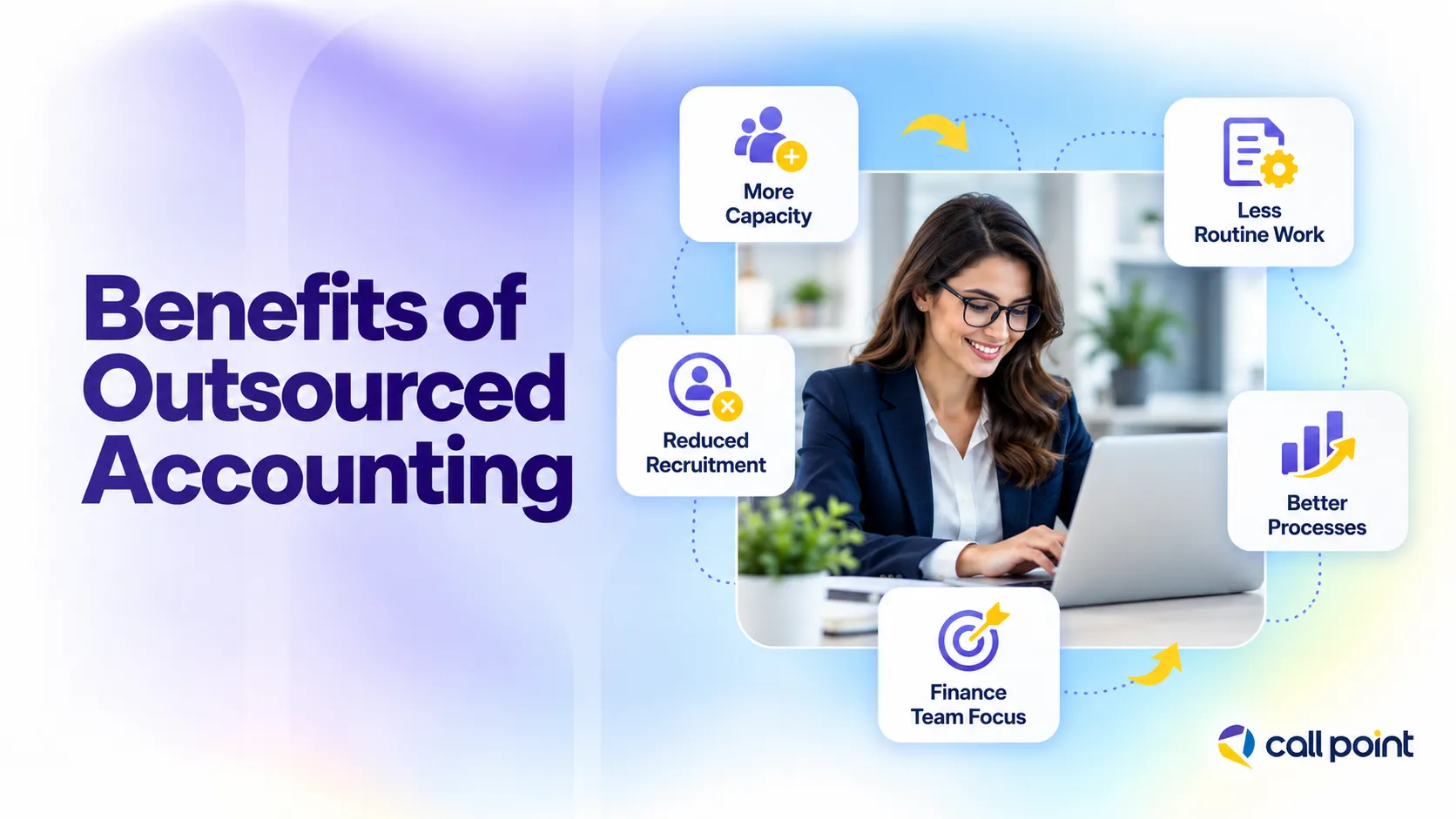
The practical value of outsourced accounting comes from how work is distributed. A business can move suitable processing activities to an external team while keeping internal finance staff focused on work that requires deeper knowledge of the company, greater judgement, or direct management involvement.
Additional Accounting Capacity
An outsourced team can provide extra processing capacity when the existing finance function is already busy.
That may be enough to keep invoices current, complete reconciliations on time, or maintain customer accounts without recruiting a new employee for every increase in workload.
The benefit becomes clearer when the company needs several types of routine support but does not have enough work in any one area to justify a separate full-time role.
Less Pressure on Internal Finance Staff
Experienced finance professionals create significant value by focusing on analysis and interpretation instead of data entry. By outsourcing repetitive tasks, we enable our teams to spend more time on critical activities like budgeting, forecasting, and cash-flow management. This shift allows our team to excel and drive impactful results.
Reduced Recruitment Burden
Hiring accounting staff involves more than salary. The company also has to recruit, onboard, train, supervise, cover absences, and replace people when they leave.
With an outsourced service, the provider manages its staffing structure while the client manages the relationship, workflow, and expected output.
There is still management involved, but it is management of a process rather than every individual employment requirement.
Better-Defined Processes
Informal accounting procedures often work because one employee knows what to do when something unusual happens. That becomes a weakness when the person is absent or leaves.
An outsourced team needs instructions that other people can follow. Which documents are required? When should an invoice be escalated? Which account code applies? When is the monthly close? Who needs to answer a question?
Documenting those points can make the accounting workflow easier to understand, regardless of who performs it.
Why Do Businesses Outsource Accounting?
Businesses usually start looking at accounting outsourcing because an existing workflow is taking too much time, falling behind, or becoming difficult to staff.
Growth is a common trigger.
A company that once processed 100 transactions a month may now handle 1,000. The accounting process did not suddenly become bad; it simply outgrew the team and workflow that were built around the smaller business.
Another common situation is experienced finance staff spending too much of their week on routine processing. A finance manager who is entering invoices, chasing receipts, or correcting transaction records has less time available for cash-flow planning, forecasting, financial review, controls, and management questions.
Staffing can create pressure as well. Accounting workloads rarely fit neatly into one job description. Bookkeeping may be needed throughout the week, payroll support at particular intervals, reconciliations at month-end, and reporting work shortly afterward.
Outsourcing gives businesses another way to organise that workload without assuming every increase in activity requires another full in-house position.
It can also provide short- or long-term support after a resignation, new contract, market expansion, system change, or rapid increase in transaction volume.
The reason for outsourcing should determine what gets outsourced. Moving more work outside the business does not automatically produce a better process.
What Are the Risks of Outsourcing Accounting?
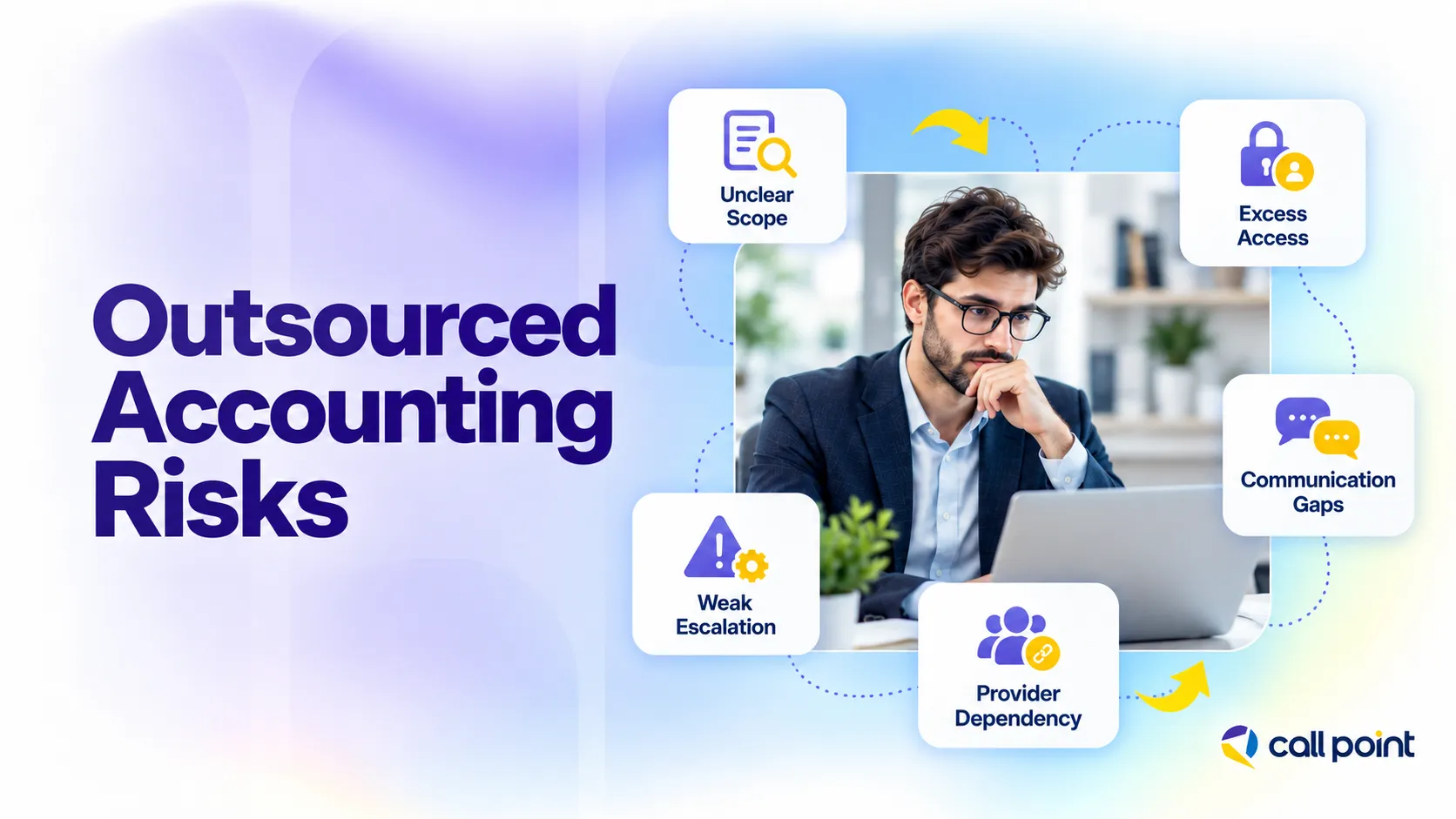
Outsourced accounting introduces its own operational risks. Most are manageable, but they should be considered before the service starts.
One risk is an unclear scope. If the instruction is simply “handle our accounts,” the provider and client may have different expectations about reconciliations, collections, payroll administration, reporting, or month-end work.
Access is another issue. Financial systems contain sensitive information, so permissions should reflect assigned responsibilities. International guidance on internal control also emphasises the importance of defining responsibilities, monitoring controls, and integrating them into the organisation’s wider governance and risk-management processes.
Communication can create delays as well. An invoice might sit unresolved because nobody knows who should answer a coding question. A customer balance may remain open because the outsourced team does not have an agreed dispute procedure.
A practical service therefore needs a named contact and a way to escalate questions.
There is also a risk of becoming too dependent on the provider. The business should continue to understand its own accounting workflow, retain important records, know how systems are administered, and maintain access to process documentation.
Outsourcing should add capacity. It should not make the underlying accounting process harder for the business to understand.
Outsourced Accounting vs In-House Accounting
Neither model is automatically better. The suitable option depends on the workload, internal expertise, need for direct supervision and the type of accounting work involved.
| Factor | In-House Accounting | Outsourced Accounting |
| Staffing | Employees are hired directly | Provider manages its delivery team |
| Recruitment | Managed internally | Managed mainly by the provider |
| Daily supervision | Direct internal management | Managed through agreed workflows and service expectations |
| Company knowledge | Usually develops through direct involvement | Requires structured knowledge transfer |
| Cost structure | Includes salary, benefits, recruitment, training, software, and other employment costs | Can reduce staffing and overhead costs by paying for the defined support or service scope needed |
| Systems | Internal user access | Controlled access for external users |
| Best fit | Work requiring continuous internal involvement | Defined processes that need additional capacity |
Many companies use both.
A business may have an internal controller or finance manager while outsourcing bookkeeping, reconciliations or accounts payable. This can keep financial leadership close to the company while moving some repetitive processing elsewhere.
The right question is therefore not always “Should we outsource accounting or keep it in-house?”
It may be “Which parts of our accounting process actually need to remain in-house?”
How Do You Choose an Outsourced Accounting Provider?
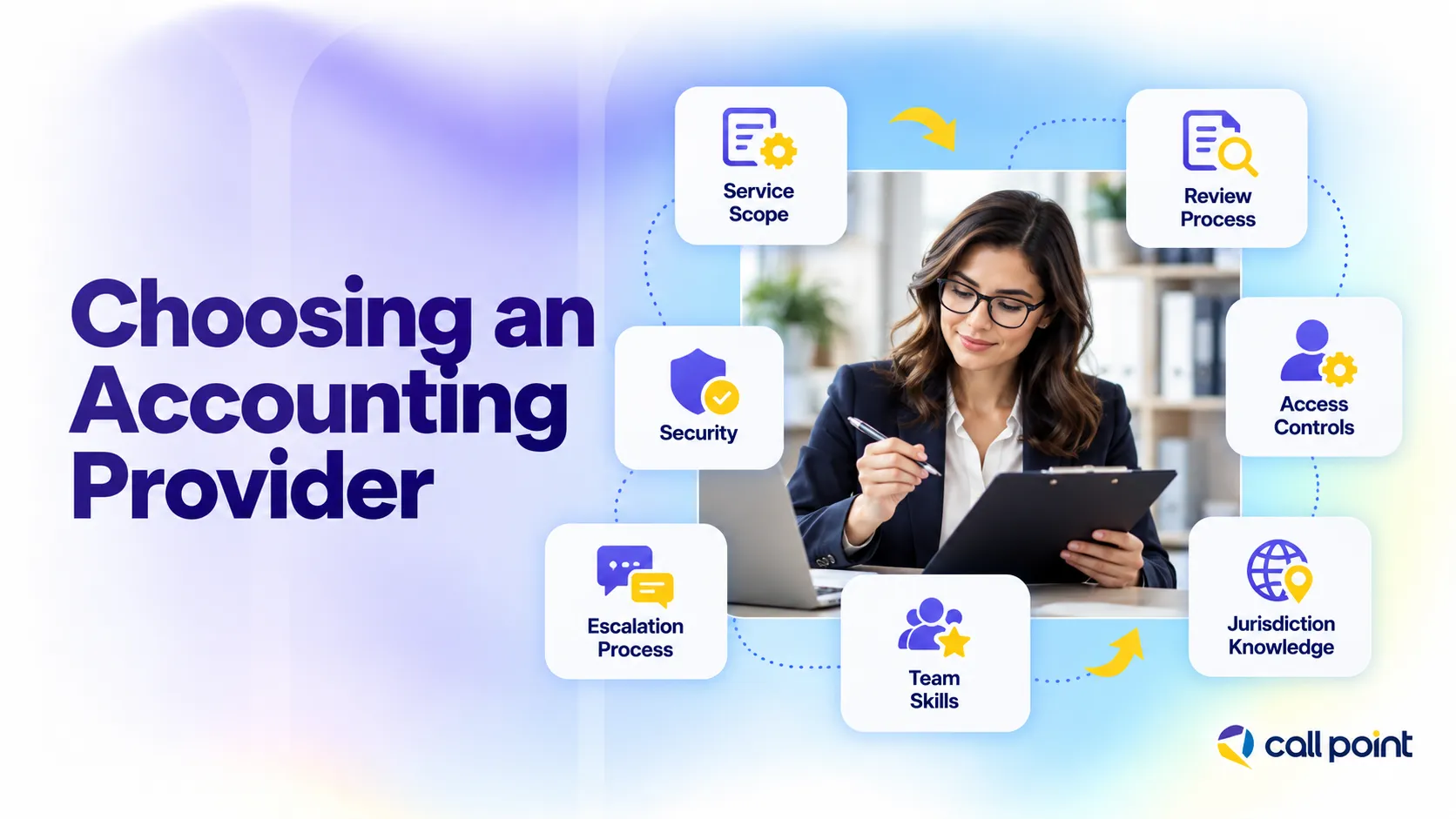
Start with the accounting work you actually need rather than comparing providers only by their service menus.
If accounts payable is the problem, ask how invoices are received, entered, checked, queried, and reported. If reconciliations are falling behind, ask who prepares them, how unresolved differences are handled, and who reviews the work.
Operational questions reveal much more than claims such as “accurate service” or “expert accounting.”
Ask who will work on the account, who reviews completed tasks, how errors are corrected, how questions are escalated, and what happens if the main assigned team member is unavailable.
Security also deserves specific questions. Instead of asking whether a provider “takes security seriously,” find out how users receive access, whether permissions can be restricted, how credentials are managed, and how access is removed when someone no longer needs it.
For international businesses, capability should also include jurisdiction awareness.
Accounting standards can differ from one country to another. The IFRS Foundation provides guidance on the use of IFRS Accounting Standards by jurisdiction, while individual countries may also apply their own company law, tax rules, payroll requirements, filing obligations, and professional licensing standards.
A provider must clearly define its services and identify when local accountants, tax advisors, auditors, payroll specialists, or other qualified professionals need to be involved.
How Call Point Supports Outsourced Accounting
One of our commercial cleaning clients was dealing with a growing finance workload as the business expanded. Supplier invoices, expense records, and routine bookkeeping were taking more time from the internal team, while managers still needed to focus on operations, staff, and client service.
Call Point helped move defined accounting tasks into a more structured workflow. Our team supported bookkeeping, invoice processing, expense tracking, and other agreed finance administration, while the client kept payment approvals and financial decisions internally. This reduced the amount of repetitive accounting work sitting with the client’s management team.
The result was a clearer division of responsibilities and a more consistent process for routine accounting tasks. Call Point continues to work within the client’s systems, approval rules, and reporting requirements so the outsourced support fits the way the business already operates.
Frequently Asked Questions
Is Outsourced Accounting the Same as Bookkeeping?
No. Bookkeeping can be part of outsourced accounting, but the overall service may cover much more. Depending on the scope, outsourced accounting can include bookkeeping, AP, AR, reconciliation, payroll administration, invoice and expense processing, month-end preparation, and management-reporting support.
Can a Small Business Outsource Its Accounting?
Yes. The decision should depend more on the accounting workload than on the number of employees. A small company processing large transaction volumes may benefit from external support, while a much larger company with a simple finance workflow may comfortably keep most accounting activities in-house.
Can an Outsourced Accounting Team Work With Our Existing Accountant?
Yes, if the roles are clearly defined. An outsourced team may perform routine accounting preparation while an internal accountant, external accounting firm, finance manager, controller, CFO, tax adviser, or auditor handles work that requires deeper review or professional judgement.
Is Outsourced Accounting Secure?
Security depends on how the service is designed and managed.
Role-based permissions, controlled credentials, individual user accounts, documented workflows, access reviews, and clear escalation procedures can reduce unnecessary exposure. Businesses should assess the provider’s actual controls rather than assuming that outsourcing is either automatically secure or insecure.
Do Accounting Rules Change by Country?
Yes. Accounting standards, tax requirements, payroll obligations, financial reporting rules, and professional licensing can vary by jurisdiction.
Businesses operating internationally should confirm which standards apply and use appropriately qualified local professionals when the work requires jurisdiction-specific tax, audit, legal, or regulatory expertise.
How Much Do Outsourced Accounting Services Cost?
Cost depends on the work being outsourced. Transaction volume, service scope, number of accounts, reporting needs, payroll activity, accounting complexity, team structure, software, and cleanup requirements all affect the price. Ask providers to define exactly what is included before comparing their fees.
Final Thoughts
Outsourced accounting can be a practical option when routine finance work starts taking too much time from your internal team. The goal is not to move every accounting responsibility outside the business, but to identify repeatable tasks that can be handled efficiently while your team keeps control of approvals, financial decisions, and higher-level review.
If bookkeeping, invoice processing, reconciliations, or other accounting tasks are creating a backlog. Call Point Business Solutions can help you build a clear outsourced workflow around your existing systems and processes. Contact our team to discuss your accounting support requirements and request a customized outsourcing proposal.