

Despite the rise of chat, email, and automation, phone support still holds a strong place in customer communication. Recent surveys show that a large share of customers prefer speaking to a real person when they need help or information.
This shift keeps inbound and outbound call centers relevant for businesses that want reliable support and steady outreach.
Inbound teams handle questions, issues, and service needs, while outbound teams focus on reaching prospects, gathering insights, and driving new opportunities.
Together, they shape how a company manages customer expectations, builds trust, and supports long-term growth across different stages of the customer journey.
Key Takeaways
- Inbound handles customer support, while outbound focuses on sales outreach and lead generation.
- Inbound improves loyalty and retention through quick, personalized issue resolution.
- Outbound drives growth by generating leads, conducting research, and boosting brand visibility.
- Inbound calls include customer service, tech support, sales, upgrades, and payment processing, while outbound calls include cold calls, warm calls, appointment setting, lead generation, telemarketing, and market research.
- A hybrid approach balances retention and expansion by combining inbound support with outbound engagement.
- Both call types provide valuable customer insights, helping businesses refine products, services, and marketing strategies.
What are Inbound Call Centers?
An inbound call center is where customers call in when they need help or have questions about any product or service. These call centers receive customer calls and help them with orders, answering questions, and solving product or service issues.
Let’s say your customer has a problem with a recent purchase or needs help logging into their account. An inbound team will step in to resolve their issues. The team agents are trained to listen, guide, and fix issues as quickly as possible so the customer leaves satisfied.
Most inbound centers use systems like IVR menus to route calls to the right person and CRM tools to pull up customer info instantly.
Inbound call centers exist in industries that require real-time support, including banking, e-commerce, healthcare, and tech.
Amazon, for instance, uses inbound centers to handle everything from delivery updates to refund requests.
What are Outbound Call Centers?
An outbound call center, as the name implies, is where the calls go out instead of coming in. Here, call center agents proactively place calls to potential or existing customers.
The calls are meant for lead generation, new product launch, feedback collection, sales outreach, appointment scheduling, or as reminders.
Outbound call centers use tools like auto-dialers and CRM software to smooth up the entire workflow. With these tools, agents can skip voicemails, track who they’ve spoken to, and pick up exactly where the last call left off.
Like inbound centers, outbound centers also exist in almost every industry. And that includes real estate, finance, healthcare, and more.
HubSpot’s sales team is a perfect example of how an outbound call center should operate. They call leads who signed up for a demo or downloaded a guide. They also make calls to understand the customers’ needs and thereby offer solutions that fit.
How do inbound and outbound call centers differ
| Inbound Call Center | Outbound Call Center |
| Handles incoming calls from customers. | Makes outgoing calls to customers or prospects. |
| Focused on customer service and support. | Focused on sales, lead generation, and outreach. |
| Agents respond to customer queries or issues. | Agents initiate contact with customers. |
| The goal here is to resolve problems and ensure satisfaction. | Here, the goal is to promote products, gather feedback, or close deals. |
| Performance is measured by response time and customer satisfaction. | Performance is measured by conversion rate and the number of successful calls. |
| Commonly used for product support, order tracking, and account management. | Commonly used for product promotion, follow-ups, and customer retention calls. |
6 Types of Inbound Calls
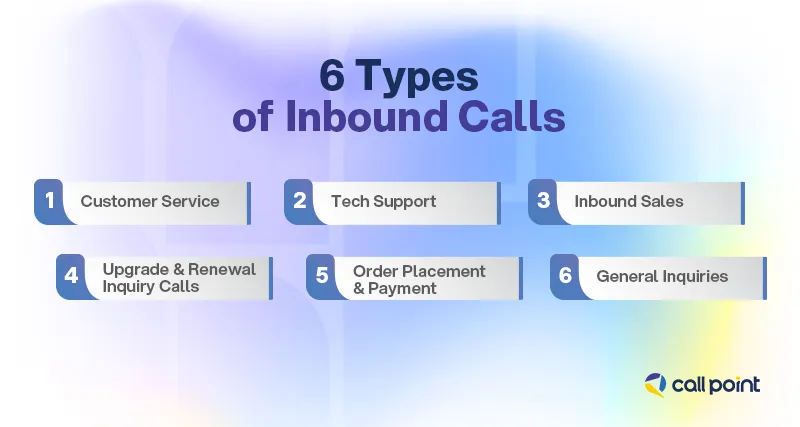
Common inbound call types include customer service, technical support, inbound sales, upgrade and renewal inquiries, payment and order processing, and general questions. Each type serves as a key touchpoint to resolve issues, provide guidance, retain customers, and create sales opportunities.
1. Customer Service
Customer service is a key function of inbound call centers where customers call for help, info, or to report issues. These calls often involve delivery delays, billing problems, product defects, returns, or general questions.
Beyond solving problems & responding to queries, an inbound customer service team focuses on building trust & customer loyalty through empathy, clear communication, and reliable support.
2. Tech Support
Technical support focuses on helping customers solve technical issues with a product or service. It could be troubleshooting errors, setup help, or guiding through configurations.
For example, when a customer struggles to connect their new Wi-Fi router, a support agent patiently walks them through each step until it’s fixed.
3. Inbound Sales
Inbound sales occur when representatives handle calls from people already interested in a product. These agents listen carefully, understand customer needs, and suggest the best fit.
Thriving in this area requires strong communication, product knowledge, and persuasion skills to turn curiosity into a confident purchase.
4. Upgrade & Renewal Inquiry Calls
Upgrade and renewal inquiry calls involve existing customers wanting to renew or explore better versions of what they use.
When managed well, these calls not only retain customers but also increase revenue as many choose premium upgrades or add-ons.
5. Order Placement & Payment
Order placement & payment calls entail customers making calls over the phone to place orders & make payments, even with online options available.
They value speaking to a real person who confirms stock or pricing details. This personal conversation makes them feel secure about their purchase.
6. General Inquiries
General inquiries involve questions about office hours, company policies, or availability. But they’re often the first touchpoint for new customers.
A quick & polite response here sets the tone for trust and can easily open the door to future sales or support opportunities.
7 Types of Outbound Calls

The main types of outbound calls include cold and warm calls, appointment scheduling, lead generation, telemarketing, telesales, and market research. The customer insights from these conversations facilitate a company’s product development workflow, marketing, & service strategies.
1. Cold Calls
Cold calls are proactive calls made by telemarketing agents to people who haven’t previously interacted with the company. Here, the recipient isn’t expecting the call. So, it can sometimes lead to frustration.
That’s why callers have to show resilience, confidence, and the ability to handle rejection gracefully.
Take Salesforce for example. They have their in-house cold calling team who carries out the job regularly as part of their business development task. They create a prospect list first, build call scripts, and then make personalized calls to create awareness.
2. Warm Calls
Warm calls involve telemarketers reaching prospects who have had some prior interaction with the company, such as a previous inquiry, referral, or event attendance.
Because the recipient is somewhat familiar with the brand, these calls are generally better received and have higher conversion potential.
Following up with someone who downloaded an eBook or requested a demo is an ideal instance of warm calls. This type of call turns curiosity into a purchase discussion if handled deftly.
3. Appointment Setting
These calls focus on scheduling meetings between potential clients and the sales team. Agents contact prospects to arrange convenient times for discussions, ensuring the lead stays engaged.
Call Point Business Solutions offers an outbound calling service for appointment setting across various industries. We have helped tons of our clients convert prospects into customers through booking appointments via calls.
4. Lead Generation
Lead generation calls aim to identify prospects and gather information about their needs and interest level. Your agents will reach out to spark curiosity and qualify potential buyers.
Robbie, the owner of a property management company, approached AltaLeads to generate leads. The agency ran a lead generation campaign via cold calling with its Pro cold callers.
And the result was phenomenal. From 10K+ calls in 20 days, they generated 39 leads from which 5 converted into paying customers.
5. Telemarketing
Telemarketing involves actively promoting a product or service to a targeted list of potential customers via voice calls. Unlike lead generation, it focuses on generating immediate interest and encouraging the prospect to take action.
Cognism reports, on average, connecting with a lead takes three cold call attempts. They also add, the success rate for having a conversation from a cold call is 65.6%
6. Telesales
Telesales is when your agents follow up on qualified leads to guide them from interest to purchase. It’s closely related to telemarketing, but it has a specific goal, and that is closing the sale.
Thunderbit discloses, the typical sales close rate across industries is around 20%. That means only one in five prospects becomes a customer.
However, close rates differ by sector. Computer Software averages 22%, Finance ~19%, Electronics ~23%, and Business/Industrial ~27%.
7. Market Research Calls
Not all outbound calls are about sales. Market research calls aim to gather insights about products, services, or brand perception. Your agents will ask structured questions to understand customer opinions, preferences, or needs, which will help your business refine offerings.
Imagine you own a consumer goods company. Now, you want to launch a new product. Your outbound callers can survey households about it widely before the launch. These calls will provide valuable data related to the product demand, which will help shape marketing and product strategies.
4 Key Benefits of Inbound Call Center Services
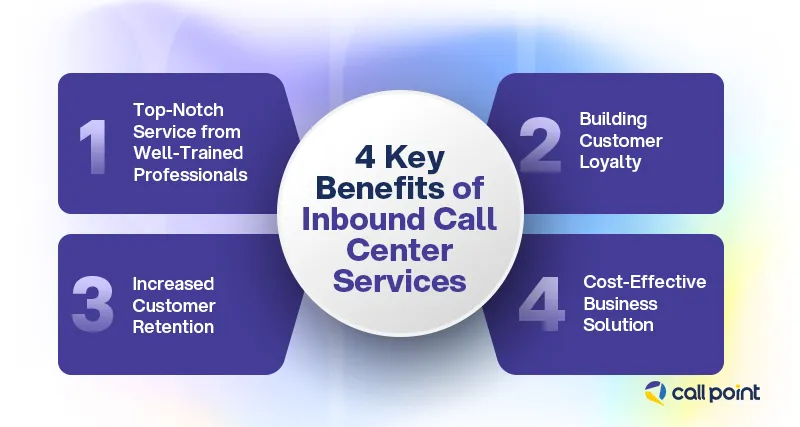
Inbound call center services will give you access to trained call center agents, help build customer trust, increase customer retention, and offer a cost-effective solution. They will empower your businesses with smooth & round-the-clock support while maintaining efficiency and cost control.
Top-Notch Service from Well-Trained Professionals
Inbound call center services ensure every customer interaction is handled professionally with care. The best providers have skilled agents who use advanced tools like CRM systems, AI-based call routing, and real-time analytics to deliver efficient and personalized support.
At Call Point Business Solutions, our trained professionals combine technology with empathy to provide a smooth customer experience that reflects your brand’s values & boosts satisfaction.
Building Customer Loyalty
Excellent customer service is the foundation of loyalty. When customers know their concerns are heard and resolved quickly, they’re more likely to trust and stay with your brand.
Inbound call centers focus on consistent & quality communication. They value customer feedback and act promptly to resolve both severe & non-severe issues. This turns one-time buyers into long-term loyal customers who subscribe to your business.
Increased Customer Retention
Always remember, retaining existing customers is easier and more cost-effective than acquiring new ones. And through Inbound call center services, you can retain customers by maintaining strong customer relationships.
You can provide proactive support, follow-ups, and personalized solutions faster & better. This will help your business reduce churn, stabilize revenue, and build lasting customer connections.
According to Live Agent, companies that improve customer experience see a 42% increase in customer retention and a 33% improvement in customer satisfaction. And professional providers like Call Point Business Solutions will help you maximize your CX.
Cost-Effective Business Solution
Outsourcing inbound call services significantly cuts operational costs as it reduces the need for in-house staff, equipment, and infrastructure.
Your onsite staff can focus on core operations, while your chosen provider maintains high-quality support. Over time, this cost efficiency translates into better profitability and sustainable growth.
Take the example of Financial Services Inc. Before outsourcing, FSI’s fully loaded cost per call was $9.85, including direct labor, facilities, technology, and management overhead. After outsourcing, the blended cost per call declined to $5.40, representing a 45% reduction.
3 Core Benefits of Outbound Call Center Services
Outbound call center services will help your business proactively connect with customers, identify new opportunities, and strengthen market presence. With the combination of data, strategy, and communication, they drive measurable growth and brand visibility.
Conduct Market Research
Experienced outbound call centers conduct thorough market research to enable your business to understand customer preferences, competitor activity, and market demand.
With advanced CRM systems, automated dialers, and analytics tools, agents collect real-time insights that guide smarter business decisions. Consequently, you can refine your strategies and launch more targeted campaigns effectively.
Scale Up Brand Awareness
Proven call centers master handling high call volumes efficiently with advanced CRM tools, AI-driven analytics, and 24/7 operations. Their well-versed agents know how to overcome communication gaps, manage customer diversity, and ensure brand consistency across every interaction.
Our dedicated call center agents reach potential customers directly, share product updates, gather feedback, & create meaningful engagement that keeps the brand top-of-mind. Over the years, we have been building credibility and consolidating brand recognition across markets.
Maximize Lead Generation and Sales
As per TeleCMI’s recent statistics, companies using outbound calling centers have seen a rise in their number of converted sales by 30%
Outbound call centers play a vital role in generating qualified leads and boosting conversions. Skilled agents connect to prospects with personalized pitches, follow up on warm leads, and nurture relationships through consistent communication.
This proactive outreach increases sales opportunities and helps businesses achieve faster revenue growth.
Examples of Inbound & Outbound Call Centers
Many global companies rely on inbound and outbound call centers to enhance customer experience and grow their business.
Amazon, for example, efficiently manages inbound customer queries through AI-powered systems and skilled agents.
On the contrary, American Express uses outbound call centers to follow up with customers, promote offers, and strengthen loyalty, which leads to better engagement and retention.
However, not all outsourcing stories are successful. Some companies, like British Airways, faced customer backlash after outsourcing their call centers to a third-party provider.
Their customers experienced inconsistent communication, a language barrier, and overall low-quality service from the provider. These challenges highlight the importance of choosing the right outsourcing partner, one that balances cost efficiency with customer satisfaction.
That’s where Call Point Business Solutions makes a difference. We boast trained & multilingual agents who use modern CRM tools, AI-based call routing, omnichannel support, and real-time analytics to ensure optimum service quality.
Our agents handle inbound and outbound calls professionally to ensure your brand remains consistent and trustworthy. Hence, you can turn the outsourcing challenges into opportunities & amplify brand awareness, lead generation, and sales.
Choosing Between Inbound and Outbound Call Center Services
Whether you should pick inbound or outbound call center service depends entirely on your business goals and target audience.
For instance, service-oriented sectors like healthcare or banking benefit most from inbound support that resolves customer concerns quickly.
In contrast, businesses in retail or real estate rely on outbound centers to connect with new customers and expand their reach.
Now, ask yourself! For which customer-centric area of your business, you want to address? You can even go for a blended or hybrid call center model.
A hybrid approach will work for you if your focus is on balancing retention and growth. In such a case, you can combine inbound support with outbound sales to deliver a complete customer experience.
No matter your business type, we have collaborated with thousands of businesses globally across industries and made our name.
Over to You
The ball is in your court now! Whether your goal is customer care, business expansion, or both, providing a call center service can help you achieve any of them. But having an in-house call center isn’t worthwhile every time due to various challenges I discussed above.
Partner with Call Point Business Solutions to create personalized inbound, outbound, or blended call strategies that drive intended results.