


Customer support plays a major role in how people judge a business today. Studies show that 73% of customers switch to a competitor after repeated bad experiences, while 78% are willing to give a brand another chance when the support feels reliable and helpful.
With more products offering similar features and pricing, the way a company responds to customer issues has become a core part of its identity.
Modern support now blends human interaction, digital channels, and automation to keep problems from turning into frustration. When done well, it reduces churn, strengthens trust, and improves the overall experience for every customer.
Key Takeaways
- Customer support is how a company troubleshoots customers’ problems and answers their queries related to its product or service.
- Customer support builds loyalty and trust by resolving issues quickly.
- It includes multiple types like email, phone, chat, self-service, and social media.
- Great support reduces churn and consolidates brand reputation.
- Its key functions include handling inquiries, troubleshooting, product returns, tech help, and feedback collection.
- Modern methods like personalization and omnichannel service boost customer satisfaction.
- The integration of AI and automation makes customer support faster and more efficient.
What is Customer Support

Customer support is the process a company uses to answer customers’ questions and resolve their issues related to its products or services.
When a customer contacts the company they purchased a product or took a service from, the support team connects with them straightaway. They typically reach out for support via live chat, email, phone, social media, or other available channels.
For example, in a software company, customer support guides users in learning a new tool. If someone can’t set up an integration or encounters a bug, the support team steps in to troubleshoot, explain, and get them back on track.
Their help, consequently, turns potential frustration into a smooth and positive user experience.
9 Types of Customer Support
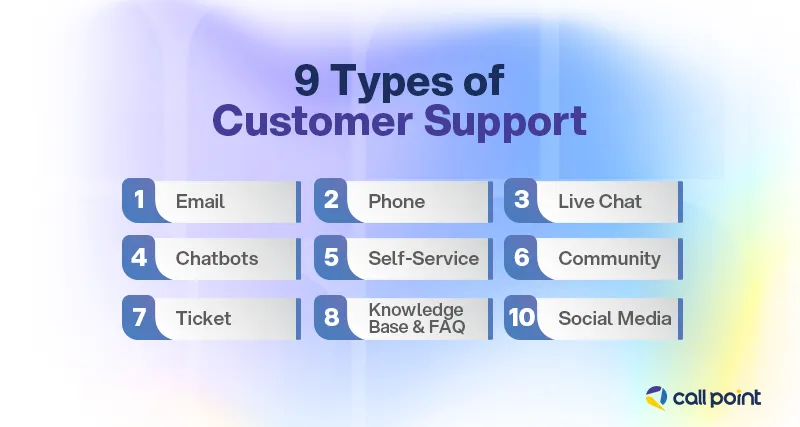
Customer support takes many forms, but these 9 types are widely used across industries. They include email, phone, live chat, chatbots, self-service, community support, ticket-based help, knowledge base & FAQs, and social media support.
1. Email
Email support is a customer service channel in which businesses assist customers via email communication. It allows users to send detailed queries, notify about issues, attach files, and receive well-documented responses without needing real-time interaction.
E-commerce brands regularly use email support to handle return requests or order discrepancies. Also, SaaS companies are known to resolve software bug reports through email communication.
2. Phone
Phone support is when a customer calls a dedicated line to speak directly with a customer support representative. It’s a super useful medium to resolve urgent issues or sensitive concerns. The personal touch experienced through this channel builds trust and reassures users.
Think of a bank where clients call to clarify unexpected charges. This real-time interaction makes a big difference in providing the best-in-class support.
3. Live Chat
Live chat support is a real-time online customer service channel where agents interact with customers via a chat window on a website or app. It allows instant answers to customers’ questions, quick troubleshooting, and improved customer experience while users browse.
Live chat is popular among travel companies to help passengers reschedule flight bookings or cancel flights.
4. Chatbots
Chatbot support is an automated support system that uses AI to answer routine questions instantly based on pre-set rules. This reduces workload for human agents and ensures 24/7 availability.
In the healthcare industry, chatbots help schedule appointments or provide preliminary symptom guidance.
5. Self-Service
Self-service is a support system where customers find solutions to their problems on their own without connecting with an agent. Through portals, tutorials, or guides, users can resolve issues independently. This not only saves time but also empowers customers.
Software companies often provide step-by-step setup guides to make user learning effortless. Also, utility providers let users check billing or usage history online.
6. Community
Community support is a customer service channel where users help each other through forums, groups, or online communities. It reduces repetitive queries and fosters engagement.
Gamers, for instance, often solve each other’s gameplay issues by engaging in communities. Even tech product users exchange troubleshooting advice for devices like smart home gadgets.
7. Ticket
Ticket support is a system that tracks and manages customer requests by creating individual tickets. Agents receive, prioritize, & resolve these tickets to ensure every issue gets addressed efficiently. This organized approach helps prioritize urgent problems and maintain accountability.
IT service teams rely on ticketing for hardware or software troubleshooting. Also, SaaS companies use it for bug reports or feature requests.
8. Knowledge Base & FAQ
Knowledge base & FAQ support provides customers with self-help resources like articles, guides, and frequently asked questions. They allow customers to solve issues & find answers to their queries independently and quickly.
Software companies, for instance, create tutorials for feature usage. This strategy reduces support load while keeping users satisfied.
9. Social Media
Social media support is where brands respond to customers’ questions, complaints & feedback on platforms like Facebook, Twitter (X), and Instagram. Support team responds to public posts & comments and also handles personal, sensitive, & detailed issues via DMs.
Airlines, for example, regularly handle flight delay updates on Twitter. E-commerce brands resolve customer queries via Facebook.
And the good thing is that we offer all these types of customer support for all industries globally. We have multilingual professionals who can interact inlanguages other than English.
Why Customer Support is Important?
As per Salesforce research, if a company’s customer service is excellent, 78% of consumers will do business with them again after a mistake.
Prompt, helpful, and empathetic support doesn’t just solve problems. It builds trust, loyalty, and long-term relationships. Customers who feel supported are more likely to return, recommend your business, and even excuse minor mistakes.
Beyond retention, good customer support can differentiate your brand from competitors. In crowded markets, products or services might be similar in price and quality. But exceptional support makes your business stand out.
The support system also creates a channel to receive valuable customer feedback. This helps companies improve their offerings based on real customer insights.
Finally, strong customer support can reduce churn, increase revenue, and solidify brand reputation.
5 Key Functions of a Customer Support Team
A customer support team handles customer inquiries, product guidance, feedback collection, orders & returns, and cross-departmental collaboration. With that, they ensure smooth customer experiences, maintain brand reputation, & drive satisfaction across multiple channels.
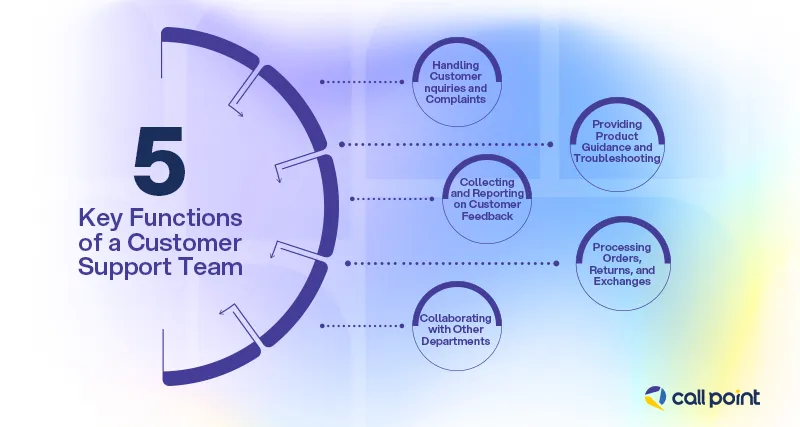
1. Handling Customer Inquiries and Complaints
Responding to inquiries and resolving complaints is one of the primary functions of support teams. This can range from answering questions about products or services to handling issues like delayed orders, billing errors, or service disruptions.
Support agents aim to resolve these concerns efficiently to maintain customer satisfaction. However, during peak times, handling many inquiries, urgent issues, and maintaining consistent quality across channels gets tougher.
2. Providing Product Guidance and Troubleshooting
A customer support team has the onus to guide users through product features and troubleshoot technical or service-related issues. This includes step-by-step assistance, clarifying functionalities, and helping customers use products or services effectively.
High-performing support team always stays updated with product changes, deals with complex issues, and explains technical information convincingly.
3. Collecting and Reporting on Customer Feedback
Customers often give feedback on support quality. The support teams act as the front line for gathering insights from the feedback. They log complaints, suggestions, and compliments, which are then analyzed to improve products, services, or processes.
Differentiating actionable feedback from general complaints and ensuring consistent reporting at times can be complex for them.
4. Processing Orders, Returns, and Exchanges
A support team handles transactions, including processing orders, returns, exchanges, and refunds. They do this by verifying order details, coordinating with logistics and inventory teams, and guiding customers through each step.
However, mistakes in order processing or delays in handling returns can frustrate customers. To prevent this, a support team relies on standardized transaction procedures, careful tracking, and clear communication with all departments involved.
5. Collaborating with Other Departments
A support staff doesn’t work in isolation. They coordinate with sales, marketing, product, and technical teams to resolve issues, launch updates, or clarify policies.
The collaboration helps a company adapt products, policies, and strategies according to real-world insights.
10 Proven Strategies for Excellent Customer Support
Core customer support strategies include predicting customer needs, providing personalized guidance, enabling self-service, integrating tools, and more. Applying them will improve your customers’ satisfaction, loyalty, and overall experience across all touchpoints.

Anticipating Customer Needs
Finding out what customers need upfront will make your support team’s effort pay off. Once this happens, they don’t have to waste time doing pointless things for customers.
To apply this strategy, make sure your support team analyzes customers’ usage patterns, past queries, and common pain points to predict problems before they arise.
They can check ticket histories, chat transcripts, and product usage data through the CRM dashboard to find accurate info.
Using Emotional Intelligence
Applying emotional intelligence means training agents to listen actively, empathize, and communicate calmly, especially when customers are fed up. If you encourage agents to connect personally while resolving issues, it will humanize interactions.
What your agents must maintain is professionalism while managing strong emotions and balancing empathy. But they do it well, it increases customer satisfaction & loyalty, and reduces escalations.
Empowering Through Self-Service
In this way, customers will solve their own issues without contacting support. Your support team will provide resources like FAQs, knowledge bases, tutorials, and guides.
And your users will find answers themselves, save time, and gain confidence without overburdening the support team.
Personalizing Every Interaction
When your support team makes customers feel valued and understood, their satisfaction level will be paramount. And this is something your agents can easily do by using CRM data, past interactions, purchase history, and preferences.
Based on the collected data, they will provide relevant solutions and recommendations. In this way, they will be guided, retained, and satisfied with the support.
Integrating Customer Support with CRM Platforms
For tracking & managing customer interactions, your support team uses a ticketing system, live chat software, call center software, etc.
Make sure these support tools are linked with CRM systems so your agents have full visibility of customer profiles, past tickets, and interaction history.
Equipping Your Team with the Right Tools
I have mentioned the use of support tools in the previous section. Right from ticketing systems, & analytics dashboards to knowledge management platforms & communication tools, you must train your team with these tools for an effective outcome.
Needless to say, the arrangement will involve extra cost, effort, and time. But the result a well-developed training program can produce is extraordinary.
When your team is equipped, they will resolve issues faster, improve processes, and amp up customer satisfaction.
Ensuring Omnichannel Support
Offering customer support through multiple platforms lets users contact your company through their preferred channel, like email, chat, phone, social media, and self-service. But to make omnichannel support convenient for your support team, integrate all your support channels.
This will allow agents to see a customer’s entire interaction history across email, chat, phone, social media, and self-service portals, and provide a consistent customer experience.
Striking a Balance Between Automation and Human Touch
Take advantage of automation for repetitive customer queries. It’s because chatbots, AI assistants, and automated notifications handle routine tasks efficiently.
But for complex or sensitive issues, always utilize human agents as they know how to connect with users emotionally and fix issues hassle-free.
Encouraging an Atmosphere of Escalation-Less Support
With this system, agents get the authority to resolve most issues without multiple handoffs. No doubt, your agents must have enough domain knowledge, decision-making skills, and experience to handle issues single-handedly.
When this happens, customers don’t have to reach out to multiple agents, thus saving their precious time and making them satisfied.
Adopting a Proactive Approach
Support teams can reach out before customers encounter problems like sending updates, reminders, or tips. Proactive messaging can prevent common issues or misunderstandings.
In this way, your support team will maximize customer satisfaction, minimize support ticket generation, and build trust.
We, at Call Point Business Solutions, offer proactive support besides addressing customer complaints, queries, and concerns. Our representatives are well-versed, and they know exactly how to approach, what to inform, and get the 5-star ratings naturally from users.
Technology and the Future of Customer Support
AI and automation are at the forefront of customer support. These systems are already helping companies manage large volumes of queries efficiently while maintaining high-quality interactions.
With machine learning, natural language processing, and predictive analytics, support teams are anticipating customer needs, suggesting instant solutions, and routing complex issues to the right agent in a flash.
AI-powered agents are now capable of handling routine inquiries. This is allowing human agents to focus on more nuanced problems.
Also, chatbots, virtual assistants, and automated ticketing systems provide 24/7 support, reduce wait times, and ensure consistent service. This not only enhances customer satisfaction but also improves operational efficiency.
How to Find a High-Performing Support Team
A high-performing support team merges skill, insight, and initiative to resolve issues before they escalate. The right team keeps customers satisfied along with driving long-term loyalty.

Find a Team that Meets KPIs
Look for teams that can offer first-response time, resolution speed, customer satisfaction scores, and retention rates. These metrics give a clear picture of both efficiency and quality of service.
Assess Experience and Skills Next
Seek agents or a team with skills & experience in your industry or customer type. Remember, experience in the same industry & customer type helps the team adapt quickly and address pain points effectively.
Evaluate Culture and alignment
Always connect with a team that values accountability, collaboration, and continuous learning. A team having these qualities tends to perform better and stay motivated during peak periods.
Test their Processes and Tools
Teams that leverage modern ticketing systems, CRM platforms, knowledge bases, and analytics dashboards deliver high-quality support. So, don’t forget to ask about their workflows, escalation processes, and how they track and improve performance.
Consider a BPO Customer Support Team
Outsourcing to a proven BPO service provider will give you access to a trained & scalable team that specializes in support across industries and channels. They bring experience & flexibility, which will allow your business to maintain high-quality support even during peak periods.
That’s where we come into play. Our 7+ years of experience in the BPO sector have enabled us to build a strong & best-in-class support team. Our team has worked across all industries, navigated challenges, and ensured maximum customer satisfaction.
It’s Your Turn
Delivering exceptional customer support will set your business apart from the competition. Whether you already have support staff or you are looking to build one, make sure the support team members are proactive, active listeners, empathetic, and quick problem solvers.
If required, consider partnering with Call Point Business Solutions to get top-notch customer support or to scale your support operations and maximize customer satisfaction. Regardless of your business type & client base, we offer premium customer support round the clock.